
 Search Articles


(CN) — In a study published in the Astronomical Journal on Monday researchers explain how their detailed chemical analysis of gas giants in a solar system some 130 light years away sheds light on the gaseous planets’ origins.
The team looked a four gas giants in the star system HR 8799 using the James Webb Space Telescope’s infrared imaging tools and found evidence the planets’ atmospheres are rich in carbon dioxide, demonstrating the presence of elements heavier than hydrogen and helium.
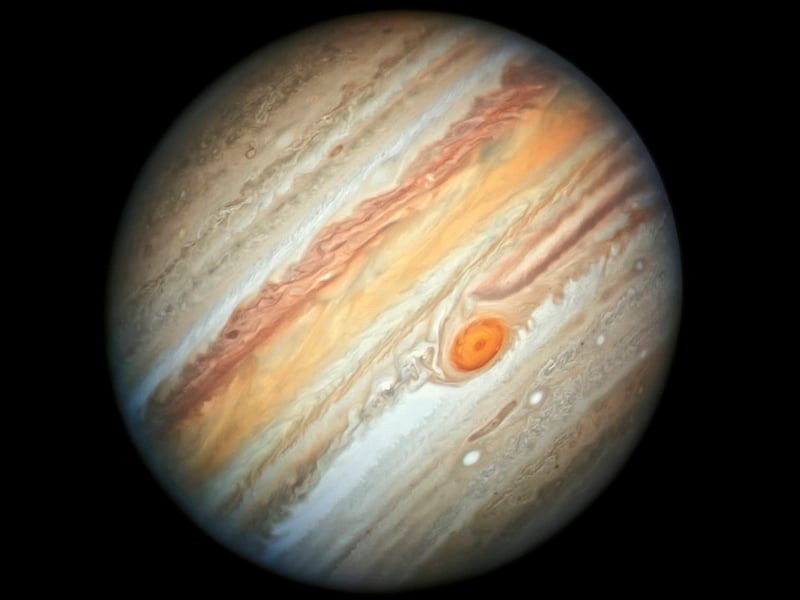
This in turn suggests the gas giants may have formed through a process called core accretion. In core accretion, heavier elements in a young solar system slowly coalesce into solid bodies that then attract lighter gasses. Core accretion is one theory put forward to explain the development of Jupiter and Saturn.
Another theorized process of gas giant formation posits they form out of condensing gasses left over from their parent star’s own birth. As such, planets formed this way would likely have similar material composition as their parent star.
Observations of the HR 8799 gas giants lend evidence to core accretion theories, the authors of Monday’s study write, though they note the necessity of further observation.
“Any strong claim about the formation of these planets will require detailed atmospheric and protoplanetary disk modeling, since connecting observable atmospheric abundances to formation history is heavily influenced by the evolution and dissipation of the disk over time,” the study authors write.
The study’s authors also examined the star system 51 Eridani, located about 97 light years from Earth. The system contains the Jupiter-like gas giant 51 Eridani b, which the researchers found showed evidence of heavier elements in its composition. The researchers also found evidence of high eccentricity in 51 Eridani b’s orbit, meaning it likely circles its star in more of an oval shape than a circle.
This result corroborates earlier studies which also found eccentricity in the gas giant’s orbit, and implies the planet experienced some yet-unknown process that impacted its orbital path.
“Updated orbits fit to the new measurement of 51 Eridani b validate previous studies that find a preference for high eccentricities, which likely indicates some dynamical processing in the system’s past,” the study authors note.
This result also sets apart our gas giants from 51 Eridani b. Compared to that exoplanet, Jupiter and Saturn have relatively low eccentricity — meaning their orbits around the sun are more circular.
William Balmer, an astronomy Ph.D. candidate at Johns Hopkins University and one of the lead authors of Monday’s study, said in a prepared statement to NASA that studying gas giants like those found in HR 8799 and 51 Eridani could give us insights into the history of our own cosmic neighborhood. Unlike our mature solar system that’s over 4.5 billion years old, HR 8799 is in its relative infancy at only about 30 million years old. 51 Eridani is even younger, perhaps not even 25 million years old.
“We want to take pictures of other solar systems and see how they’re similar or different when compared to ours,” Balmer said. “From there, we can try to get a sense of how weird our solar system really is — or how normal.”
 Follow @djbyrnes1
Subscribe to our free newsletters
Our weekly newsletter Closing Arguments offers the latest about ongoing trials, major litigation and rulings in courthouses around the U.S. and the world, while the monthly Under the Lights dishes the legal dirt from Hollywood, sports, Big Tech and the arts.