Search Articles


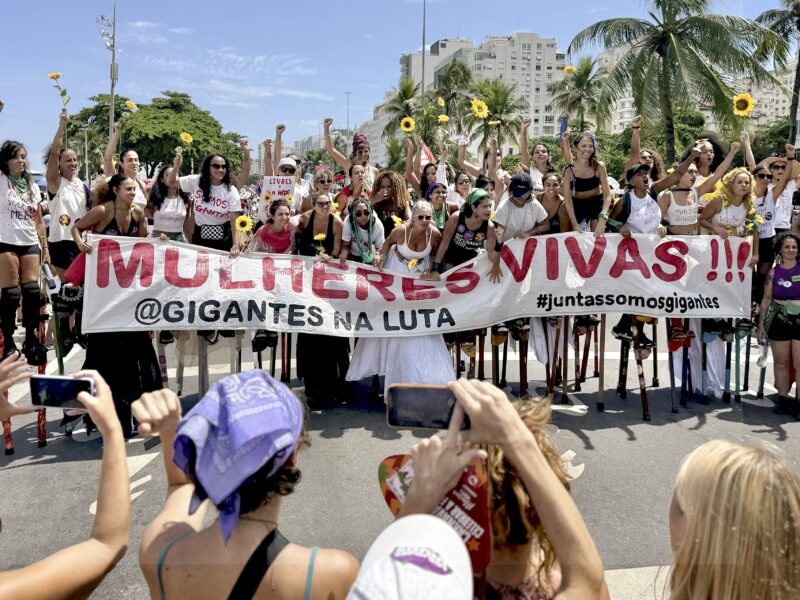
RIO DE JANEIRO (CN) — Brazil registered 399 femicides in the first quarter of 2026, the highest number for the period since the country began tracking the crime 11 years ago, according to government data released Tuesday.
The figures come from the Justice and Public Security Ministry’s database and represent a 7.5% increase from the same period in 2025, when 371 cases were registered. On average, four women were killed each day.
Since 2015, Brazil’s Femicide Law has treated the killing of women for gender-related reasons as aggravated homicide, covering crimes committed in the context of domestic or family violence or out of contempt or discrimination against women.
In 2024, femicide stopped being treated as an aggravated form of homicide and became a separate crime, punishable by 20 to 40 years in prison. In cases involving aggravating factors, the sentence can reach 60 years, the harshest penalty currently provided under Brazilian law.
Still, the killings continue to rise. In 2025, Brazil recorded 1,558 femicides, a 3.8% increase from the previous year, according to Justice and Public Security Ministry data.
That also amounts to an average of four women killed each day. The largest share of cases occurred in the state of São Paulo.
Melina Fachin, director of the Federal University of Paraná’s law school and a women’s rights advocate, said the new record is “the snapshot of a structural and persistent tragedy.”
“These numbers show how our institutional responses are still insufficient and fail to address the problem as a whole,” she said.
Fachin said Brazil has a relatively advanced legal framework, but the problem lies in implementation. Many women do not report violence, she said, and when they do, the protection network is not always able to stop the risk.
“Many times, the risks are known, but they cannot be stopped,” she said. “These rates of violence and femicide against women are a diagnosis of the state’s inability to provide effective protection to these women.”
Data from the Integrated Safe Woman Center, a Justice Ministry unit that monitors services for victims of violence, indicates that 30% of women killed in femicides in Brazil in 2025 had already reported the man who would later kill them.
Among the 481 women who had filed police reports against the future perpetrator, 20% were killed within 24 months of the first report.
Fachin said harsher criminal penalties also have limits. “Femicide does not stem from the absence of criminalization, but from the persistence of social structures, inequality and failures by the state to prevent and respond sufficiently when violence occurs,” she said.
Alice Bianchini, a lawyer and specialist in gender-based violence, said criminal justice reforms lose force without budgets and data-based public policies to support them.
“When we talk about criminal reforms, especially when those reforms are not backed by funding for public policies for women, they fall short,” she said. “A woman’s place is in the public budget.”
Estela Bezerra, national secretary for confronting violence against women at the Women’s Ministry, said part of the increase reflects a gradual improvement in reporting since 2015, when femicide began to be recognized as a specific crime.
“The phenomenon has always been widespread, and femicide has always been a central threat in women’s lives, but it was not recognized,” she said. “We are getting closer to reality, but it is still greater than what the data shows.”
Bezerra said the federal government resumed policies aimed at women starting in 2023, with the re-creation of the Women’s Ministry and the restructuring of Ligue 180, a national hotline that receives reports of violence against women and guides victims to protection services.
She also pointed to Brazil’s National Pact Against Femicide, launched in February 2026 to coordinate actions by the three branches of government on violence prevention, victim protection, accountability for offenders and the protection of rights.
According to Bezerra, half of the femicides recorded in 2025 occurred in municipalities with up to 100,000 residents, where the protection network is often more limited.
“The government’s strategy is on the right track. What we need is to move faster,” she said.
Pamela Villar, a criminal defense lawyer and partner at the São Paulo-based law firm Salomi Advogados, said the criminal justice response must be accompanied by “a solid system of education and awareness” aimed at preventing new crimes.
She added that mechanisms such as electronic ankle monitors, alerts when an aggressor gets physically close and panic buttons could strengthen the monitoring of protective orders. Those tools, she said, could help address the difficulty police face in monitoring each aggressor 24 hours a day.
Maíra Recchia, a lawyer who chairs the Women Lawyers Commission at the São Paulo chapter of the Brazilian Bar Association, said Brazil is experiencing an “epidemic” of violence against women, marked not only by an increase in cases but also by an escalation in cruelty.
Recchia links part of that scenario to the growth of digital misogyny. She said groups that attack women on social media have turned hatred into engagement and monetization, helping normalize violence.
Recchia said the digital environment did not create gender-based violence in Brazil but gave new scale to rhetoric that minimizes attacks against women.
“The digital environment is a catalyst for real-world violence,” she said. “But the fact is that women in Brazil have always faced high levels of violence.”
The debate over misogyny has reached Congress. On Tuesday, the lower house created a working group to discuss a bill that would criminalize misogyny.
The proposal was approved by the Senate on March 24 and will have Tabata Amaral, a Brazilian Socialist Party congresswoman from São Paulo, as its rapporteur in the lower house. Amaral said she intends to bring the text to a vote in the first half of the year.
The bill defines misogyny as hatred or aversion toward women and sets a penalty of two to five years in prison. It also equates misogyny with racism, which would make the conduct nonbailable and not subject to a statute of limitations.
The working group will have 45 days to complete its work and is expected to hold four public hearings with women lawmakers, civil society representatives and legal experts.
Courthouse News reporter Marília Marasciulo is based in Brazil.
Subscribe to our free newsletters
Our weekly newsletter Closing Arguments offers the latest about ongoing trials, major litigation and rulings in courthouses around the U.S. and the world, while the monthly Under the Lights dishes the legal dirt from Hollywood, sports, Big Tech and the arts.