
 Search Articles


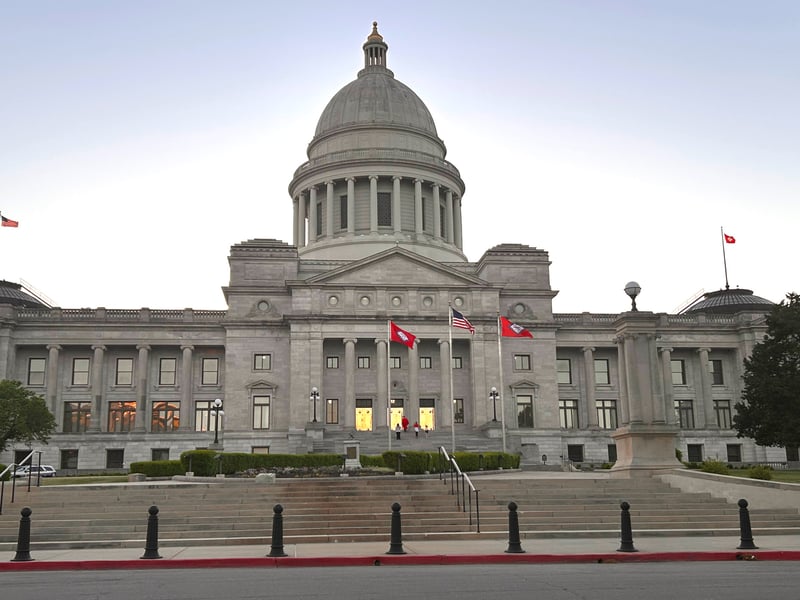
(CN) — Attorneys met Wednesday at the Eighth Circuit Court of Appeals to clash over whether Arkansas laws restricting foreign ownership of farmland and digital asset mining operations encroach on federal authority.
The case, Jones Eagle, LLC v. Wes Ward, et al., pits a U.S. citizen-owned cryptocurrency mining company against state officials, including Arkansas Secretary of Agriculture Wes Ward and Attorney General Tim Griffin. At stake is a lower court’s preliminary injunction blocking enforcement of Acts 636 and 174, which the lower court found likely preempted by federal laws governing foreign investment and arms exports.
The appeal stems from Jones Eagle’s operations in Arkansas, where principal Qimin “Jimmy” Chen, a naturalized U.S. citizen born in China, says the state retaliated against him for winning a prior federal injunction to start his business. The company claims the state laws, which bar ownership by entities from countries subject to U.S. arms export restrictions under the International Traffic in Arms Regulations, represent “government overreach” and intrude into federal foreign affairs powers.
Arkansas officials, appealing the injunction, argue the statutes are traditional state regulations of land ownership and health and safety, rooted in historical practices dating back to the nation’s founding. Citing precedents, they emphasized that states have long regulated “alien” property ownership.
On behalf of the state, Senior Assistant Attorney General Noah P. Watson framed the laws as uncontroversial.
“States have traditionally regulated land ownership, including alien land ownership, and that authority has rested with the state’s founding and is rooted in common law,” Watson told the panel. “Thus the traditional state authority can only be conflict oriented by positive law, such as treaties or statutes.”
Watson further argued Act 636 prevents prohibited foreign-owned businesses from acquiring ownership in certain lands, something states have done since the founding. He invoked a “presumption against preemption,” claiming no conflict with the Foreign Investment Risk Review Modernization Act or ITAR.
Judges quickly pivoted to ripeness, questioning whether Jones Eagle’s claims were ready for federal review given an ongoing state subpoena. Watson responded that the subpoena was “not self-executing” and issued under a different statute. He suggested abstention might apply, noting a pending state enforcement proceeding where constitutional issues could be raised.
The panel probed potential conflicts with federal law, with one judge asking whether Arkansas could prohibit a transaction approved near a military base under FIRRMA’s Committee on Foreign Investment in the United States review. Watson dismissed it as a “hypothetical,” emphasizing FIRRMA’s narrow scope and noting only a handful of reviews have been undertaken in recent years. He argued FIRRMA “should not consider issues of national interest absent a national security basis,” and does not authorize transactions but merely reviews them.
Alexander T. Jones, arguing for Jones Eagle, painted a vivid picture of harassment.
“Jimmy Chen is a U.S. citizen who launched a new business in 2023,” Jones said. “That’s not why we’re here. We’re here because, unlike most Americans who started a new business, Jimmy Chen has faced constant government overreach threatening to shut down his business.”
Jones outlined a series of government actions: Mere days after Chen secured a preliminary injunction to start his business, state officials targeted his company for investigation. The secretary of agriculture inquired about possible proof of foreign ownership, and the governor issued a press release — entitled “Sanders Administration Holds China Accountable” — asserting ties between Jones Digital LLC and China, despite Chen being an American citizen.
Jones explained that a land purchase by Chen fell through because the attorney general sent a subpoena on the day of closing to the escrow agent, unraveling the sale. This, he argued, established a concrete injury for legal standing and formed part of a broader pattern of official conduct impacting Chen’s business operations and personal life.
On ripeness, Jones argued concrete harms, including Chen considering a name change “to an American spelling so people judge my nationality based on my legal name.” He dismissed abstention, noting the state already waived it and suggested the subpoena arose under a different law.
Jones urged affirmance on preemption grounds.
“The district court correctly found that Acts 636 and 174 intrude in the field of foreign affairs, foreign relations and national security," he argued, warning of chaos if different states “choose different countries of disfavor.”
The panel included U.S Circuit Judges Bobby Shepherd, Lane Kelly and David Stras, appointees of George W. Bush, Barack Obama and Donald Trump, respectively.
 Follow @gabetynes
Subscribe to our free newsletters
Our weekly newsletter Closing Arguments offers the latest about ongoing trials, major litigation and rulings in courthouses around the U.S. and the world, while the monthly Under the Lights dishes the legal dirt from Hollywood, sports, Big Tech and the arts.