
 Search Articles


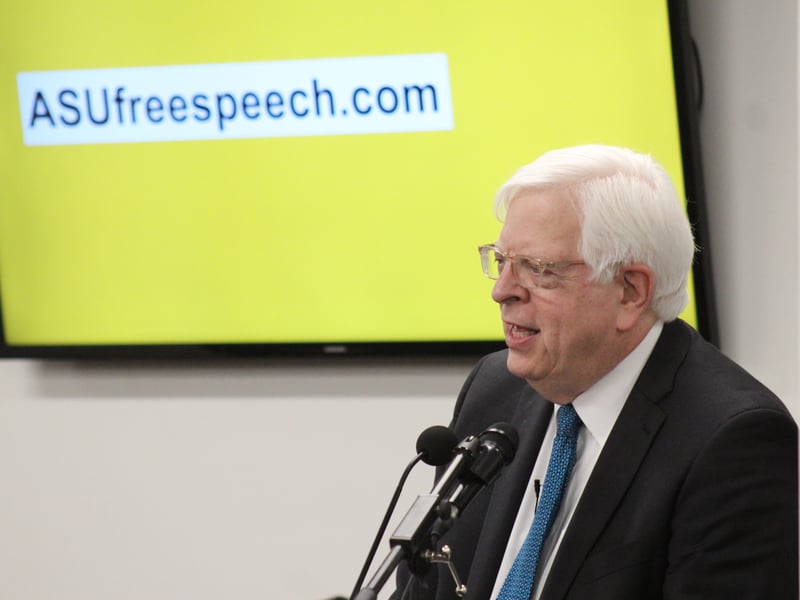
PHOENIX (CN) — Controversial radio talk show host Dennis Prager’s voice boomed throughout a small hearing room in the back of the Arizona State Senate building Tuesday.
“In the United States of America, you can march with a swastika!” Prager yelled. “Because if they can’t march, where will you draw the line?”
Prager was addressing ten Arizona legislators, six Republicans and four Democrats, on a committee assembled to investigate freedom of speech in Arizona’s three public universities.
The T.W. Lewis Center for Personal Development, a program within Arizona State University’s honors college, hosted a speaker event in February titled “Health Wealth and Happiness” and invited Prager and conservative talk show host Charlie Kirk to participate. Prior to the event, 34 professors wrote a letter to the honors college dean expressing a vote of no confidence in the leadership of the Lewis center, calling both Prager and Kirk “purveyors of hate who have publicly attacked women, people of color, the LGBTQ community.”
The letter cites multiple examples of racist and homophobic rhetoric from both Prager and Kirk, like when Prager baselessly claimed that the “overwhelming” majority of hate crimes on college campuses are hoaxes perpetrated by Black students to promote the “lie” of racism, or when Kirk said same-sex couples shouldn’t be allowed to adopt children, which was made legal in all 50 states in 2016.
After the event, in response to protests from faculty — including the letter, social media campaigns and in-person picketing — the center’s donor, Thomas Lewis, pulled his funding, forcing the center to shut down. While the university preserved all the courses and workshops taught through the center, as well as the professors who taught them, it removed Executive Director Ann Atkinson.
Atkinson claimed in the meeting that the school stifled advertisements for the event, removing physical flyers and taking virtual ads off of university screens, though she declined to say who she thinks is responsible for such actions.
The university denied claims that it fired the professor because of the conservative speakers she invited. Instead, officials say it was forced to cut her position after losing nearly half the money budgeted toward the center’s programs. Cutting the administrative position allowed the university to focus the remaining funds on the faculty and students, Executive Vice Provost Pat Kenny told the Joint Legislative ad hoc Committee on Freedom of Expression at Arizona’s Public Universities Tuesday morning.
He said the event itself was “safe and successful,” highlighting the more than 600 in-person guests and nearly 24,000 people who watched online.
ASU officials, and the four Democrats on the committee, said the fact that the event took place and was so well attended is proof that the university is dedicated to preserving free speech, regardless of public reaction.
But Atkinson told the committee that students complained to her that they felt pressured and intimidated by professors who spent class time denouncing the event and discouraging students from attending. The university, however, never received any official complaints from students or faculty regarding those claims.
State Senator Anthony Kern, a Republican from Glendale and chair of the committee, called professors standing outside the event with picket signs “intimidation,” and asked why they should be allowed to do so in front of “impressionable students.”
State Representative Analise Ortiz, a Democrat from Phoenix, said that was also freedom of speech.
“The faculty who signed the letter have a First Amendment right to speech and expression, and the institution did its job by protecting and respecting those rights and ensuring those faculty weren’t inappropriately disciplined,” she said.
During the committee hearing, Prager said every one of the 34 professors who signed the letter was “a lowlife,” and belittled their choices in studies, including Black feminism, gender and sexuality, post-colonial history and other things he deemed “leftist” ideology.
State Senator Christine Marsh, a Democrat from Phoenix, reminded the committee in the afternoon that the Arizona Board of Regents, the state’s public universities’ governing body, already investigated the issue, finding no suppression of speech committed by ASU or the faculty that wrote the letter.
That wasn’t enough for Kern and the Republicans though.
“I don’t trust our universities,” he said. “ASU, you should be ashamed of yourself.”
He demanded that the university investigate the issue and return to the Legislature within 60 days with a written summary of the events discussed, as well as any action it plans to take to rectify the situation. The Senate Judiciary committee will “act based on the thoroughness of that report,” he said.
“I’m counting on you to lead the way. Maybe bring my trust back to ASU," he added.
If Kern finds ASU’s investigation unsatisfactory, he said he plans for the judiciary committee to conduct one of its own. He declined to say what disciplinary actions may be taken.
 Follow @JournalistJoeAZ
Subscribe to our free newsletters
Our weekly newsletter Closing Arguments offers the latest about ongoing trials, major litigation and rulings in courthouses around the U.S. and the world, while the monthly Under the Lights dishes the legal dirt from Hollywood, sports, Big Tech and the arts.