
 Search Articles


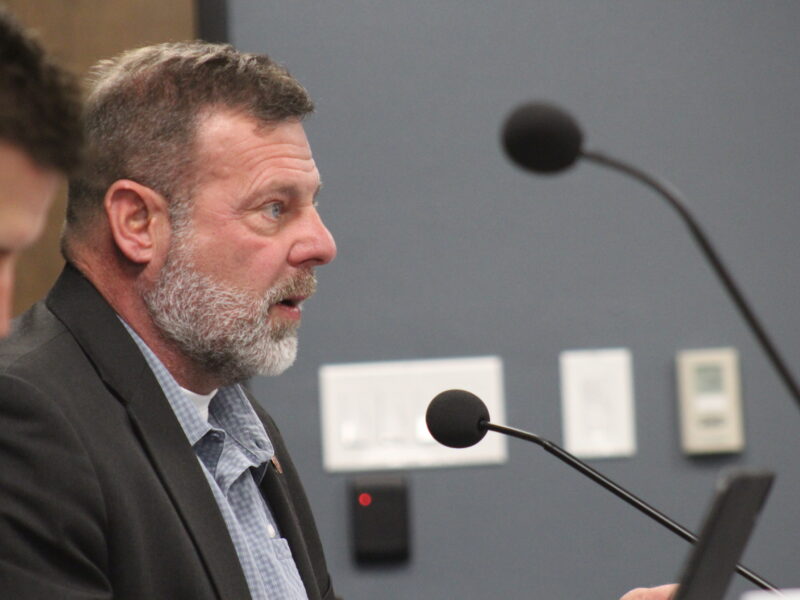
PHOENIX (CN) — Arizona lawmakers took partisan approaches to improve election integrity Wednesday, sending one measure to a House vote and killing two others.
The House Committee on Federalism, Military Affairs and Elections heard two bills sponsored by Republican state Senator Mark Finchem aimed at securing elections and increasing transparency. Both faced criticism from fellow Republican Alexander Kolodin, a state representative from Scottsdale, who said the vague language makes it difficult to predict outcomes.
Finchem’s Senate Bill 1037 prescribes cybersecurity standards for voting machines that would, among other things, prevent ballot tabulation equipment from supporting internet connectivity.
But because the text of the bill specifies “tabulation equipment that is used in a central counting center,” Kolodin said courts could interpret the bill to exclude tabulation equipment used or stored elsewhere from that internet connectivity prohibition. The bill also requires that any “accessible ports” be secured with tamper-proof seals that track when and by whom the seals are broken.
Kolodin wondered why a tabulation machine would have an accessible port in the first place.
“I would like the opportunity to question the sponsor about some of these items,” he said.
The committee held Finchem’s bills last week because he was unable to testify. But he was also not present at the hearing Wednesday to defend them.
“I have some discomfort with his bill. I think it authorizes a greater degree of internet connectivity that I am comfortable with because the degree of internet connectivity I am comfortable with is zero," Kolodin said.
Kolodin said he agrees with the intent to secure election equipment but couldn’t support a bill that might carve out an exception. He voted present.
“Anything that can be connected to the internet will be connected to the internet,” he said. “And anything that will be connected to the internet will be compromised," Kolodin said.
The three remaining Republicans voted yes, acknowledging the bill needs amending on the floor. The three Democrats voted no, meaning it failed to pass.
Committee Chair John Gillette, a Republican from Kingman, said Finchem will still have the opportunity to revive his bill via a strike-everything amendment to a different election bill.
Before the final vote was cast, Democratic state Representative Aaron Márquez introduced a striker of his own to SB 1037.
“This strike everything amendment does come from our Secretary of State Adrian Fontes,” Márquez said.
“I bet it does!” Kolodin said.
Titled the Voters First Act, the amendment would restore statewide voting centers, convert the active early voting list to a permanent early voting list, extend early voting to 5 p.m. the Monday before Election Day and allow for the continuous collection of early ballots that day.
“This proposal signals that the days of accepting the bare minimum for elections are over," the Democrat from Phoenix told the committee. “We can have it all, but the legislature must pay for it. Specifically, the intent of this strike-everything amendment is to reduce lines and ensure that every legal vote counts.”
The amendment would also increase the secretary of state’s budget for production IT and cybersecurity and require the secretary to enter into the multistate Electronic Registration Information Center to share voter registration list maintenance efforts with participating states.
Gillette said that very system has resulted in registration and ballot errors leading to the very election integrity issues he has been investigating since 2023.
He said returning to statewide voting centers, meaning a voter can cast their ballot in any county they choose rather than the one they reside in, would be akin to ballot harvesting and open up more opportunities for fraud.
“This further exacerbates all the problems that you see here today,” he said. “This multiplies them by 10.”
Gillette and the rest of the committee’s Republicans voted to reject the amendment.
Later, the committee approved on party lines Finchem’s Senate Bill 1040, which requires voter rolls to be publicly available on the internet, though Kolodin did so begrudgingly.
State law already allows political parties and candidates to view redacted versions of the voter rolls, but the bill repeals language protecting sensitive information like a voter’s social security number, date of birth and driver’s license number.
“So what do the rolls consist of according to this bill?” he asked a house staff member.
The staffer said the bill does not define voter rolls.
Kolodin held his face in his hands.
“Though it pains me, the value of making sure these voter rolls is very high,” he said. “I assure you I will not be a yes vote on the floor unless we provide a sufficient definition for what a voter roll is according to the law.
“And I do ask my colleagues in the Senate,” he added, “Please, before you bring your bills to the House, we have standards. Please make sure that you do the work.”
The bill will next be heard on the House floor.
 Follow @JournalistJoeAZ
Subscribe to our free newsletters
Our weekly newsletter Closing Arguments offers the latest about ongoing trials, major litigation and rulings in courthouses around the U.S. and the world, while the monthly Under the Lights dishes the legal dirt from Hollywood, sports, Big Tech and the arts.