Search Articles


PHOENIX (CN) — Arizona climate experts recommended Thursday that Governor Katie Hobbs renew a drought declaration in effect since 1999 as the state continues to reel from the hottest March on record.
Though a strong El Niño is likely to form over the Pacific this summer, which could bring tropical rains to the Four Corners region, members of the governor’s Drought Interagency Coordinating Group aren’t betting on it saving the day.
“This is not going to be pretty,” said Jordy Fuentes, executive director of the Arizona Power Authority.
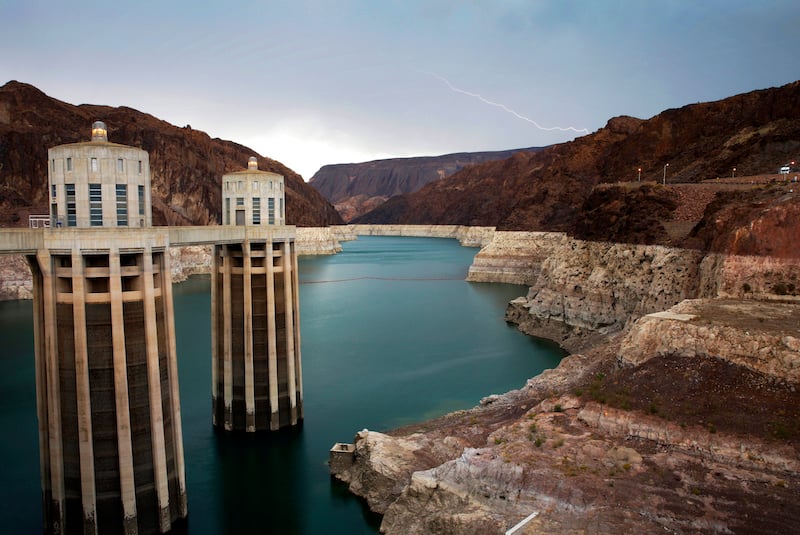
As the Southwest drought enters its fourth decade, the state’s two largest reservoirs along the Colorado River continue to inch toward deadpool, at which the Hoover and Glen Canyon dams won’t hold enough water to generate hydropower that is in turn used to pump Colorado River water across the state.
“We’ve backed ourselves in a corner and have mostly used all the tools in our toolbox,” Fuentes said. “We have very little tools left except to cut.”
The Arizona Department of Water Resources met Wednesday to discuss the most recent conservation proposal from the lower basin states (Arizona, California and Nevada) that would save up to 3.2 million acre-feet of water over two years, but Fuentes said that likely still won’t be enough.
Regardless of how much is cut, most models predict that Lake Mead, currently at 31% capacity, will drop to 1,035 feet elevation by spring 2027. When that happens, the Hoover Dam’s hydropower output will drop from 2,030 megawatts to just 382 megawatts.
“At the end of the day, you might be able to save a month or two,” Fuentes said. “But ultimately, it’s gonna drop below 1035 because there just isn’t enough water.”
At 895 feet, the dam would be unable to produce any power.
At the other end of the Grand Canyon, Lake Powell sits at 24% capacity, just 150 feet above deadpool.
On the Salt and Verde River watersheds, which provide Phoenix with about 60% of its water, the situation is not much better.
Since last year, the overall system has dropped from 76% to 53% capacity, thanks largely to one of the driest winters on record in the Grand Canyon State.
State Climatologist Erinanne Saffell said the outlook going into 2026 was optimistic. In 2025, Arizona recorded its ninth wettest fall and Maricopa County’s wettest on record.
“Then we entered into the hottest December on record for Arizona,” Saffell said.
Some snow fell in November and again in late February, but none was enough to accumulate runoff into the aquifers. Any snowpack that accumulated was quickly killed by a record-breaking March.
“Even though we had some mitigation from our very wet fall, we’re starting to see that (drought) expansion again,” Saffell said.
National Weather Service meteorologist Mark O’Malley said temperatures will continue to rise in another above-average temperature summer. In the last 50 years, average summer temperatures have steadily risen by 0.7 degrees Fahrenheit every decade. The coolest summers of the last 10 years would have been the hottest summers of the 1970s.
“I would not expect that this trend is going to change,” he said.
O’Malley reminded the group of a potential silver lining, though he said it’s likely nothing to hang a hat on.
If a strong El Niño creates warm waters in the Pacific Ocean, he said that could create more tropical storms, which would dump rainwater over the Southwest. He said there’s currently a 65% chance of a strong El Niño, but that doesn’t mean a 65% chance of heavy rain for Arizona.
“It’s a possibility,” he said. “It’s not a guarantee, but it has happened before.”
Historically there is no reliable pattern for El Niños. Some carried heavy rains while others didn’t affect the state at all.
“In reality, this is no different than any other monsoon that we see across the state,” he said.
In Northern Arizona, wildfires are already raging about a month ahead of schedule. Little to no snowpack, drought-stressed trees and a lot of dead pinyon and juniper mean a higher risk this year of crown fires, in which fire climbs to the tops of trees and quickly spreads across the canopy. So far this year, 296 fires have burned nearly 6,000 acres of forest, reported Tiffany Davila, public affairs officer for the Arizona Department of Forestry and Fire Management.
Both the 1999 declaration and a later drought declaration enacted in 2007 by then-Governor Janet Napolitano will remain in effect for the foreseeable future. Hobbs last renewed the declarations in 2024.
The coordinating group will meet again in November, having learned whether the El Niño brought favor to the Copper State.
 Follow @JournalistJoeAZ
Subscribe to our free newsletters
Our weekly newsletter Closing Arguments offers the latest about ongoing trials, major litigation and rulings in courthouses around the U.S. and the world, while the monthly Under the Lights dishes the legal dirt from Hollywood, sports, Big Tech and the arts.