
 Search Articles


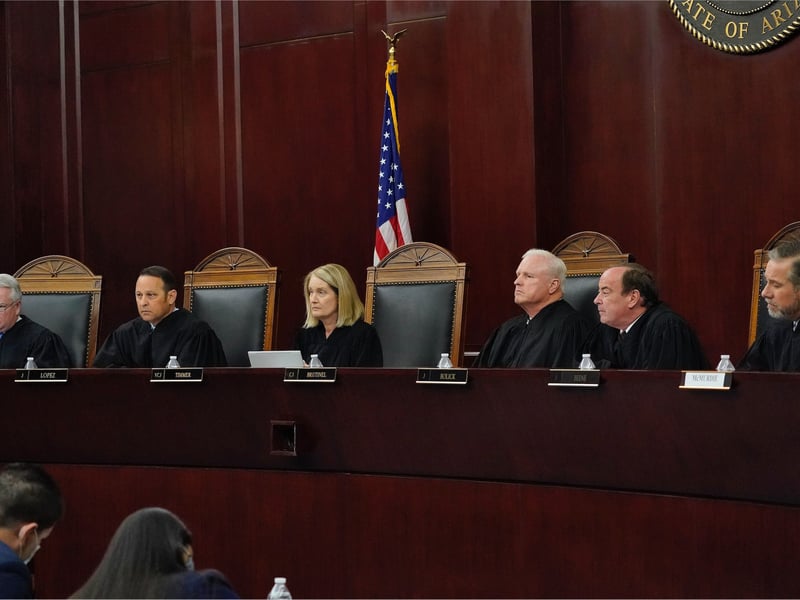
PHOENIX (CN) — As early ballots are received across Arizona, voters are faced with giving up their voice in the makeup of the state judiciary — a voice that most often goes unused.
Among the 13 statewide ballot questions posed to the Arizona voters in the 2024 general election, Proposition 137 would eliminate retention elections for judges of the Arizona Supreme Court, court of appeals and trial courts in counties with more than 250,000 people — Maricopa, Coconino, Pima and Pinal Counties.
Rather than serving four or six years and facing a retention election at the end of a term, judges in those counties and on the appellate level would instead hold office until they reach 70 years old, facing a retention election only if they violate judicial performance standards.
While the change would cut the public out of the system that holds judges accountable, supporters say it wouldn’t lead to much different results. In the 112 years since Arizona has been a state, voters have declined to retain a judge only six times, and only once above the trial court level. State Representative Alex Kolodin, who amended the ballot measure before signing his support, said voting on retention has become, for many, just going through the motions.
“Our ballots have been getting longer and longer and longer,” Kolodin said in a phone call with Courthouse News. “A third of our voters don’t even vote on judicial retention elections.”
For others, it’s become a way to retaliate against controversial decisions.
“It’s effecting political retaliation on people who aren’t politicians,” Kolodin said.
The ballot measure is in some ways a response to a growing push among Democrats to oust state Supreme Court Justices Clint Bolick and Kathryn King from office. Both are Republican-appointed judges who voted to reinstate Arizona’s near-full abortion ban in April. Both are up for retention on this year’s ballot.
If passed, the ballot measure would retroactively nullify any votes against retaining either judge, and reinstate them in the Supreme Court.
“It catalyzed the conversation, no doubt, but it’s been something that’s been an issue for a while,” Kolodin said.
To be sure, controversial rulings from judges have sparked political backlash before. Assumptions that California Chief Justice Rose Bird was soft on crime led to three justices not being retained in 1986. Several members of the Iowa Supreme Court weren’t retained after it legalized gay marriage six years before the U.S. Supreme Court followed suit.
But Andrew Dzeguze, a public law professor at Northern Arizona University, said there isn’t much evidence that retention elections actually hold judges accountable. Still, though, he said this measure is short-sighted.
“It probably is not a great idea to go from this to having no popular mechanism to weigh in on judges, given Arizona’s long history of giving voters a say in the composition of the judiciary,” he said in an email.
Keith Swisher, a professor of legal ethics at the University of Arizona, said he’s seen that some judges tend to rule differently as elections near.
“They might release someone on their own recognizance fewer times,” Swisher said in a phone interview. “They might give harsher criminal sentences. Judges of all levels have been voted out for unpopular decisions,” he continued. “It’d certainly be naive to think they don’t factor that into their mind.”
Without a retention election to worry about, Swisher said judges are more likely to stay neutral to the law. And retention isn’t the only way to hold a judge accountable.
Judges in Arizona are initially chosen and vetted by the state’s Commission on Judicial Performance Review. Worthy candidates are offered to the governor for appointment. After a judge is placed on the bench, that commission of 26 judges, attorneys and members of the public, is responsible for investigating complaints and holding judges in compliance with standards.
The ballot measure adds to existing performance standards that a judge can face a retention election if they’re convicted of a felony or any crime involving fraud or dishonesty, or if they declare bankruptcy or are foreclosed upon. Kolodin’s amendment adds that each house of the state Legislature can add one member to the commission, and that the commission must investigate malfeasance at the request of any legislator.
A since-revised version of the measure included a provision requiring a retention election for any judge who receives a reprimand from the commission, but that provision was cut from the final draft.
“Why isn’t that on the list?” Swisher asked. “I think that’s a miss.”
He also disagreed with the inclusion of the bankruptcy and foreclosure provisions, and the implication that a complaint from a legislator would be taken more seriously than a complaint from any member of the public. While he sees the benefit in eliminating retention elections, Swisher is uncertain whether the politically motivated and restrictive measure is the best move for Arizona.
“This just doesn’t seem like the right vehicle,” he said. “I don’t think that this is the right time and the right reason and the right package to do it in.”
 Follow @JournalistJoeAZ
Subscribe to our free newsletters
Our weekly newsletter Closing Arguments offers the latest about ongoing trials, major litigation and rulings in courthouses around the U.S. and the world, while the monthly Under the Lights dishes the legal dirt from Hollywood, sports, Big Tech and the arts.