
 Search Articles


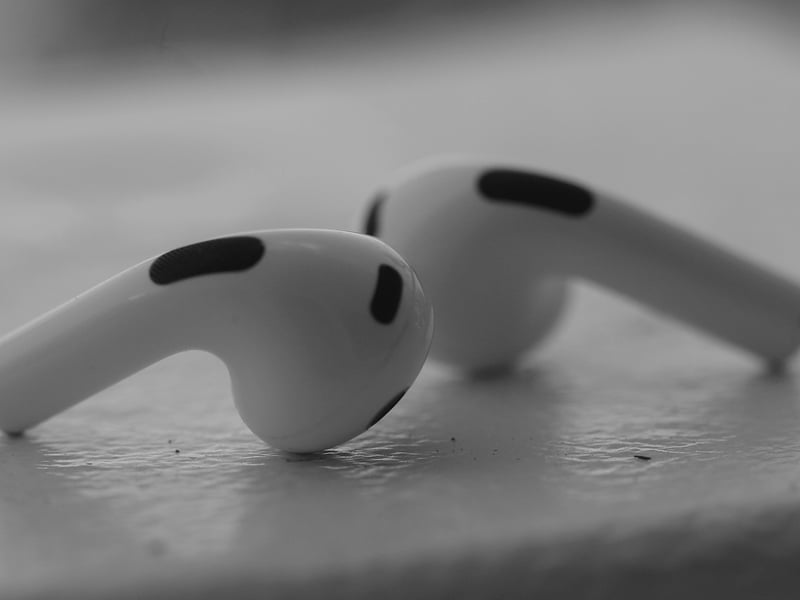
(CN) — A federal judge Monday sided with Apple in a lawsuit filed by parents who claimed their 12-year-old son suffered permanent hearing damage after listening to the sound of a high-pitched Amber Alert through a pair of AirPods.
Carlos Gordoa and Ariani Reyes claimed that their son, identified only as B.G., was watching Netflix on his iPhone in May 2020, with Apple’s first generation AirPod Pros in his ears when the alert went off. They said the sound “tore apart” his eardrum, damaging his cochlea and leaving him with permanent hearing loss in his right ear. Since the injury, the parents said, the boy suffered from “bouts of dizziness, vertigo and nausea.”
But according to U.S. District Court Judge Jacqueline Scott Corley’s ruling, which granted Apple’s motion for summary judgment, evidence gathered during discovery showed that the AirPods in question are incapable of producing an Amber Alert any louder than 113.5 decibels — “a volume below sounds commonly experienced in everyday life — and a volume magnitudes less than that which is scientifically recognized to cause hearing loss or injury.”
“According to the medical literature, sound in excess of 130 decibels is required to cause acoustic trauma for a short exposure in even the most susceptible human ear,” Corley wrote. She pointed to a doctor’s examination of the child shortly after the incident, which showed “no redness, swelling, bleeding, edema,” and found conditions more consistent with a viral infection than an injury from a loud noise.
An expert witness hired by Apple theorized that the hearing loss experience by the boy came from Covid. At the time of his injury, the Covid vaccination had not yet been released and Covid testing was not widely available. Some studies have linked hearing loss with Covid, even if the infection is largely asymptomatic.
“There is no dispute B.G. experienced tragic hearing loss and injury, but to hold Apple liable for those injuries Plaintiffs must proffer evidence sufficient to find something Apple did caused those injuries,” the judge wrote.
The plaintiffs offered up the testimony of a clinical physician who said during a deposition that the Amber Alert could have caused an “acoustic shock,” damaging B.G.’s ear. But Corley found the doctor unqualified to render an opinion about the cause of the plaintiff’s injury in this case, since he “has not conducted any research on the subject of hearing loss, participated in any observational studies, or published in medical or scientific literature related to hearing loss,” and found that his conclusions were unreliable. Without that testimony, the judge found, the plaintiff’s case couldn’t hold up.
Plaintiff’s attorney Jeremy Newell of PMR Law said they would appeal the ruling.
“We feel the court disregarded significant evidence in our clients’ favor,” Newell said in an email. “For example, if a person has significant permanent pre-existing hearing loss in the right ear, which Apple argued was caused by Covid-19, why would that person wear an AirPods Pro listening device in that same ear. Moreover, that person would not have suffered immediate, harmful, and documented effects from an Amber Alert in the same ear after the alert’s transmission from the AirPods Pro. For this reason, and others, our firm will continue to fight on behalf of our clients.”
Apple’s attorneys did not respond to an email requesting a comment on the verdict.
 Follow @hillelaron
Subscribe to our free newsletters
Our weekly newsletter Closing Arguments offers the latest about ongoing trials, major litigation and rulings in courthouses around the U.S. and the world, while the monthly Under the Lights dishes the legal dirt from Hollywood, sports, Big Tech and the arts.