
 Search Articles


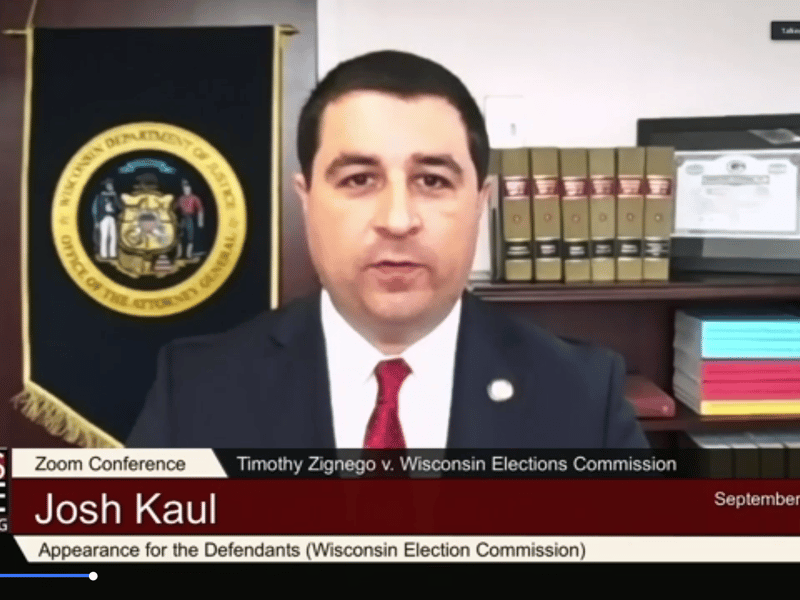
MILWAUKEE (CN) — The Wisconsin appeals court reversed on Wednesday a circuit court ruling in favor of the state’s attorney general and ordered him to comply with the state laws intended to corral his spending.
In 2018, the Wisconsin Legislature amended a law, which requires Attorney General Josh Kaul to seek approval from the Joint Finance Committee before finalizing monetary settlements in civil lawsuits, to also require uncommitted funds to be deposited in a general fund. The constitutionality of that law has been the subject of ongoing litigation by Kaul, but here his own conduct is under review.
Three years later, the Legislature sued Kaul in Milwaukee Circuit Court for avoiding legislative oversight by, for example, depositing funds into different general funds and seeking judicial consent decrees to avoid prosecution of civil lawsuits.
Wisconsin Circuit Court Judge Jefferey Anderson ceded that the law says the settlement funds must go to the “general fund,” but did not go so far as to specify which general fund. As for the consent decree sleight-of-hand, Anderson found in favor of the Legislature. Both parties appealed.
On Wednesday, the appeals court found in a 2-1 decision that Anderson had erred. Judge Maria Lazar wrote the majority opinion and relied on the plain language of the law, which states that the attorney general shall deposit all settlement funds into the general fund. A parallel state law defines as the general fund for general purpose revenues, which Lazar says should be read together to understand what the “general fund” is. In other words, Kaul may no longer use settlement funds at his discretion.
“It would be unreasonable to conclude that the new statutes are not plain on their face and do not expressly prohibit the conduct that the attorney general seeks to use to avoid legislative oversight,” Lazar said in his opinion. “Moreover, not only are the terms plain and clear, the statutes were enacted to change Department of Justice practices. Legislative intent could not be more plain.”
Lazar further noted that in 2019, the Joint Finance Committee notified Kaul that his office had not deposited any settlement funds into the correct account since the 2018 law took effect. In reply, Kaul asserted that the law only applied in a limited manner. The two parties then sent a flurry of letters back and forth, culminating in the Legislature’s 2021 lawsuit seeking declaratory judgment, injunctive relief and mandamus relief against the attorney general.
Kaul had been circumventing this statute by depositing settlement funds into a “gifts, grants and proceeds” general fund, which his office has discretion over, according to Lazar. He similarly claimed hundreds of thousands of dollars in some cases for “cost recovery” for the legal proceedings, which Kaul also has discretion over.
In his cross-appeal, Kaul asserted that the circuit court erred on the issue of the consent decree maneuver, arguing the action is simply a pre-suit negotiation not subject to the statute. He claimed to the court that because a consent decree does not require an admission of guilt, it is not technically a “prosecution” under the statute and does not require approval.
The Legislature railed against this reading of the law, pointing to the sequence of events before a consent decree can be given: A complaint is filed, fact-finding occurs and the case is prosecuted before a settlement by consent decree is possible.
The appeals court didn’t buy the attorney general’s position and ruled that he is clearly conducting and prosecuting a civil action by filing for a consent decree. No admission of guilt is required for those steps to have taken place.
Lazar noted that the Legislature clearly wrote and amended the 2018 law to corral the attorney general’s use of settlement funds. One amended section limits his spending authority to $98,300, to be credited to his discretionary account. Additionally, another added section forces funds deposited into the gifts, grants and proceeds fun to be lapsed to the general fund. This, Lazar opined, is a clear attempt to apply a check on the attorney general’s powers.
“Courts are not rubber stamps, and the attorney general’s disregard for the third branch of government is, to say the least, contrary to our founding principles,” Lazar said.
Kaul told Courthouse News that he intends to take this issue to the state’s high court: “These are senseless laws pushed by the Legislature, I’ve said that for the last six years since they were created, and we believe we are on the right side of this issue. We look forward to seeking resolution by the Supreme Court.”
Attorneys for the Legislature could not be immediately reached.
The Legislature is joined in this lawsuit by Adam Jarchow, a taxpayer. Though Kaul argued on appeal that Jarchow lacks standing because he is not claiming that settlement funds are being illegally spent, legal precedent shores up his right to challenge government spending if he can show any amount of loss.
According to Lazar, this appeal brings into question millions of dollars. In the court’s eyes, there’s plenty to lose if funds were used incorrectly, giving Jarchow at least 1 million reasons to join in the lawsuit.
 Follow @desdev5
Subscribe to our free newsletters
Our weekly newsletter Closing Arguments offers the latest about ongoing trials, major litigation and rulings in courthouses around the U.S. and the world, while the monthly Under the Lights dishes the legal dirt from Hollywood, sports, Big Tech and the arts.