
 Search Articles


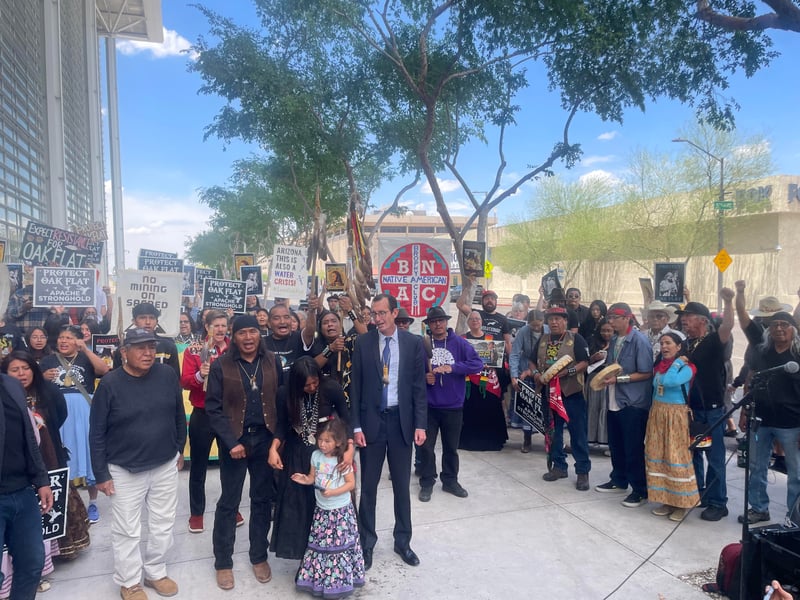
PHOENIX (CN) — A coalition of western Apaches returned to federal court in Arizona Wednesday to try again at stopping the construction of a copper mine that would destroy a 2,400-acre holy site in the Tonto National Forest.
While the Supreme Court decides whether to take up an appeal on a motion for preliminary injunction, the nonprofit Apache Stronghold asked a federal judge to temporarily pause the transfer of the Oak Flat, one of the most sacred places in Apache culture, into the private hands of Resolution Copper.
“Oak Flat means everything to our clients,” attorney Luke Goodrich said in a Phoenix courtroom Wednesday morning. “We ask that you preserve the status quo and allow the Supreme Court to do its job.”
Apache Stronghold first sued the U.S. Forest Service in 2021, challenging the environmental impact statement it produced for the land transfer on First Amendment and Religious Freedom Restoration Act grounds. If the Oak Flat is destroyed by the proposed copper mine, the plaintiffs say they won’t be able to continue ancient religious ceremonies practiced since time immemorial.
The Forest Service rescinded its environmental impact statement in 2021 and promised a new impact statement by 2025, initially vowing to give time between the issuance of the statement and the transfer of the land to allow parties to file new motions to enjoin. But Department of Justice attorney Erika Norman said in a separate hearing Monday that the government intends to transfer the land immediately upon issuance of the new statement, which will be published no later than June 16.
Goodrich said after Wednesday’s hearing that the government is intentionally trying to avoid judicial review.
“The government knows the Oak Flat is sacred,” he said. “It knows it took it from the Apache people by force.”
Now, Apache Stronghold says it will be too late to reverse the damage Resolution Copper will do to the Oak Flat if it is allowed to begin construction of a two-mile-wide mine before the Supreme Court rules on the plaintiffs’ original motion for preliminary injunction, which would pause the land transfer until the case is completely adjudicated.
“There’s no guarantee you can unscramble these eggs once they’re cracked,” Goodrich told U.S. District Judge Steven Logan.
Apaches and other Oak Flat advocates packed Logan’s courtroom and nearly filled a second courtroom with overflow seating Wednesday morning after walking more than 80 miles from the Oak Flat to Phoenix to signify the gravity of their situation.
“We are mighty like the saguaro. We are rooted like the mesquite. And we will remain,” activist and Chiricahua Apache Naelyn Pike told a crowd of nearly 200 Apaches and other supporters outside the courthouse. “Our religion, our prayers and our way of life will continue and I will fight for that!”
Representing the Forest Service, Norman conceded that “the ultimate destruction of the land will prevent religious exercise as it is right now,” but argued that the plan ultimately doesn’t violate the First Amendment or the Religious Freedom Restoration Act because Resolution Copper agreed to preserve a 50-acre campground on which the Apaches can practice their religious ceremonies.
“They just showed their weakness,” former San Carlos Apache Chairman Wendsler Nosie said after the hearing, tapping his chest. “They don’t have a heart.”
Logan agreed with the Forest Service in 2021 when the Barack Obama appointee denied the plaintiffs’ original motion for preliminary injunction, which the Ninth Circuit also denied on appeal, leaving Apache Stronghold with no other option but to hope the Supreme Court takes the case.
The high court has deferred its decision on whether to grant the petition for review 12 times, and will decide again on May 15 whether to grant, deny or defer once more.
For Logan to grant the motion stopping the transfer pending the Supreme Court decision, he must find that the plaintiffs have shown a likelihood of success in their appeal.
Goodrich said the fact that the Ninth Circuit split 6-5 on its decision is proof enough, but Norman disagreed.
“The Ninth Circuit couldn’t have been clearer that the plaintiffs’ RFRA and free exercise claims fail,” she said.
While Resolution Copper agreed not to destroy the campground and maintain access to most of the site during the 10-year construction period, their agreement comes with the stipulation that it can revoke access to the campground based on safety concerns.
“All that is left is a non-enforceable, discretionary duty,” Goodrich said, adding that he “highly doubts” Resolution Copper will actually allow access to specific holy sites during construction.
Logan said he will issue a ruling no later than 5 p.m. on May 14.
 Follow @JournalistJoeAZ
Subscribe to our free newsletters
Our weekly newsletter Closing Arguments offers the latest about ongoing trials, major litigation and rulings in courthouses around the U.S. and the world, while the monthly Under the Lights dishes the legal dirt from Hollywood, sports, Big Tech and the arts.