
 Search Articles


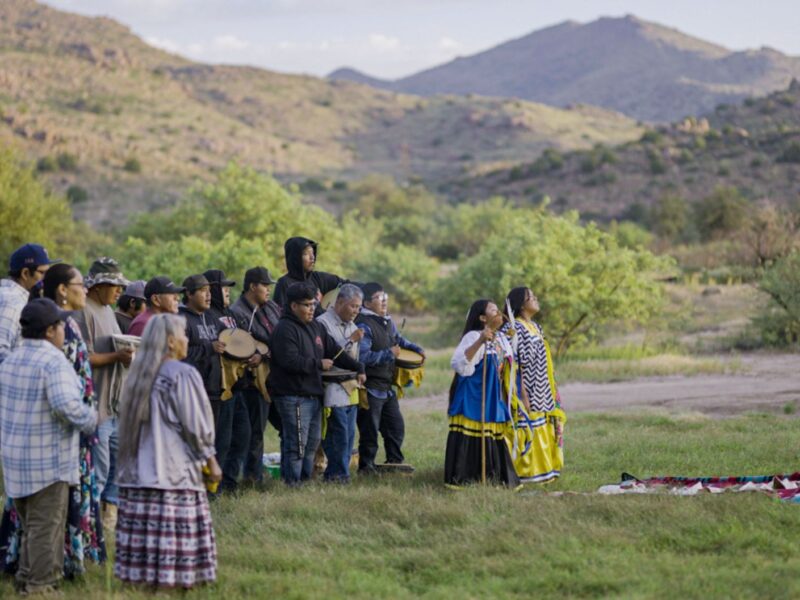
WASHINGTON (CN) — A group of Apache women filed an emergency request at the Supreme Court on Monday to prevent a sacred religious site from being swallowed by a massive copper mine.
Chí’chil Biłdagoteel, or Oak Flat, is a 6.7-square-mile sacred site littered with old-growth oak groves, springs, burial locations and archaeological sites east of Superior, Arizona. For the Apaches, Oak Flat holds a direct connection to their creator, making it a foundational part of their religious beliefs.
Oak Flat is also the seat of a large copper deposit. Resolution Copper has been trying to mine the land for two decades. It has been unsuccessful until now.
The Trump administration said Oak Flat was transferred to Resolution after an appeal court ruling on Friday. Without the justices’ swift intervention, the women warned that the Apache holy land will be turned into a 2-mile-wide crater by the private mining company.
“The United States government has a tragic history of destroying Apache lives and lands for the sake of mining interests,” the group wrote in an emergency application. “The Apaches simply ask that the land not be transferred beyond federal control and destroyed before the courts (including this court) resolve their claims.”
The federal government protected Oak Flat until 2014, when senators slipped a land transfer into the Defense Authorization Act. In the final days of his first term, President Donald Trump accelerated the project to complete the transfer.
The Apaches say the land transfer would violate the Religious Freedom Restoration Act by preventing the Apaches from conducting their most sacred religious practices after the site’s destruction.
Last May, the Supreme Court refused to review an appeal from Apache Stronghold, a nonprofit, on those grounds. But the women argue the high court’s June ruling in Mahmoud v. Taylor opened a new path, citing the free-exercise right of Apache parents to direct the religious upbringing of their children.
“If even ‘subtle’ governmental actions can pose ‘a very real threat’ to parental religious formation, how much more here, where the government’s actions will forever destroy an irreplaceable sacred site and prevent Apache parents like applicants from initiating their children in Apache religious practices,” the women wrote. “This is nothing less than ‘the destruction of [a religious] community,’ which every justice in Mahmoud agreed was unconstitutional.”
Last week, the Ninth Circuit ruled the Forest Service met its responsibilities under the National Environmental Policy Act by analyzing environmental impact and considering possible alternatives in its final environmental impact statement.
An attorney for the Apache women notified the government of their intent to file a Supreme Court appeal, requesting information on when it planned to complete the land exchange. According to the plaintiffs, the government said, “The land exchange has already been completed.”
The Apaches are pushing the justices to grant an immediate administrative stay, claiming the government appeared to be trying to evade judicial review.
“If this court pauses the transfer now but reverses course later, the government loses little,” the group wrote. “It can still proceed with the project — which it has voluntarily delayed for over a decade — and still mine every ounce of copper. But if this court denies emergency relief now, it may never get the chance to reverse course later, and the Apaches lose everything. Oak Flat will be destroyed, and the Apaches will never again be able to worship at Oak Flat.”
Shortly after the group filed its emergency application, the Justice Department and attorneys for Resolution Copper filed letters noting their opposition. The government confirmed that the land transfer had occurred and said the Supreme Court did not have jurisdiction to reverse the action.
“The applicable standard should if anything be more stringent here since the land exchange that applicants sought to prevent through this lawsuit has now occurred,” U.S. Solicitor General John Sauer wrote. “Applicants presently ask the circuit justice not to preserve the status quo but to alter it, either by undoing the land exchange or by restricting Resolution’s ability to utilize the land it recently acquired.”
 Follow @KelseyReichmann
 Follow @kelseyreichmann.bsky.social
Subscribe to our free newsletters
Our weekly newsletter Closing Arguments offers the latest about ongoing trials, major litigation and rulings in courthouses around the U.S. and the world, while the monthly Under the Lights dishes the legal dirt from Hollywood, sports, Big Tech and the arts.