
 Search Articles


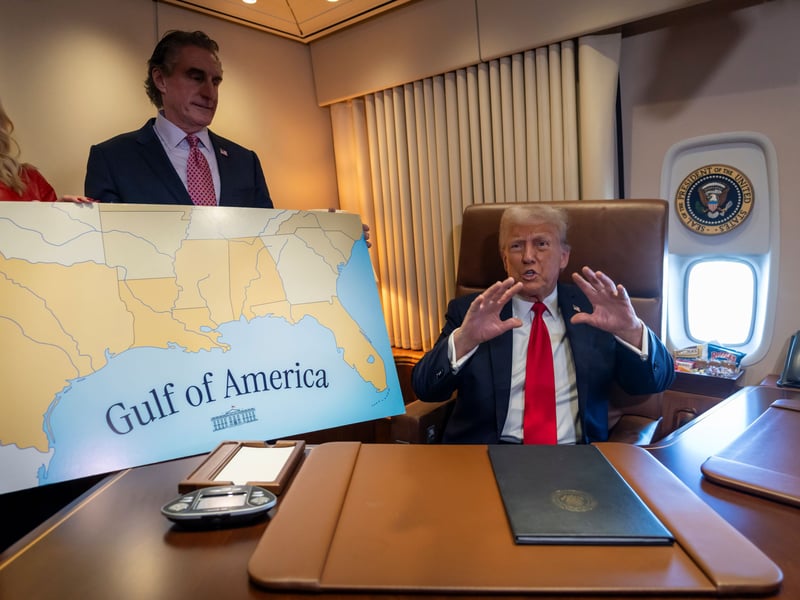
WASHINGTON (CN) — A pair of Associated Press journalists testified Thursday that the Trump administration’s ban on its reporters and photographers has pushed other outlets to soften their questions to the president for fear of similar retaliation.
Speaking on the stand before U.S. District Judge Trevor McFadden, White House correspondent Zeke Miller and chief photographer Evan Vucci described how the ban — an apparent effort to punish the AP for refusing to use “Gulf of America” in its stories — has severely hampered their coverage and made the outlet an example.
McFadden, a Donald Trump appointee, previously denied a temporary restraining order that would have frozen the ban, finding it was too early for such a remedy.
McFadden noted, however, that the ban was likely unconstitutional and suggested the White House change it.
The AP’s lawyer, Charles Tobin of Ballard Spahr, argued that the White House had instead doubled down since McFadden’s Feb. 24 decision.
“The AP spent 44 days in the penalty box,” Tobin said. “We hope to remove this unconstitutional hurdle to get the AP access to the press pool again.”
Vucci has worked as an AP photographer since 2003 and taken several iconic photos such as Iraqi journalist Muntadhar al-Zaidi throwing his shoes at former President George W. Bush and Trump raising his fist following a failed assassination attempt in Butler, Pennsylvania.
He testified that since the White House’s ban began on Feb. 11, he has been routinely turned away from covering events throughout the White House, including in the Oval Office and the East Room. Instead, Vucci has been forced to rely on his competitors or foreign AP correspondents to cover them.
He highlighted the contentious Feb. 28 meeting between Ukrainian President Volodymyr Zelenskyy, Trump and Vice President JD Vance, where the only AP-affiliated reporter in the room was a Ukrainian filmmaker.
Vucci said he managed to obtain photos that way, but without the speed or quality he’d be able to get himself.
“It kills us,” he said. “That was one of the wildest things to ever happen in the Oval Office, and we just didn’t have it.”
Miller described how he was summoned to press secretary Karoline Leavitt’s office on Feb. 11. He said he was told that Trump “wasn’t happy” that the AP would not adopt the new “Gulf of America" moniker for the Gulf of Mexico, and that the outlet would be barred from an Oval Office meeting later that day. The ban was made indefinite on Feb. 14.
Since the ban’s implementation, Miller said he noticed an apparent “softening of tone and tenor” in the questions posed to the president and was surprised by the increase of off-topic questions at the expense of topical, “news of the day” questions.
He pointed to the recent coverage of the SpaceX mission to retrieve two astronauts from the International Space Station. When they landed in the Gulf of Mexico, he said several outlets only referred to it as “the Gulf.”
McFadden seemed unconvinced that Miller’s example was enough to show that the wider media had been chilled by the AP’s ban, and instructed Tobin not to file a declaration providing specifics from certain outlets’ coverage that day. He explained that any more factual filings would further delay his eventual ruling.
Tobin argued that the chilling effect was similar to what the Supreme Court found in the 2016 Heffernan v. City of Paterson, where a police officer was demoted for carrying political signs opposing the city’s mayor. The record later showed the officer was carrying the signs for his mother, and that he explicitly disagreed with her position.
Tobin asserted that the Supreme Court’s finding was that the demotion was a warning to other officers that they could engage in similar acts “at their own peril.”
Brian Hudak, chief of the Civil Division at the U.S. Attorney’s Office for D.C., tried to point out during his cross-examination of Vucci that AP photographers still have a certain level of access to the White House, such as the press briefing room and the grounds.
He presented a series of images depicting recent visits by foreign leaders, such as French President Emmanuel Macron and British Prime Minister Keir Starmer, both as they entered the White House and other scenes from their meetings inside the Oval Office.
Vucci explained that the meeting images were pulled from the European press pool, and that the AP photos from outside the building were far inferior to images from inside the meetings, where he could capture the moment and observe anyone in the room.
 Follow @Ryan_Knappy
Subscribe to our free newsletters
Our weekly newsletter Closing Arguments offers the latest about ongoing trials, major litigation and rulings in courthouses around the U.S. and the world, while the monthly Under the Lights dishes the legal dirt from Hollywood, sports, Big Tech and the arts.