
 Search Articles


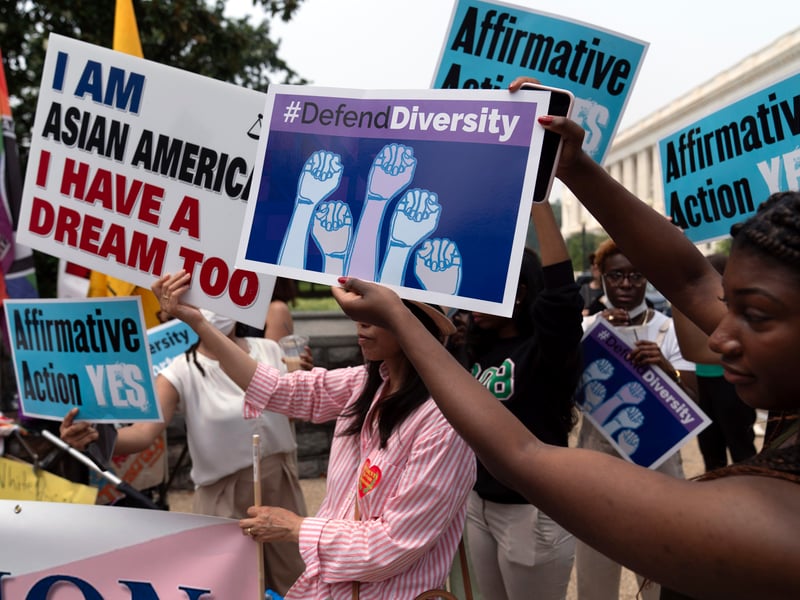
WASHINGTON (CN) — The Supreme Court could boost President Donald Trump’s attack on diversity, equity and inclusion programs next week when the justices review one Ohio woman’s “reverse discrimination” suit.
Marlean Ames — who is heterosexual — claims that the Ohio Department of Youth Services passed her up for a promotion, instead hiring a lesbian who was “arguably less qualified.” She was later demoted and replaced with a gay man — who Ames says was similarly unqualified for the position.
Ames sued the department, charging Title VII violations for a hostile work environment, retaliation and sexual orientation discrimination. The Sixth Circuit rejected her claims, finding that she didn’t meet the standard for majority-group plaintiffs challenging discrimination by minority groups.
At the Supreme Court, Ames will argue that majority-group plaintiffs are unlawfully held to a higher standard than minority-group plaintiffs bringing discrimination claims.
“Courts have made it harder to eradicate discrimination by imposing a ‘background circumstances’ requirement on majority-group plaintiffs, and only those plaintiffs,” Ames wrote.
Ames’ case comes to the court amid a rise in majority-group discrimination claims — sometimes called reverse discrimination. Julian G.G. Wolfson, an employment and civil rights lawyer with Littler, said the jump in suits includes discrimination claims against initiatives for women of color or certain scholarship programs.
“I don’t think we’re seeing here some huge uptick all of a sudden in the majority being discriminated against; I don’t think anything’s really changed on that front,” Wolfson said. “The law certainly hasn’t changed on that front either.”
The Supreme Court’s 2023 ruling in Students for Fair Admissions v. Harvard appeared to instigate this wave of claims, Wolfson said. The blockbuster ruling gutted university affirmative action programs. While private companies were not directly implicated in the case, employers saw the writing on the wall for increased scrutiny of diversity programs writ large.
Trump added to those concerns immediately upon taking office, signing an executive order claiming to eliminate all diversity, equity, inclusion and accessibility programs across the government. The administration said it would also prosecute so-called discrimination based on these policies in the private sector.
If the Supreme Court eliminates the “background circumstances” standard, Wolfson said it could be a boon for majority-group discrimination claims.
“It’s going to make it easier — like, a lot easier,” Wolfson said. “This could affect how companies defend DEI initiatives because we’ve seen cases out there where companies will rely on the background circumstances test to say, ‘hey, we are not discriminating because you can’t prove background circumstances.’ We remove that and it becomes a lot easier to challenge DEI programs.”
The background circumstances test originated in McDonnell Douglas v. Green in 1973 , where the justices established a prima facie case that an employer’s supposedly discriminatory action diverged from what a normal employer would do.
“There has to be something fishy and something different because the normal inference that would be allowed in a typical case, the courts have said, doesn’t arise where the plaintiff is a part of the majority,” Wolfson said.
In her brief, Ames frames this as an extra burden for majority-group plaintiffs like herself: “She would, just like every other Title VII plaintiff, need to demonstrate before a jury that ‘the defendant intentionally discriminated against’ her. … But what is clear is that ‘background circumstances,’ as an ‘artificial, arbitrary, and unnecessary barrier[]’ to relief, robbed her of any opportunity to do so.”
Title VII prohibits employment discrimination based on race, sex, and other protected categories. Whether an individual belongs to a majority or minority group, civil rights groups say all Title VII claims should apply the same basic inquiry at summary judgment: Did the plaintiff present sufficient evidence to support an adverse employment action because of their protected status?
The NAACP Legal Defense & Education Fund and others said that by framing the background circumstances test as an extratextual burden for one group, Ames was asking the court to ignore the realities of this country’s legacy of discrimination. The test, the NAACP said, is instead a recognition that Black people and members of other marginalized groups are far more likely to endure employment discrimination.
“Majority-group plaintiffs are, of course, protected by Title VII,” the NAACP wrote. “They simply cannot rely on this country’s persisting legacy of discrimination targeting minority-group plaintiffs as a relevant factor in support of their claims because they do not share that legacy.”
 Follow @KelseyReichmann
 Follow @kelseyreichmann.bsky.social
Subscribe to our free newsletters
Our weekly newsletter Closing Arguments offers the latest about ongoing trials, major litigation and rulings in courthouses around the U.S. and the world, while the monthly Under the Lights dishes the legal dirt from Hollywood, sports, Big Tech and the arts.