
 Search Articles


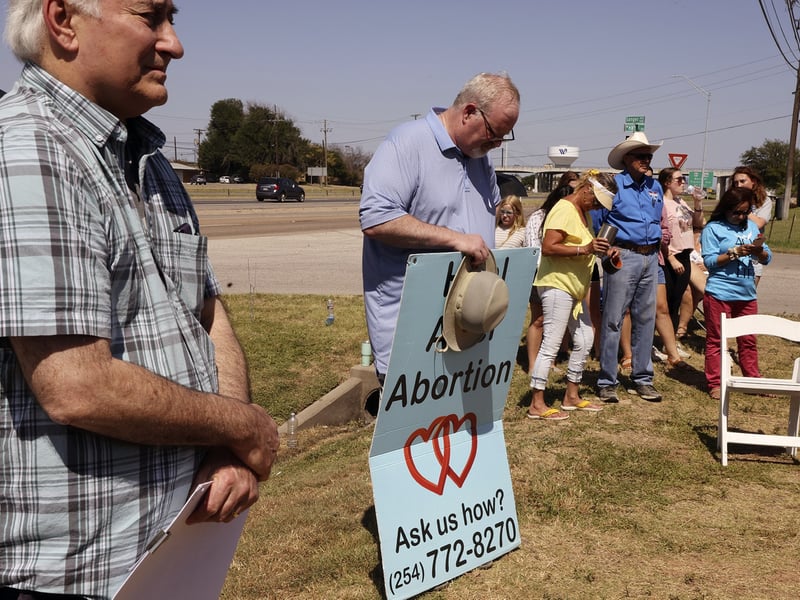
SAN DIEGO (CN) — After a hearing Monday, a federal judge must decide whether a San Diego ordinance preventing demonstrations outside of schools should be halted. An anti-abortion activist is suing the city, claiming the ban unconstitutionally prevents him from handing out leaflets to high school students.
In 2024, the city of San Diego updated a 1997 ordinance that created buffer zones extending 100-feet away from the entrances and exits of schools, medical facilities and religious institutions.
In those buffer zones, protesters can’t display signs. The ordinance also bans demonstrators from approaching people entering and exiting the buildings within eight feet in order to talk to them or hand them leaflets or literature, unless they have the consent of the person they’re approaching.
In November, Dan Blythe, an anti-abortion activist who has demonstrated across California, sued San Diego claiming the city’s ordinance violates his and other activists’ First and Fourteenth Amendment rights to free speech and demonstrate by preventing them from handing out literature to students on public sidewalks at Patrick Henry High School in San Diego as they leave school.
“The ordinance prohibits plaintiff from engaging in this activity unless he has first gained the consent of each student whom he is approaching and to whom he is offering leaflets,” Blythe writes in his complaint. “Obtaining consent is an unrealistic requirement for distributing literature to multiple people arriving in waves and leaves plaintiff unable to engage in the critical literature distribution aspect of his free speech activity. Plaintiff is concerned that, if he fails to abide by the ordinance, he will be arrested for engaging in this free speech activity while outside high schools in the city of San Diego.”
At Monday’s hearing on Blythe’s motion for a preliminary injunction hearing, U.S. District Judge Gonzalo P. Curiel, a Barack Obama appointee, asked Blythe’s attorney if the city’s ordinance didn’t align with the Supreme Court’s 2000 ruling in Hill v. Colorado , in which the court found that a Colorado law restricting protests in front of health care facilities did not violate the First Amendment.
“This is not a clinic where people have to go through a gauntlet of demonstrators,” said attorney Michael Millen. “Mr. Blythe is not doing anything that anyone would characterize as harassment.”
Blythe, Millen added, has not and does not plan to disrupt students’ educational environment.
“It’s myopic to think that unwanted approaches are not disruptive to school environments,” said San Diego City Attorney Matthew Zollman, even if Blythe isn’t going to be demonstrating or passing out literature until the school day is over.
His children’s own school only has one entrance and exit for security reasons, so essentially, if Blythe was to demonstrate at their school, he would have a captive audience, Zollman added.
Municipalities have a duty to prevent obstructions to student’s learning environments, he added.
“What is harassment?” Curiel asked. “Is it harassment if I approach a student within 100 yards of the school with a message the student wasn’t interested in hearing?”
After taking a moment to look up the definition of harassment on his computer, Zollman said it depends on the context.
“It’s not the message, it’s more the conduct or the way it’s presented,” he said.
Curiel said he’d take the matter under submission and grant Millen’s request to amend Blythe’s complaint to make some aspects of it clearer.
In his complaint, Blythe asks the court to declare the city’s ordinance unconstitutional and award him damages after a jury trial.
Subscribe to our free newsletters
Our weekly newsletter Closing Arguments offers the latest about ongoing trials, major litigation and rulings in courthouses around the U.S. and the world, while the monthly Under the Lights dishes the legal dirt from Hollywood, sports, Big Tech and the arts.