
 Search Articles


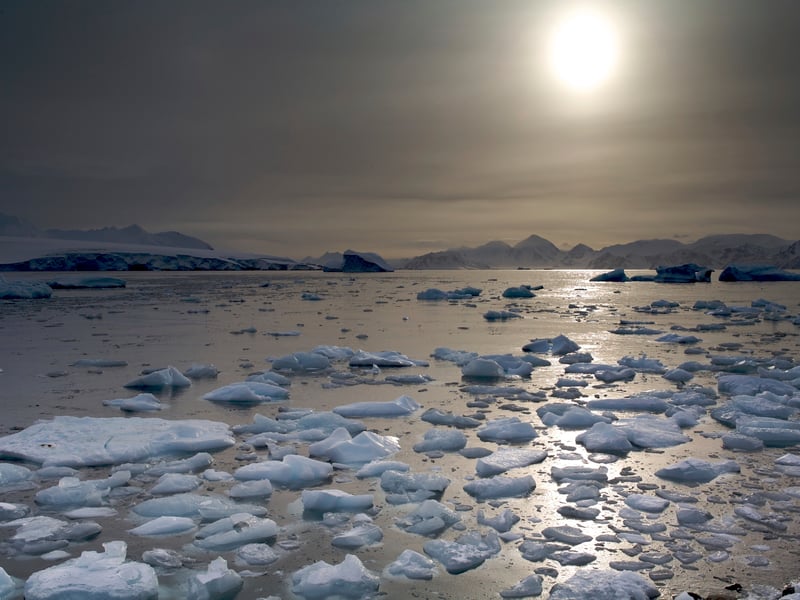
(CN) — A saltier, warmer ocean likely sounds inviting — unless you’re a penguin or seal. According to researchers, those exact conditions are developing in the Southern Ocean, which is not only shifting in temperature and salinity but also losing ice at an alarming rate.
Also called the Antarctic Ocean, the massive body of water already faced the planet’s largest environmental shift seen in decades when it lost an amount of sea ice equivalent to the size of Greenland in 2015.
Now, scientists, in a paper published Monday in the journal Proceedings of the National Academy of Sciences, expect even bigger changes on the horizon as the ocean has begun to lose not just a substantial amount of sea ice, but fresh water, too.
Growing sea ice is complex and mostly relies on good weather conditions and coincidence. Warm, salty water is pushed down to the ocean’s depths and replaced on the surface by cold, less salty water — a process known as “freshening” that creates the perfect environment for fresh sea ice.
“Saltier surface water allows deep ocean heat to rise more easily, melting sea ice from below,” said lead researcher Dr. Alessandro Silvano from the University of Southampton, emphasizing just how fragile polar oceans can be. “It’s a dangerous feedback loop: less ice leads to more heat, which leads to even less ice.”
Since the 1980s, marine researchers have dutifully tracked the Southern Ocean’s surface as it freshened, building a strong layer of sea ice coverage that creates essential habitat for Antarctic marine life and traps warm water deep in the ocean.
Recent developments in satellite technology, however, have produced data that concerns researchers studying the seas — particularly in areas south of the 50° latitude, which runs through deep southern hemisphere countries like Chile, Argentina and New Zealand.
Using both the new satellite technology and floating robotic devices that run along water columns collecting data, University of Southampton researchers have detected a sudden break from the Southern Ocean’s typical freshening routines. Instead, the sea is getting hotter and saltier, meaning sea ice has reached multiple record lows.
The dual utilization of both space and in-ocean technology is groundbreaking for marine science, as it’s the first instance in which researchers have been able to monitor changes in the Southern Ocean in real-time.
“While scientists expected that human-driven climate change would eventually lead to Antarctic Sea ice decline, the timing and nature of this shift remained uncertain,” said Aditya Narayanan, a co-author on the paper and postdoctoral research fellow at the University of Southampton. “Previous projections emphasized enhanced surface freshening … which could have supported sustained sea ice cover. Instead, a rapid reduction in sea — an important reflector of solar radiation — has occurred, potentially accelerating global warming."
So much sea ice has been lost that even the Maud Rise polynya — a gap or “hole” in the sea created by melted ice — has re-emerged. The polynya last froze over in the 1970s, but has since returned and was recently recorded nearly as large as Switzerland, a record-breaking size.
“The return of the Maud Rise polynya signals just how unusual the current conditions are,” said Silvano, noting that the Southern Ocean, and even the planet, could be permanently reshaped if the “salty, low-ice” state continues. According to Silvano, some effects can already be seen in the form of stronger storms and warmer oceans globally.
Supported by the European Space Agency, the research team hopes that their findings raise alarm bells for other scientists. Our current understanding may be insufficient to accurately predict future changes, says University of Southampton professor and study co-author Professor Alberto Naveira Garabato.
“It makes the need for continuous satellite monitoring all the more pressing, so we can better understand the drivers of recent and future shifts in the ice-ocean system,” said Garabato.
Subscribe to our free newsletters
Our weekly newsletter Closing Arguments offers the latest about ongoing trials, major litigation and rulings in courthouses around the U.S. and the world, while the monthly Under the Lights dishes the legal dirt from Hollywood, sports, Big Tech and the arts.