
 Search Articles


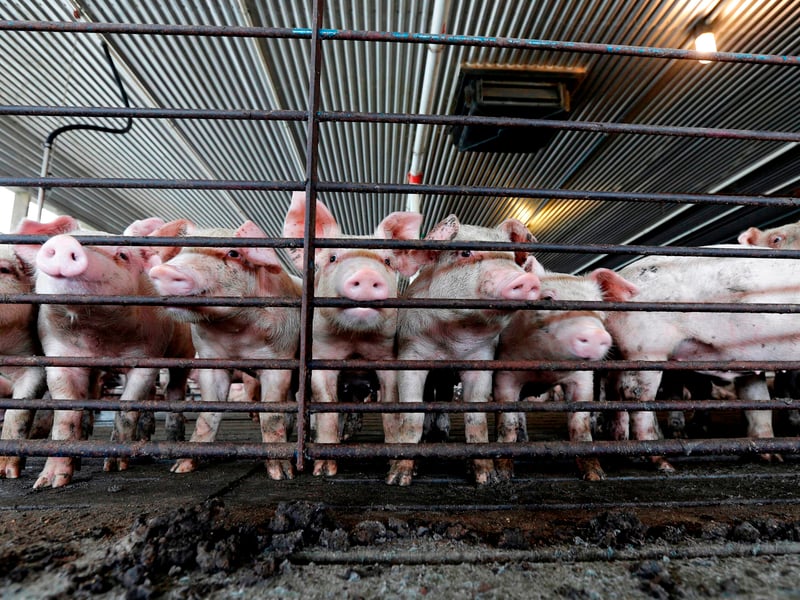
(CN) — An activist group that seeks to expose animal abuse urged a federal appeals court panel Wednesday to reverse a ruling upholding Iowa’s “ag-gag” statute, which makes it a crime to use a recording device while trespassing on livestock facilities.
Iowa Citizens for Community Improvement and other animal rights advocates sued the state, claiming Iowa’s trespass statute aimed at protecting livestock facilities violates the First Amendment by imposing enhanced criminal penalties for using an electronic surveillance device to record or transmit images while trespassing on private property.
While the Eighth Circuit earlier upheld most of the statute, the judges found the plaintiffs had standing to challenge the constitutionality of a provision barring a trespasser’s “use” of a camera or recording device. On remand, U.S. District Judge Stephanie Rose, a Barack Obama appointee, granted the state’s motion to dismiss the suit and held that Iowa’s law withstands constitutional scrutiny as applied to the plaintiffs.
ICCI appealed that ruling to the Eighth Circuit.
Attorney David Muraskin, with Washington, D.C.-based FarmSTAND representing ICCI, told the circuit judges Wednesday a recording made by the group on private property that is used on social media for advocacy is protected speech.
“In this narrow First Amendment challenge, ICCI seeks to protect its right to record when its presence is objected to, but it is recording on property that is otherwise open to the general public and there is no prohibition on recording,” he told the court.
Muraskin said ICCI’s challenge is the application of Iowa’s law to property where you are otherwise allowed to record.
“I can record in grocery stores … absent a sign that says I cannot record,” he said. Iowa’s statute applies when a protester is told to leave. “What has been limited is my continued protest” by recording, which violates free speech, he said.
Assistant Attorney General Breanne Stoltze, arguing in defense of the statute, said access to property that is open to the public may be limited by the property owner.
“As far as this notion that there are certain places that are open to the public, I would certainly push back on the notion that ‘open to the public’ means the same thing as ‘public property.’
“Certainly, to the extent that something is open to the public, like, say, a small business owner’s business, that’s subject to the business owner’s invitation,” she said. “And longstanding Iowa trespass law gives the property owner the right to withdraw that invitation for any reason absent something that runs afoul of, say, Civil Rights public accommodation law or some other prohibition on withdrawing access.”
U.S. Circuit Judge James Loken, a George H.W. Bush appointee, referring to ICCI’s argument that the statute chills its free speech, asked Stoltze, “What’s your answer to the ‘chilling’ argument?”
Stoltze replied, “There are ample other avenues of speech in this instance. Those who engage in civil disobedience are not exempt from the law, certainly not a generally applicable law such as trespass. There can be recording from public sidewalks. There can be recording by members who are not participating in the protest, who aren’t asked to leave.”
ICCI argues in a brief filed with the Eighth Circuit that Iowa’s statute, in contrast to ordinary trespass law, imposes “significantly enhanced” criminal sanctions “against ICCI’s staff and members who engage in the civil disobedience, if they also record the protests.”
The group said it seeks to act within the “tradition of nonviolent civil disobedience” along the lines of lunch counter sit-ins to draw attention to an issue by accepting punishment for refusing to leave.
In response, the state in its brief wrote, “The First Amendment does not protect committing a crime and then recording the commission of that crime.”
The state points out that the lower court upheld the restrictions on use of a camera only “when there has first been an unlawful trespass.” Thus, the statute “does not burden substantially more speech than is necessary to further the state’s legitimate interests.”
Other members of Wednesday’s panel were U.S. Circuit judges Raymond Gruender, a George W. Bush appointee, and L. Steven Grasz, a Donald Trump appointee. The court did not say when a ruling would be issued.
 Follow @roxalaird16
Subscribe to our free newsletters
Our weekly newsletter Closing Arguments offers the latest about ongoing trials, major litigation and rulings in courthouses around the U.S. and the world, while the monthly Under the Lights dishes the legal dirt from Hollywood, sports, Big Tech and the arts.