
 Search Articles


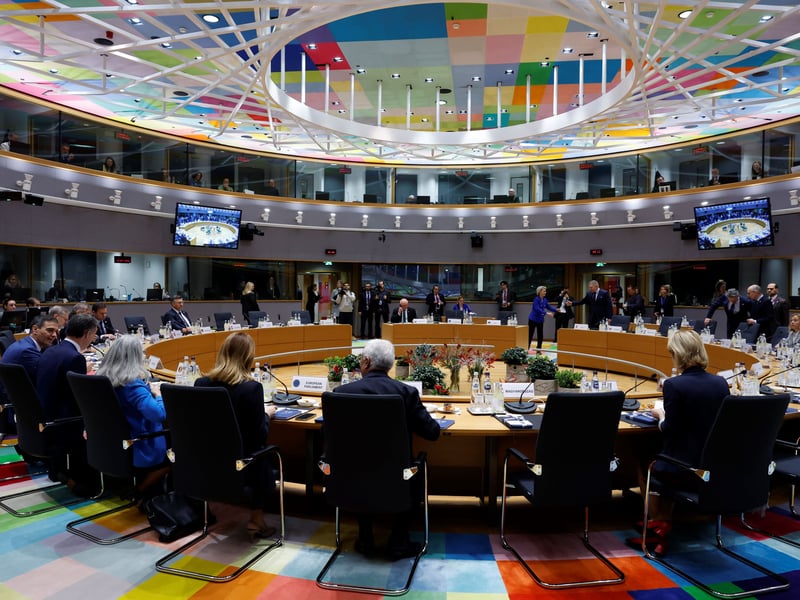
BRUSSELS (CN) — From trading with Trump to ramping up the bloc’s competitiveness to handling digital battles and unhappy farmers, European policymakers will have their work cut out for the in the coming year, marked by new leadership and increasing global competition.
How can the EU prepare for Trump trade wars?
Trade relations with the U.S. are a top priority for Europeans. Trade and Economic Security Commissioner Maroš Šefčovič highlighted the importance of the transatlantic trade relationship even before taking office, but European officials are preparing for a tough ride.
As a presidential candidate, Donald Trump pledged to impose tariffs of up to 20% on all foreign imports. European officials and capitals are scrambling to prepare potential responses, though there is no clear public plan yet.
He specified that the EU is on the hook as well.
“I told the European Union that they must make up their tremendous deficit with the United States by the large scale purchase of our oil and gas,” Trump posted on social media on Dec. 20, 2024. “Otherwise, it is TARIFFS all the way!!!”
In 2023, the United States’ trade imbalance with the EU on goods was $209 billion, according to the Census Bureau. There were $576 billion in imports from Europe and $367 billion in exports from the United States.
A revamped EU-U.S. Trade and Technology Council, a bilateral forum created to heal ties shattered under Trump, could be rehashed as a platform to deal with future issues.
Is the EU ready to step up its defenses?
With Russia’s Ukraine war far from over and a vast majority of EU member states ramping up their defense spending and war preparedness, the next year is expected to be a fight about how to pay for it all.
European Commission President Ursula Von der Leyen announced the need for around 500 billion euros ($514 billion) in investment to boost the bloc’s military-industrial complex during her first term. A white paper on defense, which the European Commission should present within its first 100 days in office, is expected to offer funding proposals.
Once Trump is in the White House, European NATO members expect the old discussion on their defense spending to come back with a vengeance. European NATO allies have been holding eleventh-hour talks about safeguarding their interests under the new administration.
The Western military alliance estimates that 23 of its 32 members will meet the 2% GDP spending goal this year, which Trump pushed members to reach, but discussions are already shifting toward 3% of GDP.
European diplomats are also weighing the risk of the incoming Trump administration cutting support to Ukraine, which the bloc would need to make up for.
In the wider security spectrum, migration is expected to be a contentious topic, with EU member states increasingly pushing to crack down on irregular migration into the bloc.
For that, the European Commission will present a new directive on legal options to return illegal migrants arriving at the bloc’s borders to non-EU countries. A contentious proposal: opening so-called return hubs outside the bloc’s borders, in countries like Albania or Morocco, that could process the applications of asylum-seekers. Italy has already tried the scheme, which is blocked by the courts for now.
Can Brussels boost Europe’s ailing economy?
Whatever it takes to ramp up European competitiveness — that was the bottom line of former Italian Prime Minister Mario Draghi’s landmark report on how to reform the bloc’s economy amid rising global pressure.
He warned in the report that to prevent Europe’s economic decline, the bloc must invest twice as much as it did rebuilding the continent after World War II. Many of the report’s nearly 170 proposals will influence Europe’s decision-making over the next five years.
While the European Commission could propose some over the course of next year, the real fight will be over the possibility of common debt, which more frugal EU member states, such as Germany and the Netherlands, fundamentally oppose.
Will digital regulations create a Musk showdown?
During von der Leyen’s first term, the EU embarked on a digital legislation spree with a set of laws aimed at regulating emerging technologies and enforcing fair competition.
Those included the Digital Services Act, which covers large online platforms such as X and TikTok and how they monitor for illegal content; the AI Act, covering artificial intelligence; and the Digital Markets Act, a set of rules designed to curtail the abuses and monopolies of tech giants and make the digital marketplace fairer.
With all three sets of laws now in place, the next phase is how Brussels can enforce them in a changing digital world.
Europeans are worried that tech billionaire and X owner Elon Musk’s detour into the new U.S. administration could widen the rift between the two sides of the Atlantic as he aims to put up a fight against regulators.
EU officials expect a possible confrontation between the European Commission and Musk over an investigation into X and more broadly, with the incoming Trump administration, as Brussels likely aims to enforce stricter competition rules against foreign companies.
Since taking office in early December, the EU’s new competition chief, Teresa Ribera, has drawn up plans to help European companies scale up and take on global rivals, with the first proposals expected over the course of 2025.
Green Deal or no deal?
Farmers throwing manure at EU institutions in Brussels provided one of last year’s most memorable images — and the anger is unlikely to subside over the next year.
The finalization of the EU-Mercosur trade agreement with the South American bloc in December ignited strong opposition within the EU farming and food community, with France leading the protest.
All eyes will be on how the EU Clean Industrial Deal, which the European Commission should present in February as one of its flagship initiatives of the first 100 days, will take into account farmers’ gripes about high prices and the burdens created by environmental initiatives.
Another key issue will be how Brussels can lay the groundwork to reform the bloc’s Common Agricultural Policy, which accounts for more than a third of the EU budget and should be renegotiated in the next two years.
With the EU executive eyeing funding sources to boost the bloc’s competitiveness, the vast pot of money could get redistributed, though most EU capitals oppose such a step for now.
And with the bloc looking at enlarging from 27 to up to 36 member states — potentially taking in western Balkan countries as well as Ukraine and Moldova — in the distant future, EU officials are increasingly interested in revamping how funds get distributed.
Subscribe to our free newsletters
Our weekly newsletter Closing Arguments offers the latest about ongoing trials, major litigation and rulings in courthouses around the U.S. and the world, while the monthly Under the Lights dishes the legal dirt from Hollywood, sports, Big Tech and the arts.