
 Search Articles


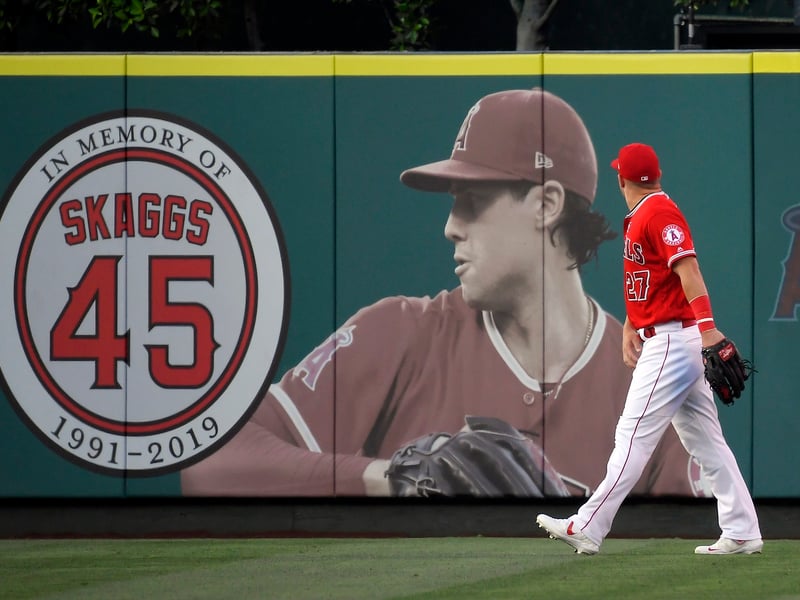
SANTA ANA, Calif. (CN) — Los Angeles Angels star Mike Trout put on a blue suit Tuesday to testify about his longtime friend and former teammate, Tyler Skaggs, a pitcher who died of a drug overdose in 2019.
Skaggs’ widow and parents have accused the Angels of being complicit in the tragic death of the pitcher; they say the Angels knew that one of their communications directors, Eric Kay, was selling pills to a number of players on the team, including Skaggs. Kay has already been convicted of selling Skaggs the pills that killed him — counterfeit oxycodone laced with fentanyl — was sentenced to 22 years in federal prison.
Trout, clearly uncomfortable speaking in a courtroom filled with jurors, journalists and attorneys, got choked up when asked about the moment he heard that Skaggs had died.
“I cried,” Trout said. “I loved him.”
Speaking in a kind of low growl, Trout recalled how he and Skaggs met when they were teenagers, playing in the minor leagues. The two played for the Cedar Rapids Kernels in Iowa, and stayed together in a basement belonging to a host family.
“It was a nice basement,” Trout said with a smile. Referring to Skaggs, he said, “He was very funny, outgoing, fun to be around.” He later added: “He was hyper. Always had a red bull. Wired.”
Later, when the two were both playing for the Angels, Skaggs could often be seen on roadtrips carrying around a boombox. “He was a DJ,” Trout said.
Though Trout admitted that he knew that some players had drug problems, including fellow outfielder Josh Hamilton, Trout said that he never knew Skaggs to take drugs, other than alcohol and marijuana.
Trout was also questioned about Eric Kay, who as director of communications would often prepare the players for media interviews. Trout said that Kay took part in what plaintiffs attorney Bill Haggerty referred to as “shenanigans,” where players would pay Kay to perform dangerous or disgusting stunts. In one, players paid Kay $1,000 to be hit in the leg with a 90 mph pitch. Trout admitted that he and slugger Albert Pujols were behind that particular shenanigan.
When asked if Kay was paid to eat a bug off the clubhouse floor, Trout replied that it was “a few hundred bugs,” and added, “I was behind that.” When asked if Kay was paid to pop a pimple off his back and eat it, Trout said sheepishly, “I’m not proud of that one.”
“Are you aware Eric Kay would procure sex workers for players during spring training?” Haggerty asked.
“No,” Trout said flatly.
Throughout the trial, which began last week and is expected to continue for around two months, plaintiff attorneys have tried to show that Kay was in throes of addiction, and that he also strived to serve the players, to please them in any way possible. So far, all their witnesses have been from the Angels organization. They have all denied knowing that Kay was moonlighting as a drug dealer.
Trout was no different. The future Hall of Famer said he had no idea Kay was even taking drugs until one day when he was informed by a clubhouse attendant.
“Chris came up to me and said, ‘Stop making Eric Kay do crazy stuff,’” Trout said, referring to the attendant.
“He said the money was going to a bad purpose?” Haggerty asked.
“Yes,” Trout said in his typically clipped voice. “Drugs. That’s what I got out of it, yes.”
He said he confronted Kay: “I just said, ‘Hey, you got two boys at home. You gotta get this right.’”
When asked if he had offered to pay for Kay’s drug rehab, Trout said the overture was more general.
“I don’t specifically remember saying that,” Trout said. “I just said, you need anything, you let me know.”
After learning that Kay was doing drugs, Trout not only stopped paying him to take part in clubhouse antics, he also stopped signing baseballs for him.
“I made sure I knew where they were going,” Trout said.
Exiting the courtroom after about two hours of testimony, Trout declined to comment.
 Follow @hillelaron
Subscribe to our free newsletters
Our weekly newsletter Closing Arguments offers the latest about ongoing trials, major litigation and rulings in courthouses around the U.S. and the world, while the monthly Under the Lights dishes the legal dirt from Hollywood, sports, Big Tech and the arts.