
 Search Articles


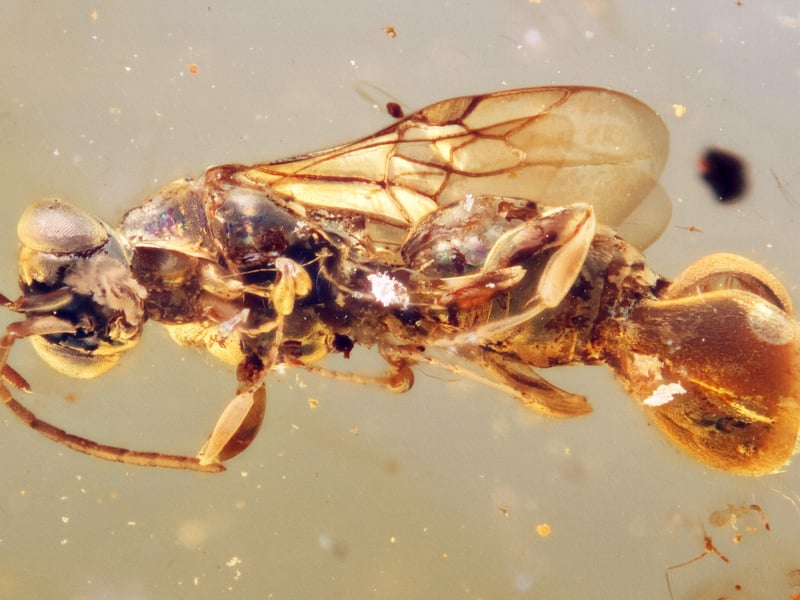
(CN) — Scientists have unearthed a 99-million-year-old wasp preserved in amber that they say represents not just a new species but an entirely new family of insects from the mid-Cretaceous period.
Sirenobethylus charybdis, the newly identified species detailed in a study published Wednesday in the journal BMC Biology, possessed a unique abdominal structure — a complex, three-flapped mechanism capable of opening and closing.
Study authors described this apparatus of the prehistoric wasp as “round and resembles that of the Venus flytrap, the carnivorous plant that captures insects between its leaves.”
Researchers Taiping Gao, Lars Vilhelmsen and their colleagues from the Capital Normal University in China and the Natural History Museum of Denmark employed micro-CT scanning to examine 16 female specimens discovered in Myanmar’s Kachin region.
Microscopic examination revealed intricate anatomical details. The lower flap featured thick spines spread across its middle, with shorter, more densely packed spines along the edges. Two muscle attachment points suggested a sophisticated muscle system controlling this body part.
The research team says in their study that the findings suggest “Chrysidoidea displayed a wider range of parasitoid strategies in the mid-Cretaceous than they do today.”
The researchers hypothesize that the wasp was likely a koinobiont parasitoid — an insect whose larvae inhabit a host without immediately killing it. They envisioned the wasp “would have waited with the apparatus open, ready to pounce as soon as a potential host activated the capture response.”
Researchers speculate that the ancient wasp might have hunted fast-moving prey like small winged insects or jumping bugs. Its elaborate capturing mechanism suggested an advanced hunting strategy, despite limitations in long-distance pursuit.
The team says the soft, membranous areas and bristly brush inside the lower flap indicated a gentle approach to host handling during egg-laying, rather than a violent capture. Its sting was uniquely positioned in a groove on the top side of the middle flap, facilitating easy insertion when capturing a host.
Phylogenetic analysis revealed that this wasp represents a distinct lineage near the base of the Chrysidoidea group. Unlike modern wasps, this ancient species possessed a completely unique host-catching method with no parallel in any known existing insect.
This discovery offers also insights into a prehistoric past. Modern Chrysidoidea wasps exhibit “a range of life histories” from parasitizing beetle larvae to laying eggs in stick insects and inhabiting solitary bee nests.
The mid-Cretaceous period, spanning roughly 100 to 90 million years ago, was a time of significant evolutionary transformation. Flowering plants were rapidly diversifying, dinosaurs still dominated the terrestrial environment, while small mammals and early birds were establishing their own ecological niches. And insect species were evolving survival strategies that would ultimately shape modern ecosystems.
The amber-preserved specimens of Sirenobethylus charybdis, found at the Noije Bum hill in Myanmar’s Hukawng Valley, are now stored in the Key Lab of Insect Evolution and Environmental Changes at Capital Normal University.
 Follow @JeremyYurow
Subscribe to our free newsletters
Our weekly newsletter Closing Arguments offers the latest about ongoing trials, major litigation and rulings in courthouses around the U.S. and the world, while the monthly Under the Lights dishes the legal dirt from Hollywood, sports, Big Tech and the arts.