
 Search Articles


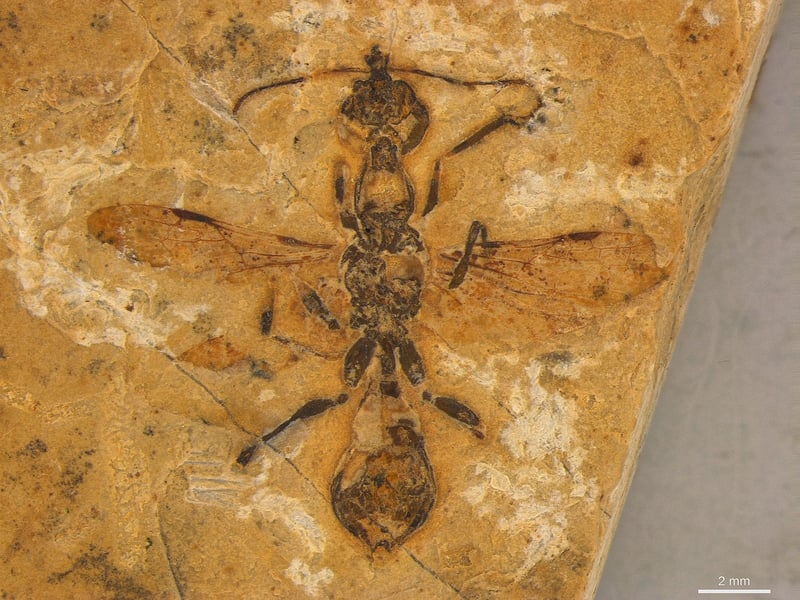
(CN) — Scientists have identified what is now considered the oldest ant specimen in the fossil record, a 113 million-year-old “hell ant” discovered in northeastern Brazil. The groundbreaking find, detailed in a study published Wednesday in the Cell Press journal Current Biology, pushes back the timeline of ant evolution and provides new insights into how these insects spread across ancient continents.
The remarkably well-preserved specimen, encased in limestone rather than amber, belongs to the extinct Haidomyrmecinae subfamily — predatory insects that roamed Earth during the Cretaceous period equipped with specialized scythe-like jaws unlike anything seen in modern ants.
Lead researcher Anderson Lepeco of the Museu de Zoologia da Universidade de São Paulo said the fossil marks a pivotal moment in ant history, not just for its age but for the evolutionary clues it carries.
“Our team has discovered a new fossil ant species representing the earliest undisputable geological record of ants,” Lepeco said via a press release. “What makes this discovery particularly interesting is that it belongs to the extinct ‘hell ant,’ known for their bizarre predatory adaptations. Despite being part of an ancient lineage, this species already displayed highly specialized anatomical features, suggesting unique hunting behaviors.”
The discovery upends previous assumptions about ant evolution, as the oldest known specimens were previously found in France and Burma preserved in amber. Finding a hell ant in Brazil demonstrates that ants had already achieved widespread global distribution and significant diversification earlier than scientists had thought.
“Even though there have been hell ants described from amber, this was the first time we could visualize this in a rock fossil,” Lepeco said.
The specimen came to light during a systematic examination of one of the world’s largest collections of fossil insects from the Crato Formation, a geological formation renowned for exceptional fossil preservation. This collection is housed at the Museu de Zoologia da Universidade de São Paulo.
“When I encountered this extraordinary specimen, we immediately recognized its significance, not only as a new species but as potentially the definitive evidence of ants in the Crato Formation,” Lepeco said. “This finding highlights the importance of thorough examination of existing collections — private or in museums — and brings a spotlight to Brazilian paleontology and the underexplored fossil insect fauna of the country.”
The discovery is also notable for the specimen’s exceptional preservation, which enabled researchers to study it using micro-computed tomography, a high-resolution 3D X-ray imaging technique. The analysis revealed that the ant is closely related to previously identified hell ants found in Burmese amber, indicating that these insects likely migrated between ancient landmasses multiple times during the Cretaceous period.
Perhaps most surprising to researchers was the specialized feeding apparatus observed in the specimen.
“While we expected to find hell ant features, we were shocked by the characteristics of its feeding apparatus,” Lepeco said. Unlike modern ants with mandibles that move laterally, this ancient species had mandibles that extended forward parallel to the head, with a facial projection anterior to the eyes — a radically different design than what we see in today’s ants.
“Finding such an anatomically specialized ant from 113 million years ago challenges our assumptions about how quickly these insects developed complex adaptations. The intricate morphology suggests that even these earliest ants had already evolved sophisticated predatory strategies significantly different from their modern counterparts,” Lepeco added.
The discovery raises broader questions about the evolutionary pressures that drove the development of such specialized features in these ancient insects and why, despite their apparent success for millions of years, hell ants ultimately became extinct while other ant lineages survived and diversified into the thousands of species seen today.
The findings also represent an example of how advances in imaging technology are allowing scientists to extract new detail from ancient specimens. Techniques like micro-CT scanning provide researchers with the ability to examine internal structures and morphological details that would have been impossible to study a decade ago.
 Follow @JeremyYurow
Subscribe to our free newsletters
Our weekly newsletter Closing Arguments offers the latest about ongoing trials, major litigation and rulings in courthouses around the U.S. and the world, while the monthly Under the Lights dishes the legal dirt from Hollywood, sports, Big Tech and the arts.