
 Search Articles


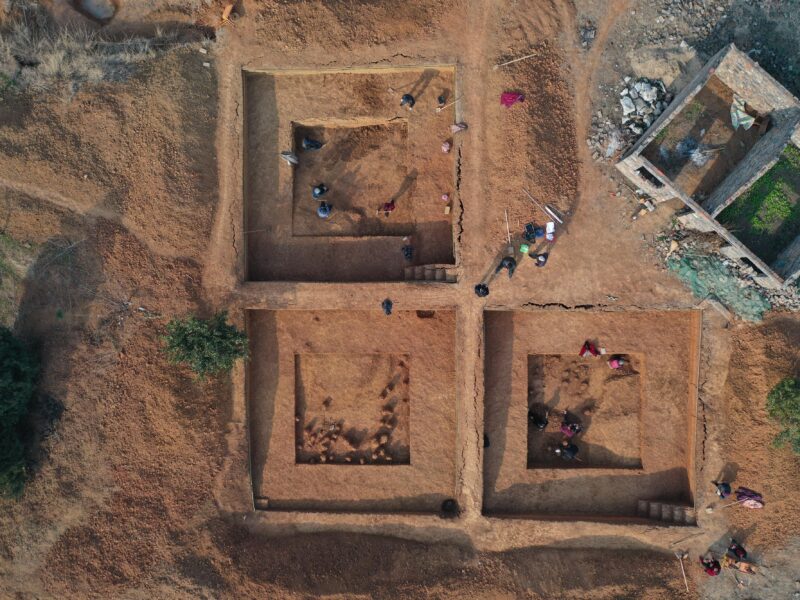
(CN) — Stone tools uncovered in central China suggest early humans there were far more inventive than scientists once believed, making complex tools tens of thousands of years earlier than expected.
Archaeologists say the tools, dating back as far as 160,000 years, include some of the earliest known examples of composite, or hafted, tools in the region. Such tools combine a stone working edge with a handle or shaft, a technique long associated with later periods in Africa and western Europe.
The findings, published Tuesday in Nature Communications, come from excavations at Xigou in China’s Henan Province, where researchers uncovered 2,601 stone artifacts dating to between about 160,000 and 72,000 years ago.
Most of the tools were made from quartz and quartzite and fragments were small, often measuring less than two inches.
“The explorations revealed hominins in this region were far more inventive and adaptable than previously believed, at a time when multiple large-brained hominins were present in China, such as Homo longi and Homo juluensis, and possibly Homo sapiens,” said Shi-Xia Yang of the Chinese Academy of Sciences, the study’s corresponding author, in an email. “This study represents the first attempt to acquire key updated information regarding the behavior of these hominins.”
Stone tool innovation is often linked to advances in early human behavior, including planning, problem-solving and adaptability, researchers say.
In Africa and western Europe, more complex technologies are thought to have emerged during the later part of the Middle Pleistocene, roughly between 300,000 and 50,000 years ago. In East Asia, however, archaeologists have long believed that technological change came much later, around 40,000 years ago.
The Xigou tools suggest otherwise.
“For a long time, early hominins in East Asia were believed to have relied on simpler, more conservative stone tools, with major technological changes occurring only around 40,000 years ago,” Yang said. “Finds from Xigou show that early technologies in China featured prepared-core methods and innovative retouched tools dating back 160,000 to 72,000 years ago, which is far richer and more complex than previously acknowledged”.
Researchers identified a wide range of tool types, including cutting, scraping and boring tools. Microscopic wear on the stone surfaces suggests some were used to work plant materials such as wood or reeds. The manufacturing process involved multiple steps, pointing to careful planning and foresight.
“Small-sized flakes were primarily produced with core reduction strategies ranging from expedient to well-organized (core-on-flake and discoid technologies),” Yang said. “The dominant small tool retouching patterns evidence a great degree of technological standardization and complexity. Among the most striking finds was the discovery of hafted stone-tools — the earliest known evidence of composite tools in East Asia.”
Hafted tools are considered a major technological leap because they improve efficiency and durability. Attaching a stone edge to a handle allows for greater force, control and versatility.
“These tools combined stone components with handles or shafts, and demonstrated complex planning, skilled craftsmanship, and an understanding of how to enhance tool performance,” Yang said.
Although the site did not preserve animal bones or other direct evidence of daily life, the tools still offer insight into how people lived and adapted to their environment.
“While the lack of mammal bones and other evidence makes it difficult to deduce how they lived, their stone tools indicate a high degree of behavioral flexibility and successful adaptation to the local climate and resources,” Yang said.
According to Yang, the findings also challenge assumptions about raw materials.
Quartz and quartzite were once considered poorly suited for advanced toolmaking, yet they were the only materials used at Xigou.
“Our research underscores the need to pay closer attention to the technological and functional interpretation of artifacts made from these types of materials. Indeed, quartz and quartzite were among the most commonly utilized raw materials in East Asia,” Yang said.
Subscribe to our free newsletters
Our weekly newsletter Closing Arguments offers the latest about ongoing trials, major litigation and rulings in courthouses around the U.S. and the world, while the monthly Under the Lights dishes the legal dirt from Hollywood, sports, Big Tech and the arts.