
 Search Articles


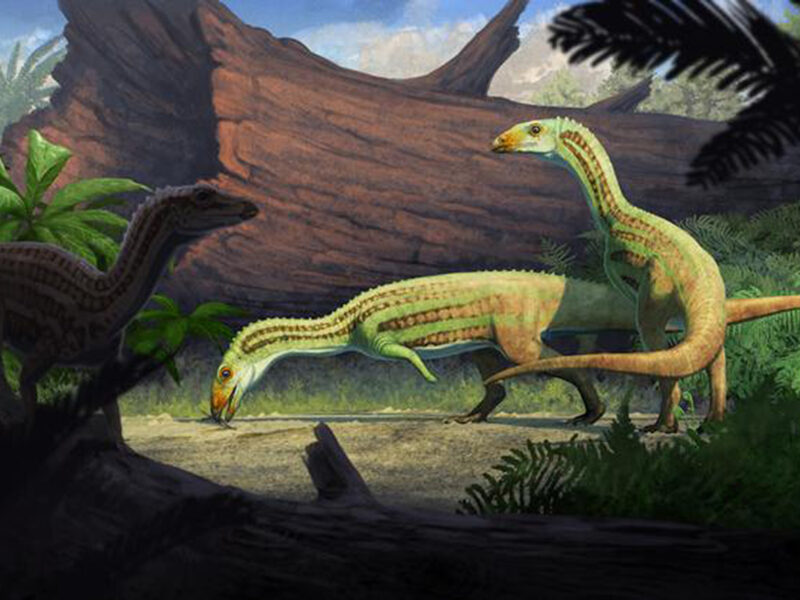
(CN) — An ancient crocodile relative may have started life walking on four legs before switching to two as it matured, a strange developmental twist revealed by fossils found in Arizona.
The animal, a newly described crocodile relative called Sonselasuchus cedrus, lived during the Late Triassic period about 225 million to 201 million years ago.
Researchers say the small reptile appears to have changed how it moved as it grew, a rare developmental shift not clearly documented in similar ancient species.
The findings, published Monday in the Journal of Vertebrate Paleontology, suggest the animal’s hind legs became longer and stronger as it matured, eventually allowing it to walk upright.
“By analyzing the proportions of the limb skeletons of different animals, they determined its bipedal stance (standing on two feet) may have been the result of a differential growth pattern,” said lead author Elliott Armour Smith, a graduate student at the University of Washington, in a press release. “We think that Sonselasuchus had more proportional forelimbs and hindlimbs as young, and their hindlimb grew longer and more robust through adulthood.”
Researchers believe these creatures started out on four legs and later began walking on two legs as they grew.
“This is particularly peculiar,” he said.
Sonselasuchus belonged to a group of reptiles known as shuvosaurids, distant relatives on the crocodile branch of the reptile family tree.
Despite that lineage, many shuvosaurids closely resembled fast-running, birdlike dinosaurs called ornithomimids that lived in the same environments.
Researchers say the similarity likely reflects convergent evolution, a process in which unrelated species develop similar traits because they occupy similar ecological roles.
“Although similar to the ornithomimid dinosaurs, these features would have evolved separately,” Armour Smith said. “And this similarity was probably due to the fact that croc-line and bird-line archosaurs evolved in the same ecosystems and converged upon similar ecological roles.
Traits such as bipedalism, a toothless beak, hollow bones and large eye sockets are typically associated with ornithomimid theropod dinosaurs, but the fossils show those features also evolved independently among crocodile relatives.
Based on the fossils, the animal stood about 25 inches tall and likely resembled a small, lightly built reptile with a toothless beak, large eye sockets and hollow bones.
Researchers say those traits likely helped it move quickly through forested environments during the Late Triassic.
The fossils were discovered at an unusually rich site in Arizona’s Petrified Forest National Park. University of Washington researchers began excavating the area in 2014 and have since recovered thousands of bones.
Among them were 950 fossils of Sonselasuchus, making it one of the most abundant animals at the site.
“Since starting fieldwork at Petrified Forest in 2014, we have collected over 3,000 fossils from the Sonselasuchus bonebed, and it doesn’t seem to show any signs of petering out,” said Christian Sidor, professor at the University of Washington’s Burke Museum, in the press release.
The site has yielded a wide range of fossils, including fish, amphibians, dinosaurs and other reptiles, giving scientists a detailed glimpse into ecosystems that existed more than 200 million years ago.
“In addition to Sonselasuchus, the bonebed has yielded fossils of fish, amphibians, as well as dinosaurs and other reptiles,” he said. “Over 30 University of Washington students and volunteers have been involved over the years. It’s exciting to see that the site continues to produce new and interesting fossils.”
Subscribe to our free newsletters
Our weekly newsletter Closing Arguments offers the latest about ongoing trials, major litigation and rulings in courthouses around the U.S. and the world, while the monthly Under the Lights dishes the legal dirt from Hollywood, sports, Big Tech and the arts.