
 Search Articles


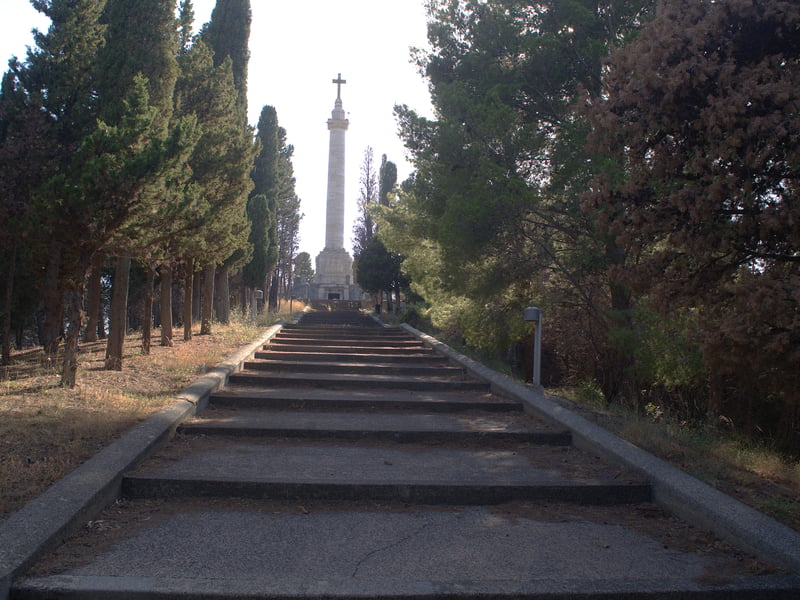
BELMONTE CALABRO, Italy (CN) — Along this sun-drenched stretch of southern Italian coastline, a massive and mostly neglected mausoleum to Italian fascist leader Michele Bianchi stands like a ghost of Italy’s troubled past on a hill overlooking the Tyrrhenian Sea.
Built during the height of Benito Mussolini’s dictatorship, it honors the son of a bourgeois Belmonte Calabro family who, like Il Duce, went from a socialist youth to a fascist after World War I.
Fascist admirers hold a commemoration here every summer. Left-wing protesters occasionally descend on the imposing structure to denounce fascism. But the grounds are unkempt, and there are few signs of regular visitors. On a recent visit, trash was piled up in rubbish bins at the monument’s sweeping stone staircase, which leads up to the monument and its 115-foot tall column crowned with a cross.
And yet decades after World War II, this mausoleum is still here — a dark reminder that Italy’s fascist past lives on in ways that can feel awkward, embarrassing and pernicious but are often just ordinary.
Italy — which saw two generations born and raised under Mussolini — isn’t about to write off its fascist past as entirely abhorrent. If anything, the country under Prime Minister Giorgia Meloni, who was elected in 2022, is doing quite the opposite.
In 2012, Meloni helped found the far-right Brothers of Italy. It’s an offshoot of the Italian Social Movement, a party forged after World War II by fascist veterans and of which Meloni was a member. The Brothers party adopted the Movement’s symbol: a flame in the colors of the Italian flag.
In April, the Meloni governmentissued a postage stamp honoring Giovanni Gentile, an Italian fascist philosopher. In parliament, far-right politicianshave taunted their opponents by celebrating a fascist-era Italian flotilla, the Decima Flottiglia MAS. Many of the unit’s members fought under Nazi SS command after Italy’s surrender and committed numerous atrocities.
Meanwhile, in Belmonte Calabro, work is underway to make the Bianchi mausoleum into a tourist attraction. Officials are renovating the grounds, sprucing up a walkway that leads into town and even building a museum dedicated to Bianchi, who once served as one of Mussolini’s top aides.
To critics, it’s part of a broader effort under Meloni to rewrite Italian history, celebrating aspects of fascism and its adherents as a force for good. “We are living a moment of revanchism,” said Francesco Filippi, an Italian historian who studies fascism and its continuing influence on Italy. “It’s only begun.”
“There’s this boasting about fascism having a positive role inside Italian history,” Filippi added. “They have a road map for reevaluating lots of symbols. Let’s not fool ourselves into thinking it will end with a postage stamp.”
A town and its fascist monument
Bianchi’s memory looms large in this picturesque mountainside town, where even the main street is named after him.
On a recent afternoon, Roberto Veltri, Belmonte Calabro’s mayor, walked along Via Michele Bianchi. Leaning over the railing, he pointed down at an impressive stone retaining wall underneath a town built into the flanks of steep hills.
“It was built by the fascists,” he said. Sure enough, decorative stone fasces protruded out about halfway down the wall. The symbol — a bundle of wooden rods around an ax that represented power in ancient Rome — was later adopted by Italy’s fascists.
Veltri turned to a nearby fascist-era monument erected to soldiers from Belmonte Calabro killed in World War I. Two fasces protruded from it too. “Fascism did a lot of damage,” Veltri said — but “what are we supposed to do? Do we go and demolish all these public works we have?”
Italy, he said, is full of buildings, highways, monuments and crucial infrastructure built during Italy’s two decades under fascist dictatorship. “It’s a paradox, but you live with paradoxes,” he said.
“We can’t go and demolish it all,” Veltri said. “It’s not like you can demolish this history simply by demolishing a statue.”
Keeping statues is one thing — but renovating a mausoleum for a high-ranking fascist is another.
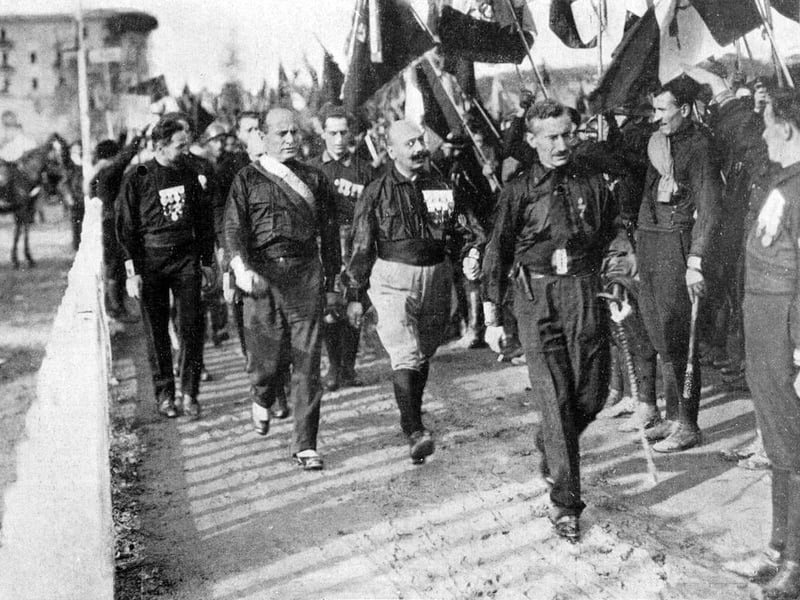
Bianchi, a leader of the 1922 March on Rome that brought Mussolini to power, played a central role in the regime’s public works ministry. Beforedying from tuberculosis at age 47 in 1930, heoversaw development projects in his native Calabria, one of Italy’s poorest regions at the time.
Although Bianchi is little known today, he was hailed as a fascist hero by Mussolini’s regime. Until the regime fell apart during World War II, Roman-saluting fascist leaders including Mussolini himself visited the mausoleum on anniversaries of his death.
Because he died in the early years of the dictatorship, Bianchi’s role in the fascist narrative is less understood, and his story is often overshadowed by other fascist leaders. Still, “he was one of the founders” of fascism in Italy, Filippi said. “Some even say he was the true thinker behind fascism.”
For Veltri, restorting the mausoleum below Belmonte Calabro is nonetheless a worthy cause for the town. At a cafe facing the war monument, he sat down and explained his reasoning.
“Fascism wrote an ugly page in history,” he said. It was a “distorted ideology” of white supremacy and antisemitism that killed thousands. “Thus, from this point of view, it was a horrible thing.”
And yet fascism must also be credited for helping develop the country, Veltri argued. “They left an indelible mark,” he said. “A great many of the most important public works were carried out by Mussolini.”
In Calabria, for example, Bianchi led efforts to bring roads and railways to La Sila, a rugged mountainous plateau infamous for its highway robbers. During his lifetime, Bianchipromoted La Sila for tourist development.
Veltri said the regime sought to win the hearts and minds of Italians through its public projects.
“These public works were meant to consecrate the fascist ideology,” he said. “In this way, people would think of fascism as good as long as a public project was good.”
‘Mussolini also did good things’
Despite the violence and crimes of the Mussolini regime, Italians like Veltri still believe a century after his rise to power that fascism brought progress to Italy.
Italians were conditioned to view fascism in a favorable light because Mussolini’s regime happened to coincide with the advent of modernity in Italy, said Filippi, the fascism expert.
“Widespread use of the radio took place under fascism. Widespread use of the automobile took place under fascism,” he said. “There’s a context of nostalgia for a kind of Italy that seems better than the current one. Here you are leaving history and going into myth.”
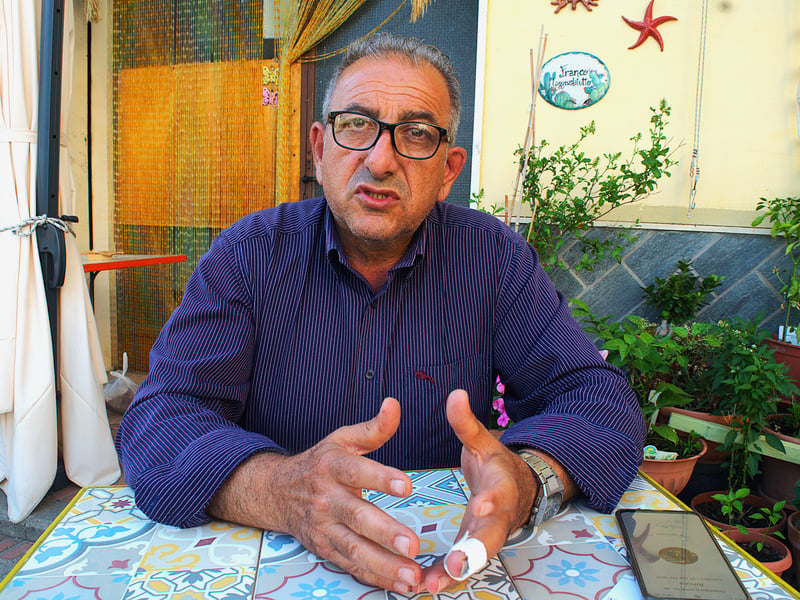
Filippi is familiar with these myths. He dissected them in a recent book, the title of which roughly translates to “Mussolini also did good things: On the idiocies still in circulation about fascism.”
During book tours, he says he’s heard ridiculous claims about fascism from his fellow Italians.“They’ll say, ‘Well, at least Mussolini invented the university in Italy.’” But while Italy can take credit for having the oldest continuously operating university, that institution was founded in Bologna in 1088 — “800 years before Mussolini was procreated.”
Unlike in Germany, the Allies did not force post-war Italy to purge itself of fascists. There was no Italian equivalent of a Nuremberg Trial, and swaths of fascist officials — including government ministers, judges, police officers, mayors and teachers — remained in their posts.
Long before Meloni, Italians had “largely succeeded in burying” their complicity in fascism, MacGregor Knox, a historian on fascism at the London School of Economics and Political Science, said in an email.
“The onset of the Cold War gave Italy (far more than Germany or Japan) a free pass,” Knox wrote. To counter the rise of Italy’s Communist Party, Italy saw “only superficially ‘defascistized’” elements of society like the police, the army and the church.
Fascism’s long duration in Italy also was a factor, Filippi said.
“By the end of the Second World War we had two generations that were born and raised under fascism, and no one wanted to pose the question about what was needed to defascistize the country,” he said. “This question was so complicated because the regime was inside all the tissues of society, and so it was preferable to not ask the question.”
In that way, the old fascist state lived on. “[Italy] was democratized, but many fascist-era societal and governmental structures were changed in name only,” Filippi said.
He cited the national pension system as one example. After taking power, Mussolini centralized pensions under the National Fascist Social Security Institute, known in Italian as the Istituto Nazionale Fascista di Previdenza Sociale or INFPS.
After the war, the system kept functioning under the same name — with only the word “fascist” dropped. Even today, Italians still receive their pensions from INPS. “This is how it was with everything,” Filippi said. “You change the name but you don’t change the structures. The problem is that fascism has been a sort of background noise for decades.”
From fascist monument to tourist attraction
As Belmonte Calabro prepares to renovate the Bianchi mausoleum, the project offers a glaring example of how Italy’s fascist legacy lives on, becoming normalized and even celebrated.
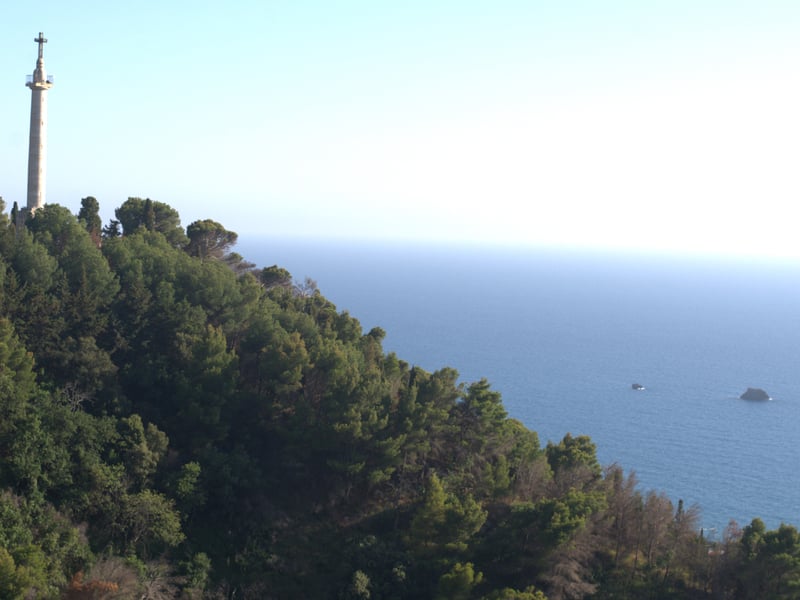
For Mayor Veltri, Bianchi wasn’t a bad man but rather a syndicalist who put the interests of Italian workers and Calabria at the center of his politics. “You could take the statue and move it to a less frequented place,” he said with a shrug — but he didn’t think that was the right approach. “We need to remember our history, so that we can look toward the future in the right way.”
Veltri dismissed calls by left-wing groups to include signs and information at the mausoleum highlighting crimes committed by the Mussolini dictatorship. “There are better suited places to protest,” he said. In his view, it wouldn’t be appropriate to turn the mausoleum into an anti-fascist emblem.
He said work to restore the mausoleum and build a Bianchi museum would move ahead this summer with local and national funds. “If people want to visit it, why not let them?” he said. “It should be made into a tourist attraction.”
If the Bianchi mausoleum takes off as a tourist site, it wouldn’t be alone. Numerous fascist-era buildings and public works in northern Italy — deemed cutting-edge for their time — are popular tourist destinations, Veltri said. Among them: the tomb of Mussolini himself.
As for this particular monument, Veltri had fond memories. “When we were children,” he said, “schools went on field trips to the monument, and they went all the way to the cross to look out at the panorama.” He added admiringly: “It’s an imposing structure looming over the Tyrrhenian coast.”
Courthouse News reporter Cain Burdeau is based in the European Union.
 Follow @cainburdeau
Subscribe to our free newsletters
Our weekly newsletter Closing Arguments offers the latest about ongoing trials, major litigation and rulings in courthouses around the U.S. and the world, while the monthly Under the Lights dishes the legal dirt from Hollywood, sports, Big Tech and the arts.