
 Search Articles


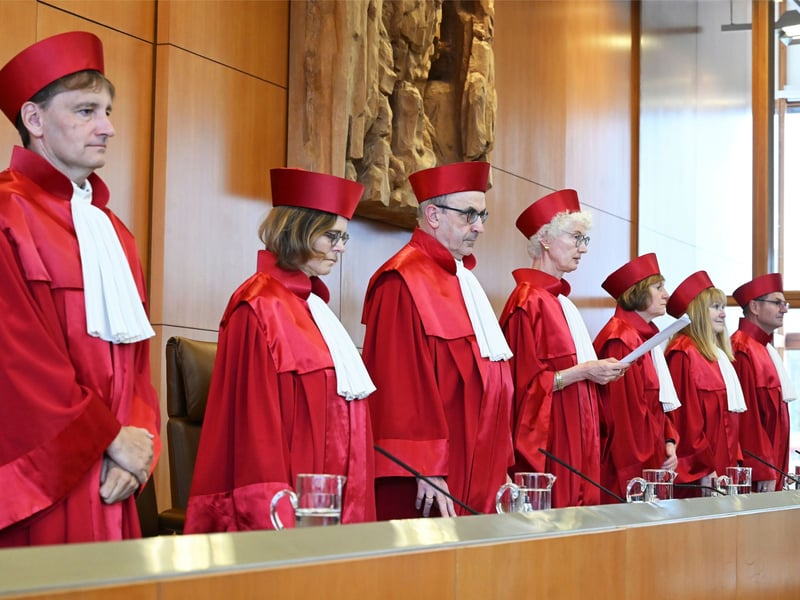
(CN) — Something unusual is happening in Germany: A nominee for the country’s highest court, the Federal Constitutional Court, is at the center of a major political row reminiscent of the toxic culture wars over U.S. Supreme Court picks.
On Friday, Germany’s ruling conservatives abruptly nixed a Bundestag vote on three nominees to the court after it became apparent that Frauke Brosius-Gersdorf, a law professor nominated by the center-left Social Democrats, would not be confirmed after she came under attack by a right-wing media campaign as “ultra-left” for her views on abortion and gender equality. Bloggers also sought to damage her by claiming she’d plagiarized parts of her dissertation by using material from her husband’s thesis.
Also making Brosius-Gersdorf a target, she backed compulsory vaccination during the Covid-19 pandemic and supports banning the far-right Alternative for Germany. That party, better known as the AfD, is the country’s second-most popular political party but it was recently declared a danger to German democracy by the domestic intelligence agency.
Alexander Clarkson, an expert on German politics at King’s College London, said many Germans are disturbed by the controversy over Brosius-Gersdorf because they worry Germany’s judiciary, praised for its independence, may be at risk of becoming politicized in a fashion that mirrors the United States.
“The fights over the Supreme Court are held up as an example of what Germany is supposed to avoid,” Clarkson said, speaking by telephone. “Everybody keeps referring to the States as an example of how dysfunction can lead to a potential collapse of democracy.”
Maxim Bönnemann, the chief editor of Verfassungsblog, an online legal forum and publisher based in Germany, said judicial appointments to the Federal Constitutional Court have rarely become politicized. He said the last time a candidate turned so controversial was in 2008.
“Usually, the elections are supported by broad consensus,” he wrote in an email. “The focus has been on the professional qualifications of the candidates — mostly either judges or professors of law — rather than genuinely political issues.”
It’s widely accepted that the Constitutional Court “should not be seen as a political actor, but rather as an independent institution committed solely to (constitutional) law,” he added.
“In general, judicial personalities — unlike in the U.S. — play a minimal role in Germany,” he said. “Typically, judicial appointments to the Federal Constitutional Court do not receive broad public attention. Very few people know the names or positions of sitting justices.”
This uproar over Brosius-Gersdorf has the potential to be deeply damaging for the coalition government led by the center-right Christian Democrats with the Social Democrats serving as the junior partner. The government has been in office for only 71 days.
On Tuesday, Brosius-Gersdorf, a 54-year-old legal scholar at the University of Potsdam, came out swinging back at her critics.
She called the media reports about her “inaccurate and incomplete” and said her body of legal writings showed she was a moderate.
“It was not fact-based, but rather driven by the goal of preventing the election,” she wrote in a statement. “Labeling me as ‘ultra-left’ or a ’left-wing radical’ is defamatory and not true.”
The campaign against her was cheered on by the Alternative for Germany and spearheaded by Christian fundamentalists who portrayed her as an “abortion activist” who wants to “deny fetuses basic rights” and legalize abortion up until birth.
Brosius-Gersdorf said her critics falsely portrayed her stance on abortion as denying “human dignity” to fetuses. Instead, she said her legal research sought to find solutions to questions about when abortion should be permissible, such as when the health of a pregnant woman is at risk.
“Human life is entitled to the fundamental right to life from the moment of implantation,” she wrote. “I have always advocated for this.”
Later Tuesday, she was set to appear on “Markus Lanz,” a major television talk show. She has been widely defended by legal scholars.
Bönnemann said “the scale and intensity of the attacks are unprecedented.”
“Brosius-Gersdorf is a renowned professor of constitutional law,” he said. “Anyone familiar with her writings knows that the accusations from the CDU that she is ‘radical left’ or ‘ultra-left’ are detached from reality.”
Bönnemann dismissed the notion that Brosius-Gersdorf’s election to the 16-judge court could swing decisions toward a progressive agenda. Judges on the court serve 12-year terms and must retire at age 68.
“The idea that individual judges can ‘swing’ decisions in a progressive or conservative direction is mostly foreign to German constitutional culture,” he said. “Overall, political ‘camps’ or ‘majorities’ play a far less important role on the Court than in the U.S.”
It remains unclear what will happen to Brosius-Gersdorf’s nomination with furious Social Democrats seemingly unwilling to withdraw their pick.
German Chancellor Friedrich Merz, the leader of the conservatives, postponed a vote until September. Right-wing factions within Merz’s party, reacting to a social media storm over the nominee, forced Merz to cancel the vote.
This right-wing bloc’s frustrations can be traced back to former Chancellor Angela Merkel and her move to stay in power through so-called “grand coalition” governments that aligned her Christian Democratic Union, or CDU, with the Social Democrats. In doing so, she naturally had to make concessions to the center left.
“There was a kind of frustration that the CDU was not doing proper right-wing conservative politics,” Clarkson said.
Upon taking the party’s helm, Merz promised to be more conservative, but he too was forced into a grand coalition after failing to win a majority in parliament. The Christian Democrats, like Germany’s other major parties, have until now refused to govern with the Alternative for Germany, though that firewall is eroding.
The Brosius-Gersdorf affair, then, can be seen as evidence that some Christian Democrats see going into government with the far right as an option.
“The AfD always wanted to politicize the judiciary,” Clarkson said. “There’s a worry that this isn’t just about the AfD anymore. There’s also conservative factions of the CDU who want to politicize the judiciary.”
He said the conflict shows parts of the CDU are eager to sabotage Merz’s coalition with the Social Democrats.
“They want to create an environment where at least large parts of the CDU increasingly think that coalition with the AfD is actually OK and does not endanger the state of the constitution,” Clarkson said. “I would disagree with that, but part of that strategy in working with the AfD is to sabotage and undermine the basic functioning of the state.”
Bönnemann said the controversy showed “political debates are becoming more aggressive” in Germany and “that the conventions of parliamentary culture are under pressure.”
“Especially on the right side of the political spectrum —including parts of the governing CDU — there is a desire to break with the old ways,” he said. “The longstanding consensus that the Constitutional Court should be shielded from excessive politicization is eroding. That consensus existed because politicians recognized that an overly politicized court would be dangerous for its legitimacy and independence.”
Courthouse News reporter Cain Burdeau is based in the European Union.
 Follow @cainburdeau
Subscribe to our free newsletters
Our weekly newsletter Closing Arguments offers the latest about ongoing trials, major litigation and rulings in courthouses around the U.S. and the world, while the monthly Under the Lights dishes the legal dirt from Hollywood, sports, Big Tech and the arts.