
 Search Articles


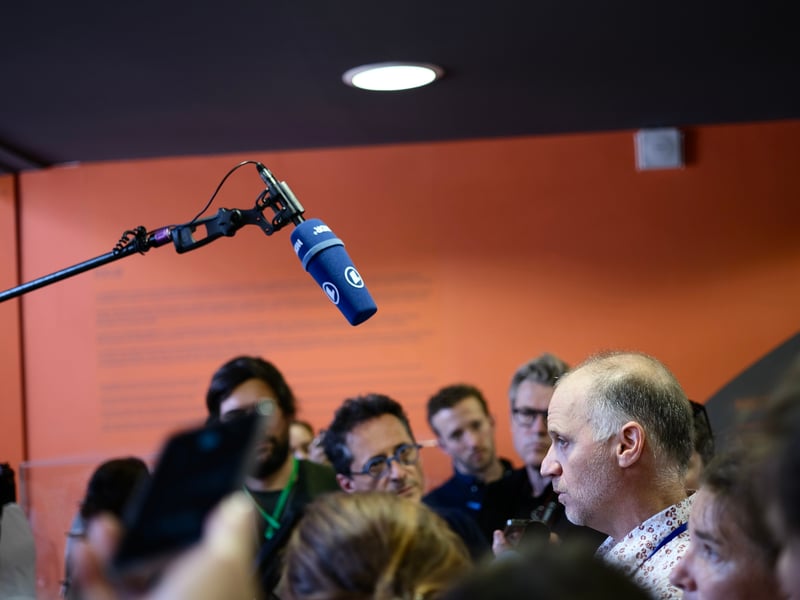
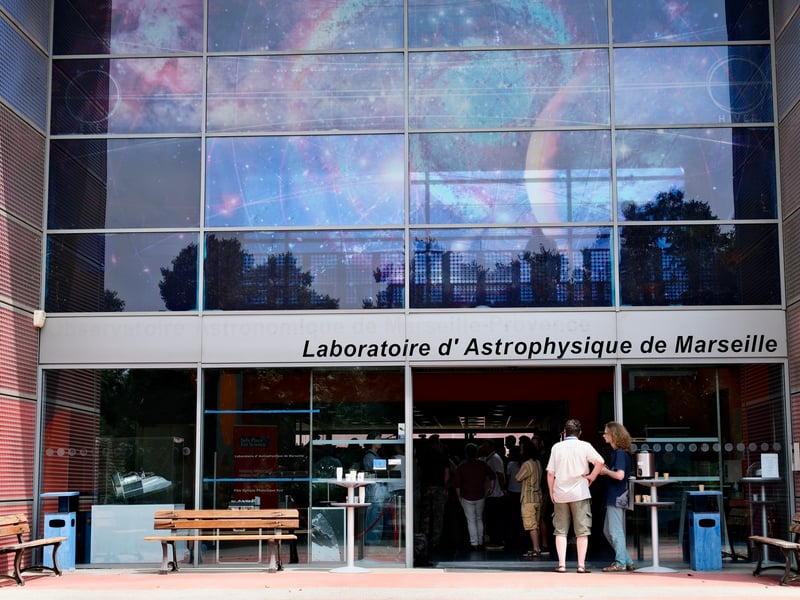
MARSEILLE, France (CN) — On Thursday, Lisa — an American researcher specializing in biological impact, who asked to go by a pseudonym — tensed up in the courtyard of Aix-Marseille University’s astrophysics lab, sitting at a picnic table surrounded by roughly a dozen journalists.
In a shaky voice, she asserted that the reporters around her could not take her photo, even if the footage only showed the back of her head. She feared that losing anonymity could prompt professional consequences in the U.S.
“The worry is, we’ve already seen that scientists are being detained at the border coming into the U.S., granted they are not U.S. citizens,” she explained, when asked if she was afraid to go public. “But they’re even saying now that if you speak out against the government, they will deport you, and I don’t need anything against me at the moment until I can officially move here with my family.”
Lisa is one of the scientists who was accepted into Aix-Marseille University’s Safe Space for Science program, which is devoting $16.3 million in grants to Americans whose research is under threat and will house them over a three-year period. Though she still needs some questions answered before signing the contract, Lisa said, “My plan is just to get out [of America] if I can.”
Thursday’s event was presented as a welcoming ceremony for the American researchers arriving in Marseille. However, in the morning, the press was informed that only eight scientists were currently on the ground, some of whom hadn’t yet been officially accepted into the program. Official decisions will be made in mid-July, and the full group of around 20 people will arrive in September at the earliest.
Most of the scientists had apprehensions about talking to reporters; in response to interview requests, some asked to withhold or change their names, while others gave a flat “no.”
The reactions highlighted the line that many American scientists have to toe: being too outspoken about the Trump administration’s crackdown on research could jeopardize current or future work opportunities in the U.S.
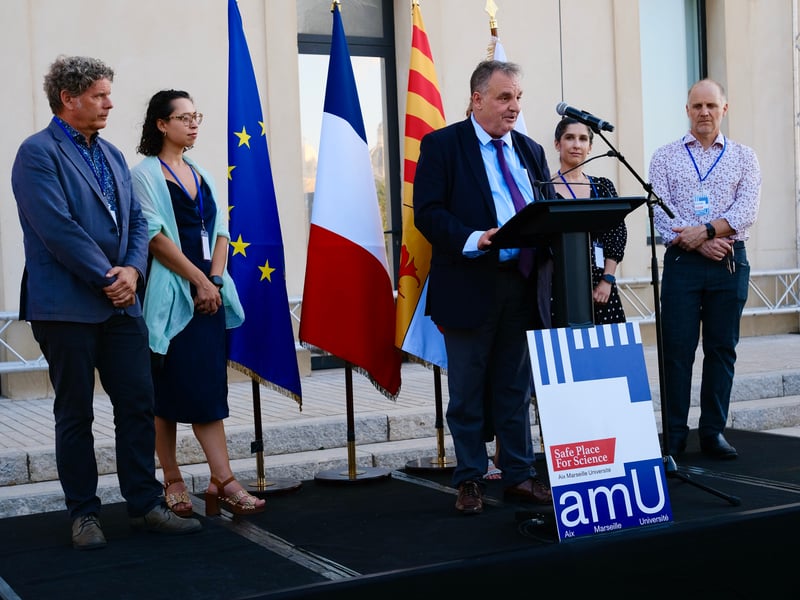
When Eric Berton, the president of Aix-Marseille University, took the podium in a welcome address on Thursday, no one had to read between the lines to find political messaging. He began by telling a story about how a colleague who had worked with Americans for a long time suddenly found his funding suspended a few months ago. It wasn’t because his work was scientifically contested, Berton added, but because “it no longer corresponded to what some people wanted to hear.”
“Years of work are being called into question on the basis of simplistic and binary opinions or certainties — but science has nothing to do with opinion,” Berton said. “Incomprehensible political choices, made with brutality, and unprecedented violence in both words and actions… No one could remain indifferent to the upheaval we were experiencing before our eyes, certainly not at Aix-Marseille University.”
Berton continued by drawing a historical comparison to World War II, when America “welcomed exiled researchers, extended a hand to them, and allowed them to continue to keep science alive,” a historical moment that he said is now reversed.
“Many European scientists had to flee their countries to continue working freely, to save their research, their ideas, and sometimes their lives… Many found refuge in the United States,” he said. “Now, in a sad reversal of history, it is some of you, American scientists, who came to France seeking a space of freedom, thought, and research.”
James, an American climate scientist in the final stages of the application process who asked to withhold his last name, told Courthouse News that while his current funding isn’t immediately under threat, he foresees that being the case in the future.
“I feel that this would be a much safer place to continue my research,” he said.
James explained that while climate is an area that is “very much under the bullseye,” so many others are, too. Words have become a huge risk factor for researchers across the board, regardless of official terminology, if they seem to be associated with the political left.
“There are stories of grants having to do with biodiversity having been cancelled, and of course, the reasons for them being cancelled weren’t in fact given,” he explained. “They conflated the idea of social diversity and ecological biodiversity and cancel grants — the word trans, as in transgender people, was used to cancel grants on transgenic mice, for example… they are completely different, of course.”
Some of the scientists on the ground showed apprehension about the program. One woman told reporters that she’d need a longer-term job offer — 10 or 20 years — to make the move, although she told Courthouse News that this hadn’t been presented as a possibility. She added that right now, most of these types of opportunities are coming from China.
“That’s the fastest because China’s just handing out job offers… They’re just going boom, boom, boom,” she said. “A lot of top people have already moved to China, and China’s laying out the red carpet… [To] one Nobel Prize winner in California, the Chinese government said, ‘You can go to any institute you want.’”
The event picked up again at golden hour on the terrace of the Museum of European and Mediterranean Civilizations, known as Mucem, overlooking the Mediterranean.
When Berton took the podium — after explicitly mentioning Trump as the catalyst for this program and a threat to democracy and scientific freedom — he said that he has been working with former French President François Hollande on developing a scientific refugee status, in a text which will be examined by France’s lower house of parliament in September. Five of the American scientists who are primed to join the program were standing by his side.
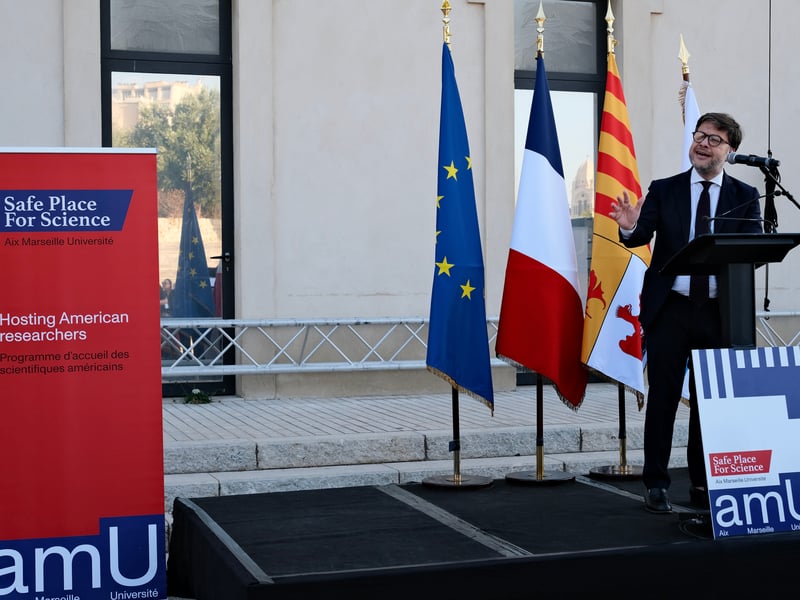
Benoît Payan, the mayor of Marseille, evoked Marseille as a welcoming city by nature and said it could be the most similar French city to the U.S. for its history of embracing immigrants. He waved his arms in the air and passionately praised the beauty of the American dream.
“Trump won’t destroy it,” he said.
 Follow @lilyradz
Subscribe to our free newsletters
Our weekly newsletter Closing Arguments offers the latest about ongoing trials, major litigation and rulings in courthouses around the U.S. and the world, while the monthly Under the Lights dishes the legal dirt from Hollywood, sports, Big Tech and the arts.