
 Search Articles


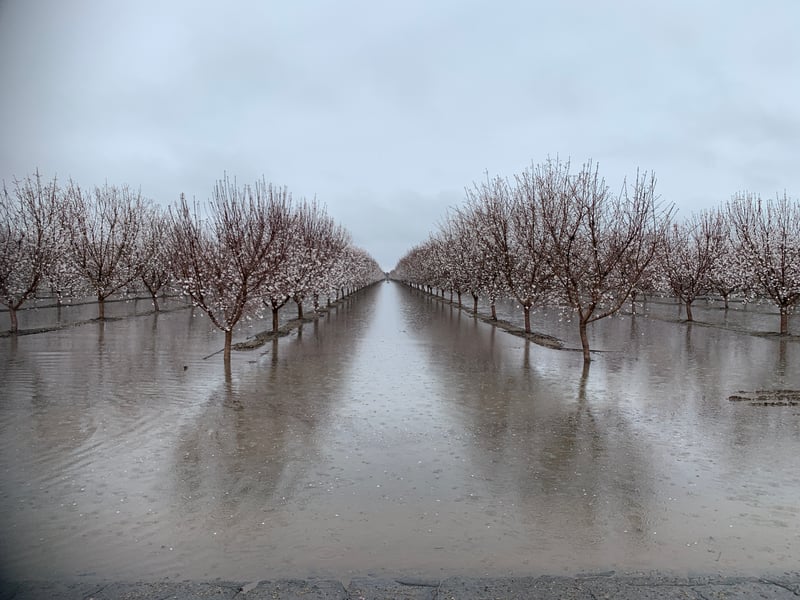
(CN) — A federal lawsuit brought by a prominent almond farmer in California’s central valley against a local water district cleared its first legal hurdle when a federal judge dismissed some of the lawsuit’s claims but allowed two key ones to survive.
Russell Harris, who self-identifies as “The Almond Man,” owns Harris Family Enterprises, which farms more than 17,000 acres of land throughout the central valley and produces millions of pounds of almonds every year. He also hosts a podcast.
In 2021, the Harris sued the Henry Miller Reclamation District, a public water district; the San Luis Canal Company, a private mutual water company that owns water rights; and several key officials of those two organizations, including John Wiersma, the general manager of both the reclamation district and the San Luis Canal Company.
In 2021, Harris purchased some farmland in Merced County from the Gambonis, a longtime farming family. The land had previously been used to grow cotton, but Harris had set his sights on expanding his almond empire.
Since almonds require far more water to grow than cotton — and indeed most other crops — Harris knew he would need more water than the new land “naturally produced.” And so he came up with a plan to build a new “collection and distribution network,” essentially four water crossings under drains and canals controlled by the Henry Miller Reclamation District. To build his crossings, Harris would need approval from both the water district and the San Luis Canal Company, of which he was a shareholder.
Though other farmers had had similar projects approved without much of a fuss, according to Harris’ complaint, his own proposal was met with a series of roadblocks. Concerns were raised about the volume of water to be transported through the crossings. Then the water reclamation board wanted to test the quality of the water. Then, in October 2020, Harris received devastating news from Wiersma: For his project to be approved, he would have to build a 200-acre-foot reservoir — roughly the size of a 200-foot-tall aquarium with the width and length of a football field. According to Harris, such a tank would cost $20 million to build.
In his lawsuit, Harris said the interference was based on “personal animus” against him and had been “orchestrated through” Wiresma. He said he lacked the same kind of “insider connections” with the members of both boards that some of the other farmers in the area had, that the board members “did not like” Harris and that Wiersma even encouraged engineers not to work with Harris. In the complaint, he said at least three other farmers had nearly identical water crossing projects approved by the boards without having to obtain so much as a permit or license. The reason, Harris said, was that the three other farmers had “insider connections.”
Though the complaint was filed in 2021, the case was put on hold in 2022 while the parties entered a long series of settlement negotiations. Those negotiations finally fell apart in 2024, and litigation resumed.
In her ruling, issued on Friday, U.S. District Judge Kimberly Mueller agreed to dismiss the claims made against the individuals acting in their official capacity, as well as four due process claims from the complaint, finding that Harris’ “constitutionally protected property interest” had not been harmed by having his project denied. But Mueller denied the defense motion to dismiss Harris’ two other equal protection claims. The courts have held that, according to the 14th Amendment, “all persons similarly situated should be treated alike.” Mueller accepted, at this stage of the pleadings, Harris’ argument that the water district and the San Luis Canal Company had “intentionally treated him differently from the comparators.”
“Harris alleges he is the only one who was required to actually obtain a license, and he was the only one required to build a reservoir,” Mueller wrote in her ruling. “Taking all of Harris’s allegations as true, as the court must do at this stage, the only reason the court can find for Harris’s differential and detrimental treatment is that he either lacked the requisite insider connections with the [water district] or that members of the [boards] had animus towards Harris.”
The case can now proceed to trial, with two out of six claims still remaining. Judge Muller also ruled that Harris can continue to seek punitive damages against the San Luis Canal Company, though not against the water district.
 Follow @hillelaron
Subscribe to our free newsletters
Our weekly newsletter Closing Arguments offers the latest about ongoing trials, major litigation and rulings in courthouses around the U.S. and the world, while the monthly Under the Lights dishes the legal dirt from Hollywood, sports, Big Tech and the arts.