
 Search Articles


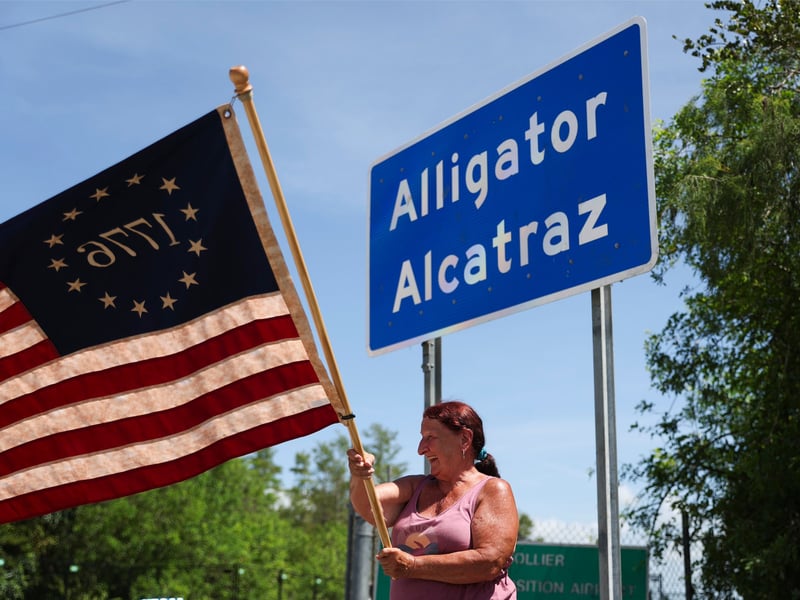
(CN) — A federal appeals court Thursday blocked a lower court’s ruling shutting down the South Florida migrant detention center known as “Alligator Alcatraz," prolonging the legal fight between environmental groups and state officials.
In the divided 2-1 decision, a panel of the 11th Circuit Court of Appeals ruled state officials “unilaterally” controlled the detention center, therefore barring the environmental groups’ claims that the site violates federal environmental laws. The appeals court decision allows the facility to continue operating while the lawsuit continues through the appellate process.
In response to the appellate panel’s ruling, Florida’s Republican Governor Ron DeSantis said in a social media post: “The mission continues at Alligator Alcatraz.”
In his social media post, Florida Attorney General James Uthmeier called the stay “a win for Florida and President Trump’s agenda.”
The ruling is a blow to Friends of the Everglades, the Center for Biological Diversity and the Miccosukee Tribe of Florida, who filed the lawsuit against state and federal officials for building the detention center without first going through any environmental review as required by the National Environmental Policy Act and the Endangered Species Act.
“The case is far from over,” said Eve Samples, executive director of Friends of the Everglades in a statement. “In fact, it’s just starting, and we’re committed to fighting on.”
“In the meantime, if the DeSantis and Trump administrations choose to ramp operations back up at the detention center, they will just be throwing good money after bad because this ill-considered facility — which is causing harm to the Everglades — will ultimately be shut down,” she added.
Late last month, U.S. District Judge Kathleen Williams told state and federal officials to transfer inmates and remove generators, gas, lighting and sewage fixtures from the hastily built site in the middle of the Everglades within 60 days.
“Every Florida governor, every Florida senator, and countless local and national political figures, including presidents, have publicly pledged their unequivocal support for the restoration, conservation, and protection of the Everglades. This order does nothing more than uphold the basic requirements of legislation designed to fulfill those promises,” Williams, a Barack Obama appointee, wrote in her Aug. 21 decision.
Uthmeier immediately appealed to the 11th Circuit, contending that the detention center is operated by the Florida Division of Emergency Management and has yet to receive any federal funding.
The majority of the appeals court panel agreed.
“The facility is a site built, led, operated and funded unilaterally by a state government — in accordance with the state’s laws — at which the state retains discretionary control over who is detained at the facility, all of which adds up to state control over the project’s outcome, not federal control,” wrote U.S. Circuit Judge Barbara Lagoa, a Donald Trump appointee.
Lagoa also criticized the lower court’s ruling of totally dismantling the detention center as overly broad.
“It is entirely unclear to us, moreover, how the district court concluded that it could order the proactive dismantling of the facility by way of a mandatory preliminary injunction,” she wrote. “If there were a substantial likelihood that the plaintiffs would succeed on their NEPA claim (and as we’ve already explained, there isn’t), the appropriate remedy at this stage might, at most, have been to enjoin the further use of or construction at the Facility pending completion of an [environmental impact statement], not the affirmative expenditure of public monies to take it apart.”
U.S. Circuit Judge Elizabeth Branch, also a Trump appointee, joined the majority.
The lone dissenter on the panel, U.S. Circuit Judge Adalberto Jordan, wrote state and federal officials publicly said the federal government would fund the facility.
“First, the detention facility at the site was built at the request of DHS and used for a federal purpose — to house federal immigration detainees,” the Barack Obama appointee wrote. “Second, public statements regarding the federal government’s commitment to fund the facility — including some made pre-construction — permitted the district court to find as a matter of fact that a concrete federal funding decision had indeed been made.”
Jordan also added the majority did not factor in the “irreparable harm” to the environment as determined by several experts who testified at the lower court hearing.
“I will assume that the majority is right in concluding that the state and federal defendants will suffer some harm absent a stay,” he wrote. “But this cannot be the end of the analysis.”
Three months ago, in response to Trump’s immigration crackdown, DeSantis and Florida’s attorney general proposed the idea of a detention center in the Everglades and used emergency powers to acquire the Dade-Collier Training and Transition Airport, a small runway surrounded by the Big Cypress National Preserve and Everglades National Park.
Within days, trucks carrying prefabricated housing, generators, security lighting and fill dirt entered the area and workers hastily set up tents and trailers to house those arrested by immigration authorities and state law enforcement.
Trump visited the facility on July 1 — the day before the first detainees arrived — and told reporters, “We’re going to teach them how to run away from an alligator if they escape prison.”
Since then, environmental activists, indigenous tribes, Democratic state lawmakers and members of Congress have decried the detention center as inhumane and detrimental to the ecosystem, pointing to reports of flooding, pest infestations, sewage backups and light pollution.
 Follow @alexbpickett
Subscribe to our free newsletters
Our weekly newsletter Closing Arguments offers the latest about ongoing trials, major litigation and rulings in courthouses around the U.S. and the world, while the monthly Under the Lights dishes the legal dirt from Hollywood, sports, Big Tech and the arts.