
 Search Articles


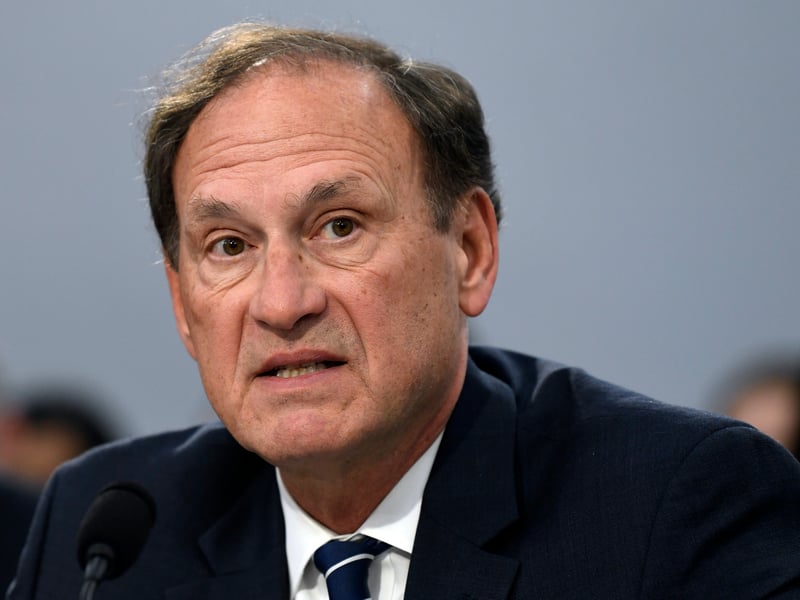
WASHINGTON (CN) — Justice Samuel Alito rejected calls to recuse from cases tied to the Jan. 6 Capitol riot on Wednesday, claiming that flags used by far-right political activists flown outside his homes did not warrant stepping away from two upcoming rulings.
“I am confident that a reasonable person who is not motivated by political or ideological considerations or a desire to affect the outcome of Supreme Court cases would conclude that the events recounted above do not meet the applicable standard for recusal,” the George W. Bush appointee wrote in a letter to lawmakers. “I am therefore required to reject your request.”
Alito blamed his wife, Martha-Ann Alito, for flying two flags that were protest symbols for Capitol rioters and the “Stop the Steal” movement outside his residences. Alito said his wife had a First Amendment right to her views, which do not impact his work on the court.
“My wife is fond of flying flags,” Alito wrote, noting her proclivity for patriotic, college, sports, seasonal and religious flags. “I am not.”
Earlier this month, the New York Times reported that an upside-down flag was flown at Alito’s Virginia residence after Jan. 6, 2021. Historically a sign of distress, supporters of President Donald Trump brandished the same symbol during the riot at the U.S. Capitol aimed at blocking the certification of the 2020 election.
While the inverted flag flew above his house, Alito and his colleagues were deciding whether the court would hear a challenge to the election. Alito said the case presented an important constitutional question in a dissent to the court’s decision not to hear the case.
Alito told lawmakers that his wife flew the upside-down flag after a neighbor displayed a sign attacking her personally. Alito accused the neighbor of berating his wife using “the vilest epithet that can be addressed to a woman.”
The neighbors in question disputed parts of Alito’s story, claiming that Martha-Ann Alito chased them down the street and spit toward their car.
Alito said he’d asked his wife to remove the flag but that she refused. Alito said that since they owned the home jointly, she had the right to fly the flag on the property.
Additional reporting showed that the Alitos flew another Jan. 6 symbol at their New Jersey vacation house. Photos from neighbors and Google Steet View images showed an “Appeal to Heaven” flag flying at the home in July and September of 2023.
Capitol rioters used the Appeal to Heaven flag as a symbol of support for Trump. The Revolutionary War relic was adopted by a sect of the “Stop the Steal” campaign pushing to remake the American government in Christian terms.
Alito said that neither he nor his wife were aware of the flag’s connection to Trump supporters. He noted that Martha-Ann Alito owned the couple’s vacation home.
Senate Majority Whip Dick Durbin and Rhode Island Senator Sheldon Whitehouse, both Democrats, urged Chief Justice Roberts last week to sideline Alito from any Supreme Court cases related to the 2020 presidential election or the Capitol riot.
“By displaying or permitting the display of prominent symbols of the ‘Stop the Steal’ campaign outside his homes, Justice Alito clearly created an appearance of impropriety,” the lawmakers wrote in their Friday letter to Roberts, who also oversees the U.S. Judicial Conference.
In the next few weeks, the court is scheduled to decide whether Capitol rioters can face felony obstruction charges. The justices ruling could influence hundreds of Jan. 6 prosecutions, including Trump’s D.C. election subversion charges. In a separate case, the justices will decide if Trump can use a presidential immunity claim to avoid these charges altogether.
Last year, the court agreed to an ethics code after reports accused several justices — including Alito — of violating laws and standards followed by the rest of the judiciary. In his letter to lawmakers, Alito said the two flag incidents did not meet the conditions for recusal under the code’s disqualification clause.
Justices are required to recuse from a case if their impartiality might reasonably be questioned. Alito said he was confident that a reasonable person could not think the political flags flown at his houses would impact his work on the court.
“The two incidents you cite do not meet the conditions for recusal set out in (B)(2), and I therefore have an obligation to sit under (B)(1),” Alito wrote referring to the disqualification rule.
Durbin and Whitehouse accused the Supreme Court and Judicial Conference of refusing to take adequate steps to investigate a stream of ethically questionable conduct from the justices, adding that Congress would be forced to step in if nothing changes.
“Until the court and the Judicial Conference take meaningful action to address this ongoing crisis,” they said, “we will continue our efforts to enact legislation to resolve this crisis.”
Last year, Alito rejected another recusal request from Durbin in a sharp statement questioning lawmakers’ understanding of the court’s work.
Durbin, who chairs the Senate Judiciary Committee, did not immediately return a request for comment on Alito’s response. The Illinois senator has so far signaled that his panel will not investigate the displays of so-called “Stop the Steal” symbols outside Alito’s home.
Still, the top Democrat has backed at least one bill aimed at strengthening the Supreme Court’s ethical guidelines.
The Judiciary Committee last summer narrowly approved Whitehouse’s Supreme Court Ethics, Recusal and Transparency, or SCERT, Act. The sweeping legislation would force the high court to develop an enforceable code of ethical conduct and open the process up for public comment.
The measure would also establish a mechanism for investigating allegations of ethical misconduct on the court and would force justices to publicly explain themselves if they decide to recuse from a case.
A push for ethics reform at the Supreme Court is also gaining momentum in the House. Georgia Representative Hank Johnson, a Democrat, earlier this month unveiled the lower chamber’s new Court Reform Now task force, which he said would support legislation to rein in what he called “judicial activism and legislating from the bench.”
The House working group, which includes other prominent Democrats such as Maryland Representative Jamie Raskin and Texas Representative Jasmine Crockett, has backed the SCERT Act.
In a statement Wednesday, Johnson said that Alito’s “unilateral and final decision as judge and jury over our recusal request demonstrates the urgent need for Congress to pass legislation that imposes on Supreme Court justices a code of conduct with an enforcement mechanism.”
“[A]ny unbiased and reasonable person would find laughable Justice Alito’s ‘the dog ate my homework, and I didn’t even know I had homework’ defense,” the congressman added.
Congressional Republicans, meanwhile, have been intensely critical of Democrats’ scrutiny of Supreme Court justices, accusing their colleagues of working to discredit the high court’s conservative supermajority.
Some GOP lawmakers, including South Carolina Senator Lindsey Graham, have even argued Democrats are trying to build a pretext to expand the Supreme Court and balance out the bench with liberal justices.
 Follow @KelseyReichmann
 Follow @kelseyreichmann.bsky.social
Subscribe to our free newsletters
Our weekly newsletter Closing Arguments offers the latest about ongoing trials, major litigation and rulings in courthouses around the U.S. and the world, while the monthly Under the Lights dishes the legal dirt from Hollywood, sports, Big Tech and the arts.