
 Search Articles


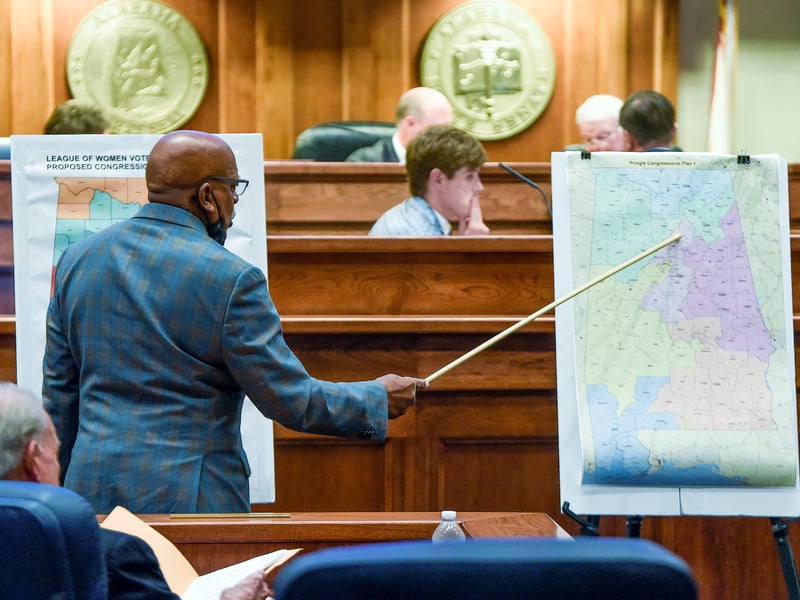
WASHINGTON (CN) — Alabama returned to the Supreme Court on Monday in search of an emergency pause on a court-ordered redraw of its congressional maps.
The state told the court it had created a new map that unified the Black Belt while maintaining communities of interest in Alabama’s Gulf Coast and Wiregrass regions.
“It was not good enough to unify the Black Belt in the 2023 plan,” Edmund LaCour Jr., the state’s solicitor general wrote in the application. “It was not good enough to jettison past district lines, eliminate county splits in the Black Belt, minimize county splits elsewhere, improve compactness, and keep together multiple communities of interest.”
However, the new map was rejected by a three-judge panel because it failed to add a second majority-black district.
“Just the opposite — it would only have been good enough if Alabama drew more sprawling districts, splintered other communities of interest, and spliced counties to attain what the court believed was the ‘required remedy’ of a second majority-black district,” LaCour Jr. wrote.
In one of its closely watching rulings last term, the Supreme Court ruled the state’s congressional maps constituted a violation of the Voting Rights Act. Following the high court defeat, the Republican-controlled Legislature presented a new map, but it did not include a second majority Black district.
On Sept. 5, a three-judge panel said the 2023 congressional maps failed to give Black Alabamians a fair and reasonable opportunity to elect candidates of their choice — a direct contradiction to what the high court ordered them to do in June.
“We do not take lightly federal intrusion into a process ordinarily reserved for the state Legislature,” the panel wrote. “But we have now said twice that this Voting Rights Act case is not close. And we are deeply troubled that the state enacted a map that the state readily admits does not provide the remedy we said federal law requires.”
The panel decided that it would not give lawmakers yet another opportunity to redraw the map and instead decided a court-appointed special master should take over the process. The panel said it did not make that decision lightly and instead was forced because of the extraordinary circumstances the Legislature put them in.
“We are not aware of any other case in which a state legislature — faced with a federal court order declaring that its electoral plan unlawfully dilutes minority votes and requiring a plan that provides an additional opportunity district — responded with a plan that the state concedes does not provide that district,” the panel wrote.
Alabama’s 2021 congressional maps were found to have violated Section 2 of the Voting Rights Act, which prohibits voting practices that discriminate on the basis of race. The 2021 maps only gave Black Alabamaians one majority district out of seven although they make up 27% of the state’s voting-age population. The redraw also split Alabama’s Black Belt, breaking Montgomery into two districts to maintain the Gult Coast district.
Voting rights groups challenged the maps for suppressing the votes of Black Alabamaians and secured a win from a three-judge panel. The Supreme Court agreed to hear the battle setting up a challenge to one of the last vestiges of the Voting Rights Act, and five justices said they would uphold the panel’s assessment.
Just when it seemed the dust had settled, lawmakers unveiled the 2023 map that lacked a second majority Black district. While a district doesn’t have to be majority-minority to satisfy the Voting Rights Act, most legal experts suspected the redraw violated the justices’ order.
The assumption of those experts was confirmed by the three-judge panel this past week.
Following the ruling, Alabama Secretary of State Wes Allen filed an emergency motion for a stay pending appeal in the Northern District of Alabama. Allen argued that Alabama does not have to create a second Black majority district to satisfy Section 2 of the Voting Rights Act.
On Monday, the three-judge panel shot down Alabama’s attempt to put its ruling on pause. The panel said it was “deeply troubled” the state chose to enact a map that violates federal law.
The case sits on the court’s emergency docket. There is no clear timeline for the progression of these cases, but often if the justices are interested they will request additional briefing from parties in the case.
 Follow @KelseyReichmann
 Follow @kelseyreichmann.bsky.social
Subscribe to our free newsletters
Our weekly newsletter Closing Arguments offers the latest about ongoing trials, major litigation and rulings in courthouses around the U.S. and the world, while the monthly Under the Lights dishes the legal dirt from Hollywood, sports, Big Tech and the arts.