
 Search Articles


The medical examiner who performed the autopsy of George Floyd is expected to testify in the Derek Chauvin murder trial Friday afternoon, but prosecutors first called a retiree of his office to present her findings.
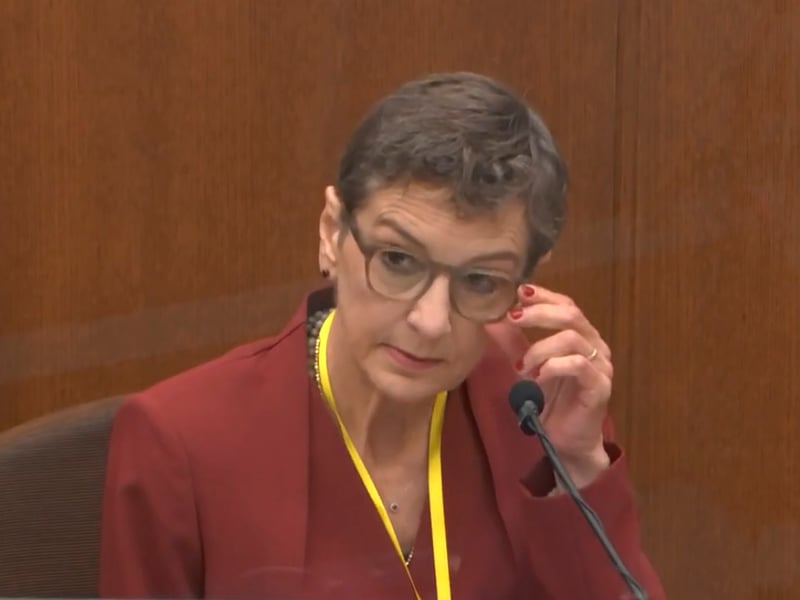
MINNEAPOLIS (CN) — The medical examiner who performed George Floyd’s first autopsy is expected to take the stand Friday afternoon in the murder trial of Derek Chauvin for Floyd’s death, but his onetime mentor appeared first to explain her take on his findings.
Forensic pathologist Dr. Lindsey Thomas, who retired from the Hennepin County Medical Examiner’s Office in 2017 and has since worked in semiretirement as a consultant, said she worked with current chief medical examiner Dr. Andrew Baker in the early years of his career as a medical examiner and considered him a friend.
She made some divergences, though, from Baker’s earlier statements about the case. The medical examiner told the FBI in early meetings after Floyd’s death that he’d found no evidence of asphyxiation and was skeptical that Chauvin’s hold on Floyd was particularly dangerous. That presents an issue for the prosecution, whose medical experts spent Thursday explaining how and why they believed asphyxia, triggered by law enforcement restraint, killed Floyd.
It’s unclear whether Baker is expected to stick by those statements. He made them, and completed Floyd’s autopsy, before watching any video of Floyd’s death. Thomas, by contrast, said she’d made her evaluations based in large part on adding video evidence to that used for the initial autopsy.
She noted on direct examination that the cause of death Baker listed for Floyd, cardiopulmonary arrest, did not rule out asphyxia. “In a way, everyone dies of it – when your heart stops, and your lungs stop, it’s cardiopulmonary arrest,” she said. “This is a death where both the heart and lungs stopped working, and the point is that it’s due to law enforcement subdual, restraint and compression.”
By the time forensic pathologists like herself and Baker interacted with a patient, she said, the actual mechanics of breathing and oxygen intake aren’t easily studied, and they aren’t the focus of medical examiners’ expertise. “By the time I see [patients], none of that applies,” she said.
As to asphyxia, she said, the term doesn’t come up much in autopsy reports. “I tend not to use the word asphyxia much, because it requires a lot of explanation. It doesn’t really offer much additional information, unless you have a chance to have a discussion like we’ve had,” she told prosecutor Jerry Blackwell. Even in cases of hangings, she said, medical examiners often prefer to describe the hanging itself over the actual mechanisms of death.
She also ruled out some of defense attorney Eric Nelson’s proposed causes of death, including a drug overdose or heart attack. Mentions of preexisting heart disease and the presence of fentanyl and methamphetamine on the autopsy report as contributing causes, she said, are the kind of data medical examiners and coroners include in the interest of providing a complete picture for scientists who may use that data in the future.
On cross-examination, Nelson sought to reintroduce the possibility of a drug overdose and push against Thomas’ contention that the prone restraint Chauvin and his fellow officers put Floyd in was dangerous. He pointed to a Canadian study which found that no deaths resulted from over 3,000 prone-position placements by law enforcement.
“Isn’t that amazing, when you consider that virtually every forensic pathologist in the U.S. has probably had an officer-involved death like this?” Thomas replied before being silenced by Cahill for argumentative testimony.
Nelson also pointed to Thomas’ stated opinion that Floyd’s heart was slightly enlarged, which she acknowledged, and the discovery that Floyd had narrowed coronary arteries. Thomas agreed that narrowed arteries were a risk factor for a heart attack, but that plenty of people lived with them without issue.
He also emphasized her testimony that methamphetamine did not have a “safe” dosage. “It doesn’t exclude the possibility that it could increase the heart rate?” he asked.
“It could. Or not,” Thomas replied.
Both attorneys briefly questioned Thomas a second time before Cahill dismissed her and called a lunch break. Court is scheduled to resume Friday afternoon.
Pool reporters also noted that someone was in the chair reserved for a Chauvin family member for the first time since trial began. The woman, who wore a wedding ring and appeared to be of Asian or Pacific Islander descent, was not identified.
Subscribe to our free newsletters
Our weekly newsletter Closing Arguments offers the latest about ongoing trials, major litigation and rulings in courthouses around the U.S. and the world, while the monthly Under the Lights dishes the legal dirt from Hollywood, sports, Big Tech and the arts.