
 Search Articles


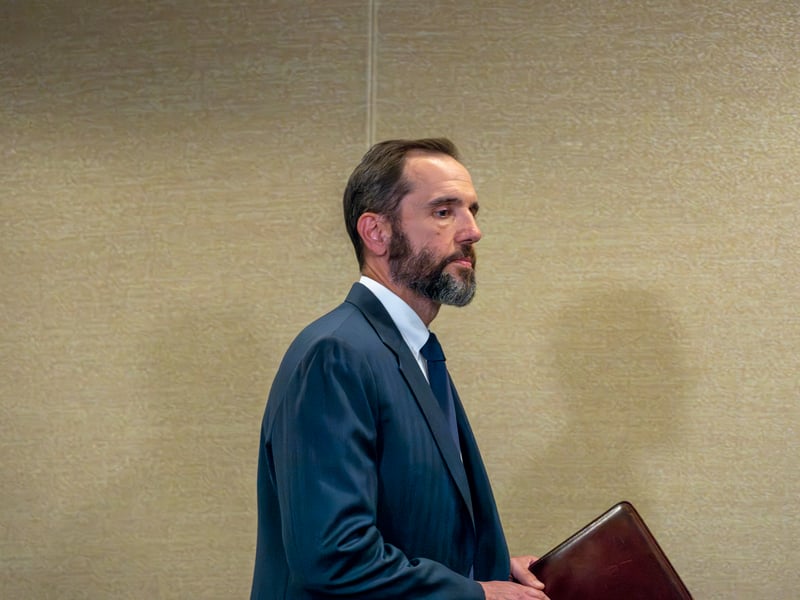
WASHINGTON (CN) — Following a failed last-minute effort by Donald Trump to block its release, Attorney General Merrick Garland made public early Tuesday morning the culmination of former special counsel Jack Smith’s investigation into the president-elect’s efforts to overturn his 2020 electoral defeat.
The 174-page final report — a common practice for special counsels after completing their investigations regardless of outcome —provides the most extensive detailing of how Trump tried to enlist the Justice Department, loyalists in Congress, former Vice President Mike Pence and, when all else failed, a mob of his supporters to remain in power.
Smith defended his decision to bring charges against the president-elect and argued that, had Trump lost the November election, prosecutors would have had ample evidence to secure a conviction on four federal charges: conspiracy to defraud the United States, conspiracy against rights, conspiracy to obstruct and outright obstruction of an official proceeding.
“The department’s view that the Constitution prohibits the continued indictment and prosecution of a president is categorical and does not turn on the gravity of the crimes charged, the strength of the government’s proof, or the merits of the prosecution, which the office stands behind fully,” Smith wrote. “Indeed, but for Mr. Trump’s election and imminent return to the presidency, the office assessed that the admissible evidence was sufficient to obtain and sustain a conviction at trial.”
Smith rejected Trump’s repeated assertions that his prosecutorial decisions to bring the election subversion case and the classified documents case were politically motivated by President Joe Biden or by Trump’s political enemies as “laughable.”
Trump slammed the report’s release in an early morning post on Truth Social, misconstruing the timing of the release as Smith’s decision. As the letter states, Smith submitted the report on Jan. 7 to Garland, who made the decision.
“To show you how desperate Deranged Jack Smith is, he released his fake findings at 1:00 a.m. in the morning. Did he say that the Unselect Committee illegally destroyed and deleted all of the evidence,” Trump falsely claimed.
Smith revealed that he and his team considered charging Trump with violating the Civil War-era Insurrection Act. A conviction under that law would have barred Trump from holding elected office.
Smith said that, while he had ample evidence to prove Trump had provoked the Jan. 6, 2021, attack, there was no modern precedent to support the charge, and the other four charges were sufficient.
“The office did not find any case in which a criminal defendant was charged with insurrection for acting within the government to maintain power, as opposed to overthrowing it or thwarting it from the outside,” Smith said.
One of the charges, conspiracy against the right to vote and have one’s vote counted, derives from a Reconstruction-era law known as the Ku Klux Klan Act, designed to prosecute KKK members who used violence and intimidation tactics to keep Black Americans from exercising their newly gained rights.
Many of Smith’s findings detailed in the report have been previously made public through the release of a massive immunity dossier in October that sought to shield the case from the Supreme Court’s sweeping presidential immunity decision.
Nonetheless, Tuesday’s report provides the public a full picture of the evidence investigators found that the incoming president tried to use his powers and influence to subvert the electoral process and prevent Biden from replacing him.
Among the findings highlighted in the report: In the months leading up to the November 2020 election, Trump pressured state officials in Republican-led states that he lost, such as Arizona, Georgia and Michigan, trying to force them to replace legitimate electors with Trump’s false slate of electors.
The special counsel wrote that when Trump’s pressure campaign failed, he still tried to move forward with his false elector plan in seven states he lost — Arizona, Georgia, Michigan, Nevada, New Mexico, Pennsylvania and Wisconsin — and have them send fraudulent certifications as if they were legitimate.
Trump and advisers like Steve Bannon and Peter Navarro crafted a plan — known as the “Green Bay Sweep” — to use Pence’s ceremonial role as president of the Senate during the election certification on Jan. 6 to use the fraudulent electoral ballots to hand Trump victory at the last second.
In the days leading up to the certification, Trump tried to pressure Pence, warning that “hundreds of thousands” of people would “hate his guts” if he didn’t cooperate, statements the former vice president cited in his memoir.
The findings show that according to the plan, Republican lawmakers like Texas Senator Ted Cruz and Arizona Representative Paul Gosar would contest their states’ legitimate electoral ballots, claiming election fraud. Then only Pence would have been able to end the crisis by accepting the illegitimate slate.
The plot was halted by the Jan. 6 attack on the U.S. Capitol where Trump encouraged his supporters to “fight like hell” after learning Pence refused to follow through, the special counsel concludes.
Garland’s decision to release the report comes as Trump is set to return to the Oval Office on Monday, after defeating Vice President Kamala Harris handily in November despite juggling two federal and two state criminal cases while campaigning.
Trump and his lawyers Todd Blanche and John Lauro, who represented him throughout the cases, sought to block the report’s release, first in a letter to Garland on Jan. 6 warning the report would “illegally interfere with the presidential transition.”
The president-elect’s co-defendants in his Florida classified documents case, Trump aide Walt Nauta and former Mar-a-Lago property manager Carlos De Oliveira, filed emergency motions in the Southern District of Florida and the 11th Circuit Court of Appeals, requesting injunctions preventing Garland from publicizing both volumes of the report.
U.S. District Judge Aileen Cannon, a Trump appointee, ruled on Jan. 7 to temporarily block the report’s release until three days after the 11th Circuit ruled.
Garland vowed on Wednesday in a brief that he would release the election subversion volume but would only make the Florida classified documents volume available for review by the leadership of the House and Senate Judiciary committees.
On Friday, the 11th Circuit rejected Nauta and De Oliveira’s motion and with Cannon’s ruling the temporary ban ran through Monday.
Cannon then ruled Monday that Garland could release the volume pertaining to the election subversion case and scheduled a Jan. 17 hearing to determine whether to block the classified documents volume.
Since submitting the report to Garland, Smith has resigned from his position as special counsel. Trump had repeatedly said he would fire Smith immediately upon taking office and has vowed to investigate him for “weaponizing” the justice system.
Smith defended his decisions, arguing that his prosecution will be remembered as an effort to uphold the nation’s laws in the historic case, despite the outcome.
“While we were not able to bring the cases we charged to trial, I believe the fact that our team stood up for the rule of law matters,” Smith wrote. “I believe the example our team set for others to fight for justice without regard for the personal cost matters.”
 Follow @Ryan_Knappy
Subscribe to our free newsletters
Our weekly newsletter Closing Arguments offers the latest about ongoing trials, major litigation and rulings in courthouses around the U.S. and the world, while the monthly Under the Lights dishes the legal dirt from Hollywood, sports, Big Tech and the arts.