
 Search Articles



THE HAGUE, Netherlands (CN) — The courtroom in The Hague fell quiet Thursday as judges at the International Court of Justice concluded months of arguments over Myanmar’s treatment of the Rohingya, sending the case out of the spotlight and into a long period of judicial deliberation.
What remains is a stark question with global weight: Whether Myanmar’s actions against the Rohingya crossed the legal threshold set by the 1948 Genocide Convention, the treaty meant to stop — and punish — the crime of genocide.
The hearings marked the first time in more than a decade that the world’s top court examined the merits of a case brought under the Genocide Convention.
Over several days, judges heard opposing arguments from lawyers for Gambia, which brought the case on behalf of the Organization of Islamic Cooperation, and from Myanmar, which rejects the genocide claims and disputes how the evidence should be evaluated.
The Rohingya are a Muslim minority from Myanmar’s western Rakhine State. For decades, they have faced discrimination, denial of citizenship and recurring violence. Tensions escalated in 2016 and 2017, when Myanmar’s military launched large-scale security operations following attacks by Rohingya militants. Villages were burned, thousands were killed and more than 700,000 Rohingya fled to neighboring Bangladesh, leaving more than a million people displaced in total.
United Nations investigators later documented killings, sexual violence, mass displacement and the systematic destruction of villages, determining that the operations showed indications of genocidal intent. Myanmar has denied those findings, saying its military carried out legitimate counterterrorism operations.
Gambia filed the case in 2019. It argues that Myanmar breached its obligations under the Genocide Convention by failing to prevent and punish acts committed against the Rohingya.
The filing was unusual. Gambia is geographically distant from Myanmar and was not directly affected by the violence. But under the Genocide Convention, any state party can bring a dispute over compliance before the court, making the case a test of how far states are willing to enforce their shared duty to prevent genocide.

Opening the hearings earlier this month, Gambia’s justice minister, Dawda Jallow, cast the case as a moral duty rooted in his own country’s experience under authoritarian rule.
“Over two decades of brutal dictatorship have taught us that we must use our moral voice in condemnation of oppression, of crimes against individuals and of groups, wherever and whenever they occur,” Jallow told the court.
Throughout the hearings, Gambia’s legal team argued that Myanmar’s military operations were not isolated abuses, but part of a broader and coordinated campaign against the Rohingya. They urged judges to look past individual incidents and consider the cumulative impact of killings, mass displacement and the conditions imposed on survivors.
Myanmar’s lawyers forcefully rejected that framing. They warned judges against what they described as selective readings of the record and an overreliance on reports from civil society groups.
Christopher Staker, leading Myanmar’s legal team, cautioned that NGO documentation should not be treated as proof without careful scrutiny. “So where a report of an NGO is cited as evidence of a fact, it cannot simply be assumed that the cited report necessarily supports that fact, much less that it proves that fact,” he said.
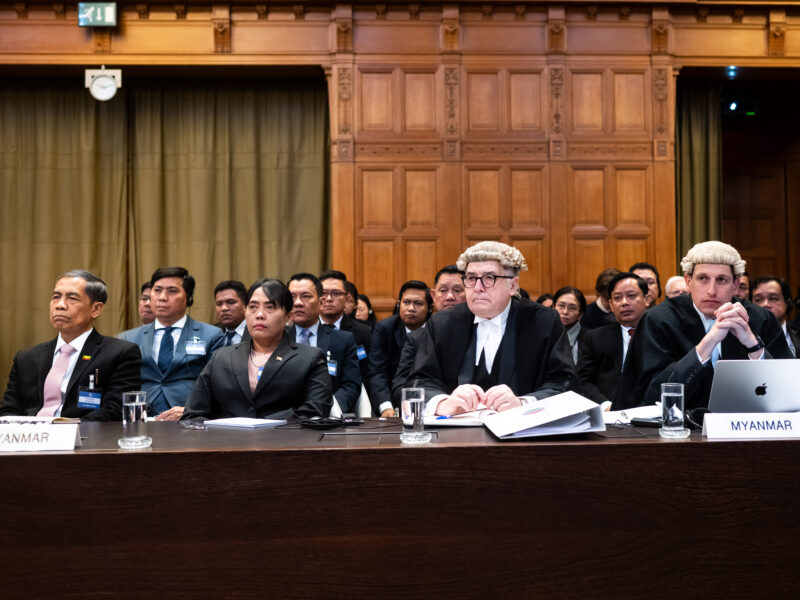
One of the central legal hurdles for Gambia is intent. Under the Genocide Convention, judges must be persuaded not only that prohibited acts occurred, but that they were carried out with the intent to destroy a protected group, in whole or in part. In one of the final exchanges, Gambia’s lawyers pressed the court to confront that standard directly.
“What remains is whether, now that the court has studied the extensive written pleadings and heard the oral arguments, whether the court is ‘fully convinced’ that genocide has been committed,” lawyer Philippe Sands told the judges.
The case arrives at that stage after clearing major procedural barriers. In 2020, the court ordered Myanmar to take emergency steps to prevent acts prohibited under the convention and to preserve evidence. Two years later, judges rejected Myanmar’s attempt to have the case dismissed on jurisdictional grounds, paving the way for the full merits phase that has now concluded.
For Rohingya survivors and their advocates, the hearings carried weight far beyond legal arguments. Matthew Smith, cofounder of Fortify Rights and a member of Gambia’s delegation, said the proceedings marked a long-overdue moment of recognition.
“For Rohingya survivors, this case is not about legal abstractions. It is about whether the world is willing to say, clearly and without equivocation, that what happened to them was genocide and that it carries consequences,” he said.
Smith added that the impact of the hearings is already being felt, regardless of when a final judgment is delivered. “Justice at the ICJ moves slowly, but this process has already helped lock the truth into the historical and legal record,” he said.
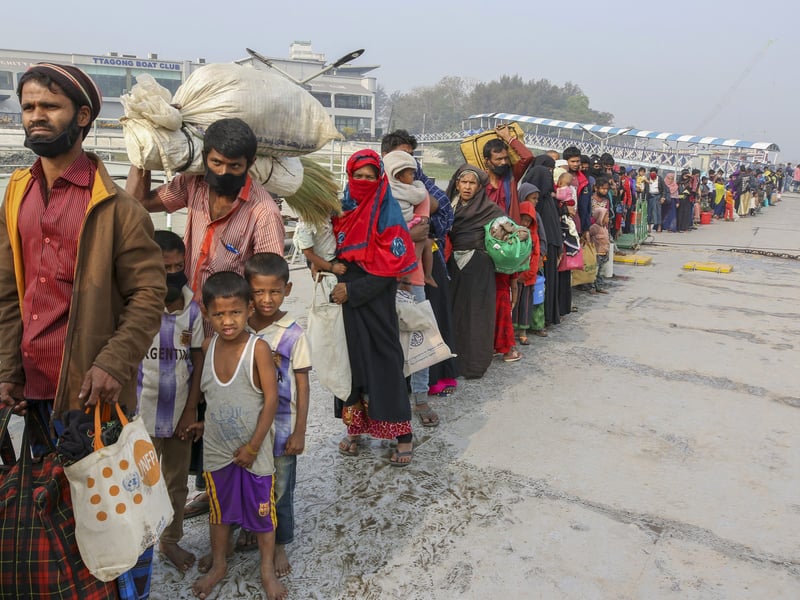
For human rights groups, the hearings mark a rare moment when accountability appears to be moving forward. Maria Elena Vignoli, senior international justice counsel at Human Rights Watch, said the case sends a message that extends far beyond Myanmar.
“Seeing it finally move toward a judgment is a powerful reminder of the ongoing need for justice for the Rohingya and it sends a message that their suffering has not been forgotten,” she said.
With the hearings over, the case now disappears from the public courtroom and into the judges’ deliberation room, a process that can stretch for months or even years. The International Court of Justice does not hold criminal trials or hand down prison sentences. Its role is to decide whether a state has breached international law, and to spell out what legal consequences follow, from ending violations to giving assurances they will not happen again.
A ruling against Myanmar would not trigger arrests or prosecutions. But it would carry heavy legal and political weight, shaping how genocide obligations are understood and reinforcing parallel efforts to pursue accountability elsewhere.
For now, the shift is from speeches to scrutiny. The evidence is on the record, the arguments have been made. The world’s highest court must now decide whether the Rohingya case meets the law’s highest threshold for genocide — and what international law requires if it does.
Courthouse News reporter Eunseo Hong is based in the Netherlands.
Subscribe to our free newsletters
Our weekly newsletter Closing Arguments offers the latest about ongoing trials, major litigation and rulings in courthouses around the U.S. and the world, while the monthly Under the Lights dishes the legal dirt from Hollywood, sports, Big Tech and the arts.