
 Search Articles


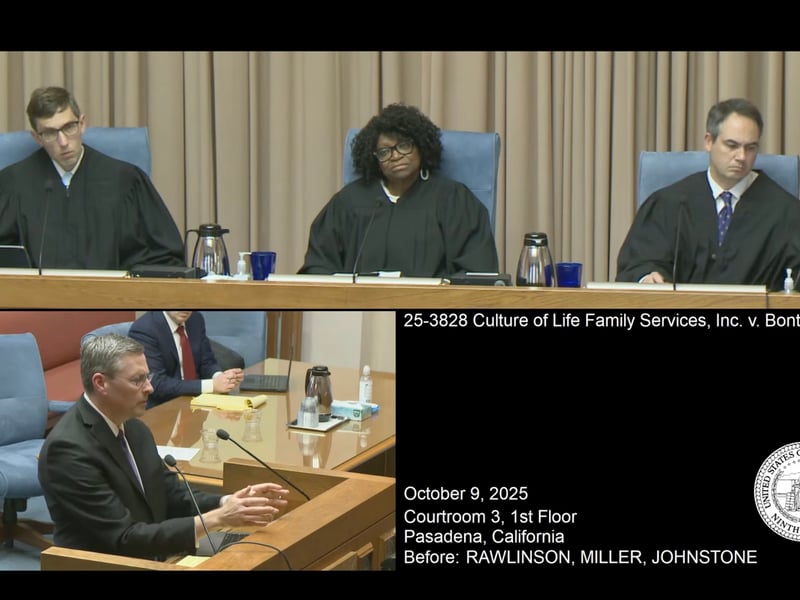
PASADENA, Calif. — Anti-abortion health care providers who offer abortion pill reversal treatments argued that California Attorney General Rob Bonta is unfairly censoring their right to free speech in front of a three-judge panel at the Ninth Circuit Court of Appeals on Thursday.
Both the National Institute of Family and Life Advocates and the Culture of Life Family Services, two faith-based organizations that promote anti-abortion counseling and alternatives to abortion, brought their arguments to the appeals court judges in the hopes of reversing federal court decisions that they say supported Bonta’s actions.
In both cases, the lower court concluded that the organizations that provided the abortion pill reversal treatment were not covered under the First Amendment because their speech was commercial. Attorneys representing the anti-abortion groups argued they were not commercial because they did not stand to gain money from the women seeking the abortion pill reversal.
“Abortion pill reversal is a lawful and lifesaving treatment. It occurs only after a conversation and informed consent from a licensed medical professional,” Caleb Dalton, senior counsel with the law firm Alliance Defending Freedom, said to the appeals judges. “The attorney general is attempting to censor information about that so that conversation never happens.”
The anti-abortion groups’ attorneys argued that their clients offer free or insured abortion pill reversal treatments. In some cases, the organizations only offer information about the treatment offered and how to get it.
“There is never an out-of-pocket payment by a woman,” attorney Peter Breen, who is head of litigation at the Thomas More Society and representing Culture of Life Services, said to the judges.
Breen added that Bonta can’t point to a single woman harmed by the abortion pill reversal.
The treatment itself involves the administration of progesterone, a hormone crucial in the early stages of pregnancy, in an effort to counteract mifepristone, which is an abortion medication used to block progesterone.
However, the treatment is not universally accepted. The attorney general’s office cites several mainstream medical organizations concluded that there is no evidence to support abortion pill reversals in its brief.
The cases stem from a 2023 dispute in Alameda Superior Court when Bonta sued Heartbeat International, a national anti-abortion group, over its social media claims about the efficacy of the abortion pill reversal. Culture of Life Services, which transferred its abortion pill reversal network to Heartbeat in 2018, filed a lawsuit against Bonta, saying the state was censoring information about the treatment.
Federal courts sided with Bonta and denied preliminary injunctions for both the National Institute of Family and Life Advocates and the Culture of Life Family Services initially. The cases were allowed to be heard in the appellate courts earlier this year.
One of the main points attorneys argued on Thursday was whether a free service or treatment could still be considered part of a commercial transaction.
The judges attempted to thread the needle between the abortion pill reversal treatment in conjunction with other services offered by pregnancy centers. U.S. Circuit Judge Anthony Johnstone, a Joe Biden appointee, questioned whether a business giving away one product in order to sell another could be considered commercial.
“The underlying core principles of commercial speech is to protect consumers, not just to ensure the speech rights of the entity advertising,” Deputy Attorney General Erica Connolly said to the appeals judges.
In its answering brief, the attorney general’s office held the opinion that the pregnancy centers, referred to in the document as “crisis pregnancy centers,” used false or misleading statements, such as “safe,” “effective” or “reverse,” with respect to California’s consumer protection laws.
Connolly also took issue with the scientific studies that purport to prove the treatment’s efficacy.
“Advertisements of medical treatments infect the informed consent process,” Connolly told the appeals judges. “They are the harm that is caused. What we are saying is that you cannot advertise that a treatment is safe and effective and that it does something that the scientific evidence does not establish that it does.”
Both cases are among the first in federal court to challenge speech related to abortion pill reversal treatments after the U.S. Supreme Court overturned the landmark abortion-rights case Roe v. Wade in 2022. The Culture of Life Family Services claims in its brief that Bonta began aggressively pursuing anti-abortion groups after the Supreme Court decision.
Subscribe to our free newsletters
Our weekly newsletter Closing Arguments offers the latest about ongoing trials, major litigation and rulings in courthouses around the U.S. and the world, while the monthly Under the Lights dishes the legal dirt from Hollywood, sports, Big Tech and the arts.