
 Search Articles


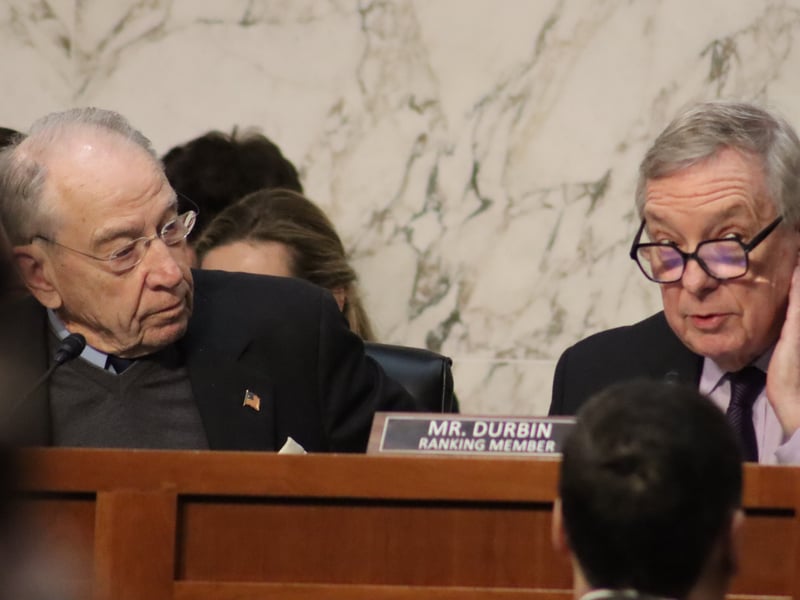
WASHINGTON (CN) — It’s nominations season once again in the Senate Judiciary Committee, where lawmakers once again convened to examine President Donald Trump’s first set of federal court appointments of his second term.
But this week’s group of nominees, which included the president’s pick for a vacancy on the Sixth Circuit and several nominees for federal courts, shared one unique attribute — none had received what has long been a traditional pre-hearing vetting by the American Bar Association.
The ABA, the country’s preeminent legal professional organization, has for decades provided reviews of judicial nominees from presidents of both parties, rating appointments on a scale from “well qualified” to “not qualified.” But the Trump administration last week gutted the organization’s ability to vet its nominees, blocking it from accessing non-public information on would-be judges and instructing nominees not to respond to ABA questionnaires or to sit for interviews with its representatives.
Attorney General Pam Bondi said at the time that the legal organization was overly partisan and no longer a “fair arbiter” of judicial nominees or their qualifications.
That move was welcome news for Republicans on the Judiciary Committee.
“The ABA is an ideologically captured institution, and it has failed in its core mission,” said Missouri Senator Eric Schmitt, who added that the organization had “stayed silent” during the Biden administration but had chosen to speak up against Trump.
Schmitt applauded Bondi’s move to sever the association’s link to the White House, agreeing with her contention that it has long been biased against Republican nominees and that the administration should treat the organization “no differently than any other leftist activist group.”
Utah Senator Mike Lee quipped that the ABA was “about as ideologically evenhanded as the Democratic National Committee.” He said that it was “stunning and alarming” that the organization had been allowed to participate in the judicial selection process in the first place.
The American Bar Association has for decades worked closely with presidential administrations to review the qualifications of judicial nominees. Under former President George W. Bush, the White House stopped giving the organization advance notice of nominations. The practice was briefly revived under the Obama administration, but Trump and Biden both abandoned it again.
Legal scholars, however, have pointed out that this latest move effectively cuts the ABA out of the nominations process completely.
The move to strip the American Bar Association of its role vetting judicial nominees isn’t the Trump administration’s only overture against organizations that have historically provided third-party advice on the judiciary. The attack on the ABA came just days before Trump attacked Leonard Leo, a prominent conservative legal activist whose Federalist Society recommended many of the president’s first-term court picks.
In a post on his social media platform Truth Social last week, Trump called Leo a “sleazebag” and a “bad person,” blaming the Federalist Society for giving him what he viewed as bad advice on nominations. “This is something that cannot be forgotten!” the president added.
Democrats sow doubt on Hermandorfer
Meanwhile, Trump’s Sixth Circuit nominee Hermandorfer, herself affiliated with the Federalist Society, was subjected to close scrutiny during her nomination hearing in the Judiciary Committee. Among other things, Senate Democrats needled the nominee on her work as director of the strategic litigation unit in Tennessee’s attorney general’s office.
Senate Minority Whip Dick Durbin, the top-ranking Democrat on the panel, questioned Hermandorfer about her involvement in a Supreme Court amicus brief supporting the Trump administration’s order rolling back birthright citizenship for the children of immigrants — a move that the high court ultimately rejected.
Hermandorfer told Durbin that while the justices ultimately struck down the birthright citizenship order, Tennessee’s friend-of-the-court brief was called out as “especially well-written” and that it had been mentioned in court hearings.
“I’m hopeful that we provided helpful information as the court considered its decision,” she said. “All you can ask is to ensure the court has all the information as it deliberates.”
Durbin also grilled Hermandorfer on her involvement with the Teneo Network, a conservative networking organization also founded by Leo. The nominee told him that it had been recommended to her by colleagues and that she was a new member who had not had “meaningful involvement” with the group.
Delaware Senator Chris Coons noted what he called the “striking brevity” of her professional record.
Before joining the Tennessee attorney general’s office, the nominee was a law clerk for now-Supreme Court Justice Brett Kavanaugh while he was a judge on the D.C. Circuit Court of Appeals. She also clerked for Justice Samuel Alito and Justice Amy Coney Barrett, and has experience as a private practice attorney.
But while Coons said she had some “impressive” clerkships, he pointed out that nominees for circuit courts often have “real experience in court.” He needled Hermandorfer for any experience she had serving as sole chief counsel on a case, as well as her experience arguing and cross-examining witnesses before juries in federal court.
Hermandorfer pointed out that she was an appellate lawyer, so such activity was not part of her normal practice.
Minnesota Senator Amy Klobuchar asked Hermandorfer about her work in a 2024 lawsuit defending Tennessee’s restrictive abortion laws. A three-judge panel ruled last fall that the exception prevented women in Tennessee from getting abortions even if they were medically necessary.
“I would say that we were carrying out the will of Tennesseans to have that type of life or health exception, but at the same time vindicating a constitutional state amendment that makes clear that there is otherwise no non-medical right to an abortion under state law," Hermandorfer said.
Beyond the blue slip
Despite tough questioning from Democrats, it would take a Republican defection for Hermandorfer not to pass a vote on the Judiciary Committee. And as an appellate judge, she is not subject to the Senate’s longstanding blue slip tradition which serves as a check for lawmakers to oppose federal court appointments.
But during a call with reporters Tuesday, Democrat-affiliated reproductive rights activists stressed the need for meaningful opposition to Trump nominees such as Hermandorfer, who they said pose a “grave threat” to abortion rights nationwide.
“The plan is clear,” said Mini Timmaraju, president and CEO of Reproductive Freedom for All, explaining that the Trump administration is angling to “stack the judiciary with extremists” who will work at “every level” to restrict reproductive freedoms.
Timmaraju told reporters that Democrats and activists needed to point out what she said were hypocritical campaign trail statements from Trump, in which the then-candidate said he would not pursue a nationwide abortion ban. She argued that putting people like Hermandorfer on the federal bench was “tantamount to laying the foundation” for such a ban.
Maggie Jo Buchanan, interim executive director of Demand Justice, added that it was important for senators to dial in on nominees records and how they have affected average Americans. She pointed out that it was easy for federal judges to seem “remote” and removed from the issues they rule on.
“Making the impact of judges, making the connection between the president nominating and the senators having the responsibility to confirm is critical,” she said.
 Follow @BenjaminSWeiss
Subscribe to our free newsletters
Our weekly newsletter Closing Arguments offers the latest about ongoing trials, major litigation and rulings in courthouses around the U.S. and the world, while the monthly Under the Lights dishes the legal dirt from Hollywood, sports, Big Tech and the arts.