
 Search Articles


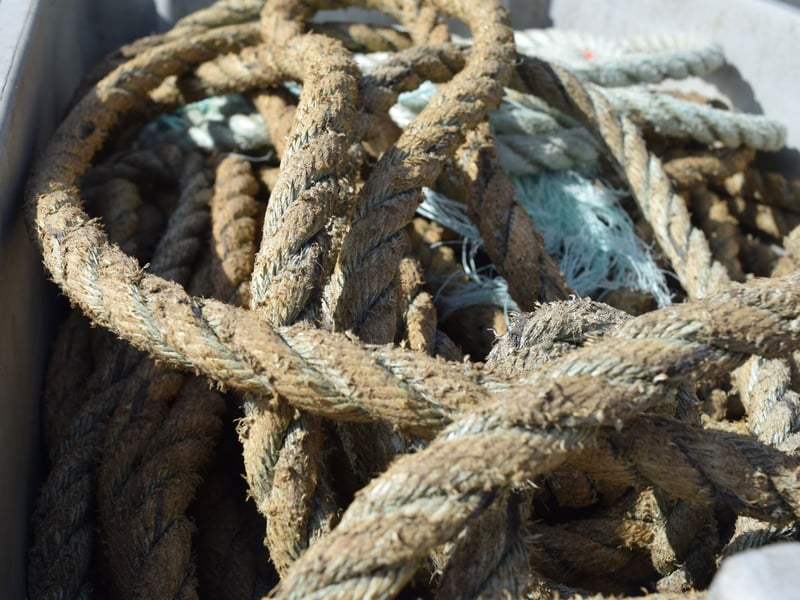
NARRAGANSETT, R.I. (CN) — The ropes hundreds of feet long curled up in the black plastic box, the synthetic fibers once hard now frayed and soft to the touch from their time in the ocean. One length of rope has a pale, bluish hue. The other had turned brown.
In March 2021, a whale disentanglement team removed these ropes from a North Atlantic right whale named Snow Cone, a name given for the shape of a callosities patch just above her blow holes, off the coast of Massachusetts.
If the rope had been left untouched, the National Oceanic and Atmospheric Administration believes the ropes would have killed Snow Cone, one of the 336 endangered North Atlantic right whales still alive today. Following the disentanglement efforts off Massachusetts, Snow Cone swam north into Canadian waters where another whale rescue team removed more rope. She then swam south with rope still stuck high in her jaw and was seen with a calf off the coast of Georgia.
Meanwhile, the rope from the disentanglement effort headed to a NOAA facility in Narragansett, Rhode Island to join a collection of tired gear that was once tangled up in whales along the east coast.
“Welcome to the gear warehouse,” said David Morin, the large whale disentanglement coordinator for NOAA’s Greater Atlantic Regional Fisheries Office upon entering the warehouse at a facility a stone’s throw from Narragansett Bay. The overhead lights buzz.
The black box holding Snow Cone’s ropes lies near the floor on shelving units that stretch about 50 feet. The stacks of boxes containing gear taken from right whales, humpback whales – even a couple of leatherback turtles and harbor porpoises – spill out onto the floor. Deflated orange buoys peak out from some boxes. In the corner, a pile of highflyer buoys leans up against the corner. Yellow and green traps – pots used for lobster and crab fishing – huddle together.
“We just keep it because it provides a window into what’s going on: what, were, how they’re getting entangled,” Morin said. “Are mitigation measures working? [The collection] may not provide concrete answers, but it’s the best we got.”
If NOAA is able to obtain the gear from an entangled whale somewhere on the east coast, from Maine on down, it ends up here. It’s a collection it has kept since the mid-90s.
For the small population of North Atlantic right whale, entanglements in rope and fishing gear are a looming threat. Entanglements, along collisions from ships, are the most common causes of right whale deaths currently, according to Morin.
On May 1, new rules are set to go in effect that mandates Jonah crab and lobster fishermen modify their gear to attach sections of weaker rope, for instance, in hopes that whales could simply break free and thus better protect the right whale. Days before the rule was set to go into effect, Michael Pentony, the NOAA greater Atlantic regional administrator, announced the administration would gradually enforce the rule because the supply chain was preventing fishermen from acquiring the new equipment.
Meanwhile, the lobster industry has challenged some of the new regulations in court. For instance, the First Circuit is scheduled to hear oral arguments this week in a case challenging a rule that stops the use of buoy lines in a strip of ocean off the coast of Maine for part of the year, effectively closing the waters down seasonally to lobster fishing.
The Narragansett warehouse is something of an evidence locker, keeping equipment that has ended up injuring or killing whales.
In a video call ahead of the visit, Morin said NOAA tries to take a forensic approach to the collection as much as possible.
The equipment is tagged and NOAA keeps chain of custody forms and it tries to determine the origin of the gear.
It’s not always easy.
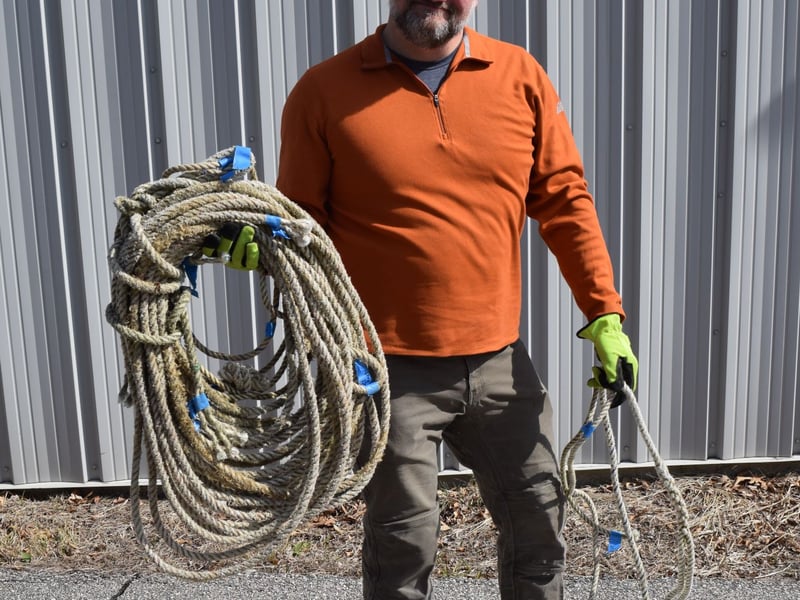
According to the 2018 Large Whale Entanglement Report – the most recent year publicly available – there were 105 entanglements to large whales in the United States that year. Most of the animals, 92, were still alive when entangled while 13 were dead. That year, the largest concentration of entanglements occurred in waters off the coasts of California and Massachusetts.
Analyzing the gear, NOAA said while 80% of the gear was fishing equipment, it could only trace 54.4% of the entanglements back to a specific fishery. Outpacing other entanglement types, 44 of the entanglements that year involved lines and buoys.
For 20 entanglements in 2018, NOAA could only say the whale got tangled up in “unidentified line.”
But sometimes NOAA gets lucky in understanding a specific entanglement and it can figure out the fisherman who owned the gear and where it was located.
“And that, that’s the Holy Grail. But if I get one a year, I’m doing great. That just doesn’t happen that often,” Morin said during the video call.
The collection also sheds light on specific mitigation efforts.
Take, for instance, weak links in rope, intended to break when a certain amount of force is applied, such as the force generated by a right whale, which can grow up to 140,000 pounds.
“Sometimes those are intact when we recover them, but sometimes they’re broken. And that gives us a hint: Okay, they will help in certain entanglements scenarios, but not in all scenarios,” Morin said.
New rules also dictate fishermen add a colored rope about a fathom long near the surface of their buoy systems – red for Massachusetts, purple for Maine. The change is intended to help researchers better understand entanglement from a distance, from areal surveys conducted at 1,000 feet.
“My plan is that it will allow us to identify more gear,” Morin said. “So even if we don’t get to it, if the plane takes a photograph, we can see that color mark. Now, even if we can’t tell the color, that will still tell us that it’s U.S. gear.
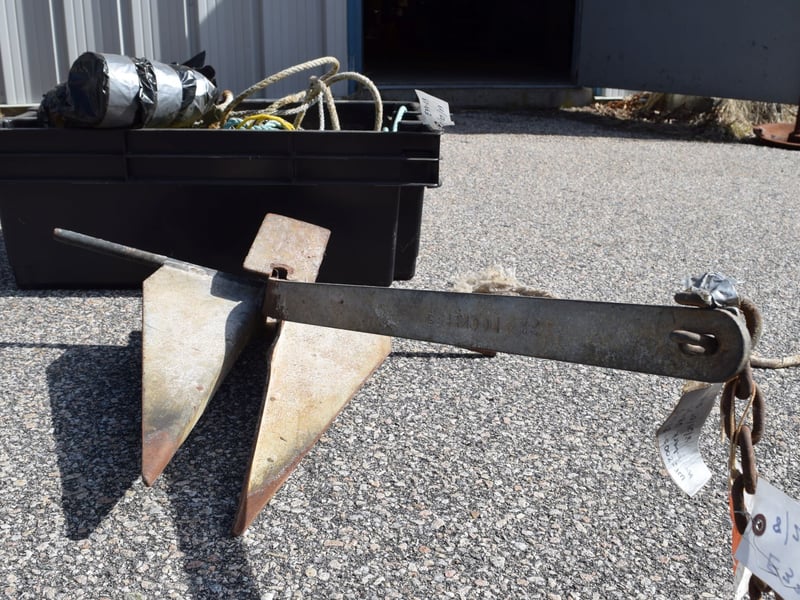
Moments after walking into the warehouse, Morin hefts a fluke anchor from a box lying on the floor. The shank of the anchor was bent sideways at an angle and attached to a rusty chain that ran to a frayed rope. Almost two decades ago, Morin helped remove this gear from a whale when he worked on a disentanglement team, using techniques once used during the heyday of the whaling industry to get close to the animals now repurposed to save them.
But because not every entangled whale is seen out in the ocean, “Disentanglement is an emergency response,” Morin said.
Leaning up against the wall was a circular trap. Green netting wraps around pitted solid metal bars. A gear analysis said in January 2017, Georgia Department of Natural Resources and Florida Fish and Wildlife Conservation Commission recovered the trap from a right whale named Ruffian off the coast of Cumberland Island, Georgia.
When first observed, multiple lines of rope formed a bridle around Ruffian’s mouth and it looked like something heavy dragged on the other end of one of the ropes.
Rescuers made a cut and Ruffian swam free from a weight that he had dragged for hundreds of miles. The trap, the analysis said, was the type used in Canada’s snow crab fishery. It weighed 134 pounds.
Morin’s phone rang.
“This is my entanglement hotline – gotta answer this,” he said.
An individual called to report that while on a boat they had seen some right whales about an hour ago. After taking some photos, they realized one of the whales was dragging rope, even though it was feeding and did not appear to be distressed.
Using the hood of his car as a desk, Morin takes notes on a yellow pad of paper, recording the coordinates. It’s off the coast of Cape Cod.
“My hunch is I know who it is,” Morin said.
About 50 right whales are swimming around Cape Cod. One of them is Snow Cone.
Morin received multiple reports a few days prior that individuals had seen her. The rope in her jaw, however, is a serious entanglement. “She’s not in good shape,” Morin said earlier.
Morin makes another call, relaying the coordinates.
“Send me a text if you’re going out,” he said.
If the factors align, if the weather conditions are good, if the disentanglement team can find the whale, if the rescue goes well, a whale will swim free – and another piece of gear will make its way to the warehouse.
 Follow @jcksndnl
Subscribe to our free newsletters
Our weekly newsletter Closing Arguments offers the latest about ongoing trials, major litigation and rulings in courthouses around the U.S. and the world, while the monthly Under the Lights dishes the legal dirt from Hollywood, sports, Big Tech and the arts.