Search Articles


(CN) — A newborn star deep inside a cloud of gas and dust appears to be “sneezing,” sending out bursts of energy that may help explain how stars like the sun take shape.
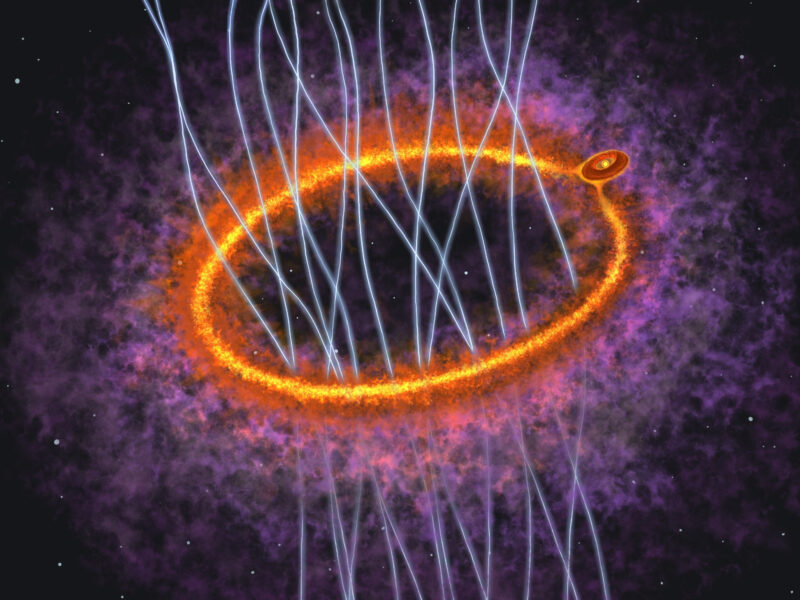
In a study published Thursday in The Astrophysical Journal Letters, scientists from Kyushu University and Kagawa University report that a young star surrounded by a dense disk of gas and dust expelled material in a way that created a massive, warm ring roughly 1,000 astronomical units wide.
That’s far larger than similar structures seen before.
According to researchers, these findings offer a closer look at the earliest stages of star formation, a process that is still difficult to observe directly because newborn stars are often hidden within thick clouds of gas.
“Thankfully, one of the most promising ways to get a clear view of protostars is to use the Atacama Large Millimeter/submillimeter Array, or ALMA, in Chile,” said Masahiro Machida, a professor at Kyushu University who led the study, in a press release. “This radio telescope lets us see the different materials that make up stellar nurseries.”
Using ALMA, the team studied a very young protostar in the Taurus Molecular Cloud, a nearby region where stars are actively forming. While stars like the Sun are about 4.6 billion years old, the object examined in the study is less than 100,000 years old.
Earlier research by the same group identified smaller, spike-like structures in similar disks, about 10 astronomical units in size. Those features were linked to magnetic activity and described by researchers as “sneezes” — bursts that release energy from the forming star.
The newly observed ring appears to be a much larger version of that same process.
“Our data showed that this ring is slightly warmer than its surroundings. We hypothesize that it is produced through a magnetic field threading the protostellar disk,” said first author Kazuki Tokuda of Kagawa University in the press release. “The warm ring we detected this time strengthens our hypothesis that baby stars undergo dynamic magnetic-gas redistribution shortly after birth, generating shock waves that warm the surrounding gas.”
Machida said the term “sneeze” is meant to describe how the material is expelled.
“In simple terms, this is somewhat similar to a human sneeze, where material is suddenly ejected outward,” he said in an email. “These events seem to help the young star release built-up magnetic energy.”
Magnetic fields are believed to play a critical role in star formation. Without a way to release excess magnetic energy, researchers say it would be difficult for stars to form under realistic conditions.
“It has long been known that newborn stars drive powerful bipolar outflows, often described as their ‘first cry,’” Machida said. “Our results suggest that, in addition to this, young stars may also undergo intermittent ‘sneezing’ events.”
The discovery could also have implications for how planets form. The disk of gas and dust surrounding a young star is where planets eventually take shape, and changes in that environment may influence how planetary systems develop.
For now, researchers say more observations are needed to understand how common these large rings are and what exactly is happening inside them. The team plans to continue studying similar systems using ALMA and to compare their findings with computer simulations.
“Not all young stars necessarily show this behavior, but similar features are being reported more frequently,” Machida said. “This suggests that such events may be relatively common, although further observations are needed to confirm this.”
The work adds to a growing body of research showing that star formation is not a smooth, steady process but a dynamic one, shaped by bursts of energy and motion that are only beginning to come into focus.
“These results highlight that star formation is a highly dynamic process, involving not only steady accretion but also intermittent and energetic events,” Machida said. “Understanding these processes is essential for building a complete picture of how stars and planetary systems form.”
Subscribe to our free newsletters
Our weekly newsletter Closing Arguments offers the latest about ongoing trials, major litigation and rulings in courthouses around the U.S. and the world, while the monthly Under the Lights dishes the legal dirt from Hollywood, sports, Big Tech and the arts.