
 Search Articles


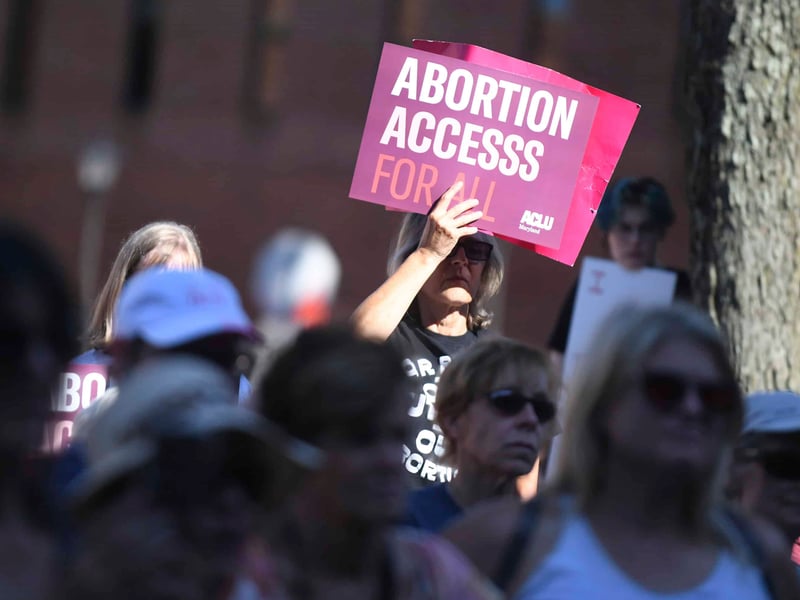
(CN) — Hoping to repeat the success of 2022’s midterm elections, a record number of states have measures on the ballot in the 2024 election seeking to further protect abortion rights across the nation.
Ten states have certified abortion-related ballot measures in the lead-up to the 2024 election, according to Ballotpedia. This beats the previous record of six states in 2022 for the most abortion-related ballot measures in a single year.
The states seeking to pass abortion-related measures this year span the political spectrum. The measures, many of which are citizen-led, seek to expand and protect abortion rights in blue-leaning states like New York, red-leaning states like Missouri and battleground states like Arizona. The measures vary from expanding the timeframe in which a person is allowed to get an abortion, to enshrining the right to an abortion in the state’s constitution.
Those 10 states are Arizona, Colorado, Florida, Maryland, Missouri, Montana, Nebraska, New York, Nevada and South Dakota.
Since the U.S. Supreme Court overturned Roe v. Wade with its 2022 Dobbs ruling, seven states have put abortion on the ballot: California, Michigan, Vermont, Kansas, Kentucky, Montana and Ohio.
Mary Ruth Ziegler, a law professor at University of California, Davis and a leading historian on the U.S. abortion debate, said the success of abortion-related state measures since Dobbs has inspired abortion rights activists to expand their efforts to protect reproductive health access.
“The range of states where the abortion rights side prevailed in 2022 expanded the map where the movement was willing to move forward,” Ziegler said. “All of those victories made the movement ready to experiment in states where there are more hurdles of various kinds.”
Recent polling shows that most Americans generally support abortion rights. According to an Associated Press/NORC poll conducted in June, roughly 61% of adults think their state should allow a person to get an abortion for any reason. As of October, 13 states have banned abortion entirely and six have imposed gestational limits at or below 12 weeks.
According to experts, the elections in Colorado, Florida and Nebraska may be the most consequential.
Colorado
In Colorado, organizers are hoping to enshrine the right to abortion in the state constitution and appeal the state’s nearly four-decade-old ban on state money being used to pay for abortions. Amendment 79, previously known as Initiative 89, requires 55% of voter support to pass.
Organizers say they gathered more than 225,000 signatures for the measure, almost twice as many as needed to put the initiative on the ballot.
A reliably blue state, abortion is already allowed at all stages of pregnancy in Colorado. The measure would prevent lawmakers from undermining abortion rights in the future.
Tracy Weitz, a sociology professor at American University, said the Colorado measure would be particularly interesting to watch because it would let Medicaid cover abortions in the state.
Currently, government funds are not allowed to be used to pay for abortions in Colorado because of a 1984 constitutional amendment that banned it except in cases where the life of a mother is in danger or when a pregnancy is a result of rape or incest.
“In addition to geography impeding people’s ability to get an abortion, not being able to use your state Medicaid for low-income individuals has been shown to be the greatest barrier to accessing care,” Weitz said.
Weitz added that, if the measure passes in Colorado, other states may follow suit and implement measures that would similarly allow the use of public funds for abortions.
Florida
If voters pass Florida’s Amendment 4 in November, the state’s constitution would be amended to protect the right to abortion until fetal viability or when necessary to protect the pregnant person’s health. The measure needs 60% of voter support to pass.
Currently, abortion is not permitted after six weeks of pregnancy, with some exceptions for rape, incest and when the pregnant person’s life is at risk. The six-week ban, enacted in May, replaced the state’s previous law allowing abortion until 15 weeks.
“Florida’s definitely a big deal, not only because it’s the first state to have to clear that 60% threshold, but also because Florida was a regional destination for people seeking abortion services before the six-week ban kicked in,” Ziegler said.
Despite public support for abortion, recent polling shows that the abortion measure currently lacks the necessary 60% support to pass. According to a poll by The New York Times and Siena College, 46% of likely voters say they would vote for the abortion rights amendment in November.
Some experts say the uncertainty of the measure’s passing may be attributed to Florida Governor Ron DeSantis’ efforts to defeat the initiative. For instance, earlier this month DeSantis sent a letter to local TV stations urging them to remove ads about the abortion-related ballot measure.
“If all things were fair, yes of course, we already know that the vast majority of Americans are in support of legal abortion,” Weitz said. “However, given everything that the state government is doing, we just don’t know how the election is going to end.”
Amanda Roberti, a political science professor at San Francisco State University, added that despite public support for abortion, the 60% threshold will be hard to pass.
“That threshold is going to be hard to get above,” Roberti said.
Nebraska
Nebraska is the only state to have two dueling abortion amendments. One of the measures, which is called “Protect the Right to Abortion” in the petition filing, would enshrine the right to abortion until fetal viability in the state constitution. The initiative also has exceptions in the case it’s needed to protect the health of the pregnant person past fetal viability.
The other measure, named “Protect Women and Children” in the petition filing, would amend the state constitution to include a ban on abortion in the second and third trimesters, with exceptions for medical emergencies, rape or incest.
Currently in Nebraska, abortion is banned after 12 weeks of pregnancy, with exceptions for rape, incest and health of the pregnant person. The measures need a majority of the vote to pass and, while it’s possible voters could approve both abortion-related measures, whichever initiative gets the most “yes” votes will be enacted.
Weitz said that in previous years she might have been worried that the existence of both competing measures may be enough to confuse voters, she’s more confident this year that this measure will pass because of the success other states have had in passing abortion-related measures since 2022.
“I’m more confident than I would have been in the past that voters will understand that this is a confusion strategy, and they will vote to expand access to abortion rights in that state,” Weitz said.
 Follow @NikaSchoonover
Subscribe to our free newsletters
Our weekly newsletter Closing Arguments offers the latest about ongoing trials, major litigation and rulings in courthouses around the U.S. and the world, while the monthly Under the Lights dishes the legal dirt from Hollywood, sports, Big Tech and the arts.