
 Search Articles


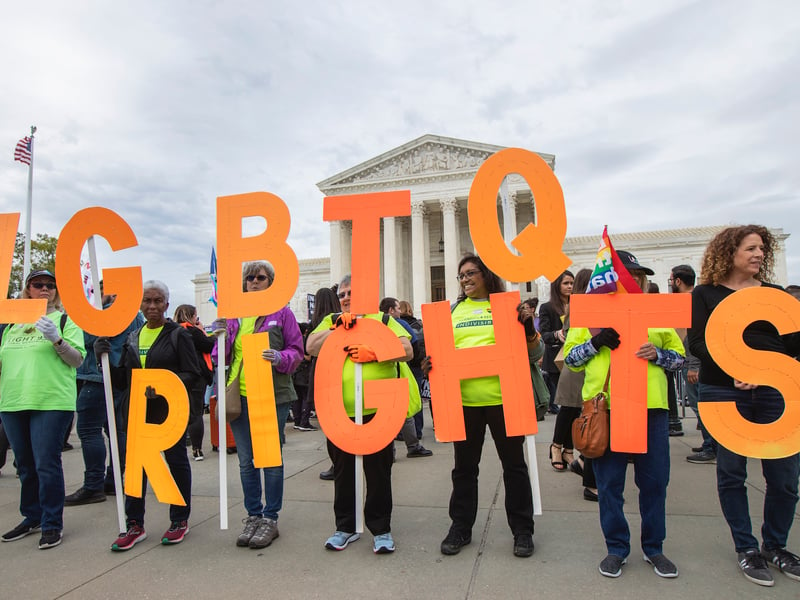
WASHINGTON (CN) — As the 10th anniversary of the Supreme Court’s landmark ruling in Obergefell v. Hodges approaches, support for same-sex couples is reaching historic highs, but LGBTQ rights are losing a foothold across the high court bench.
Over 60% of LGBTQ adults say they feel accepted by the American public, with two-thirds crediting Obergefell v. Hodges as one element in the normalization of same-sex marriage, according to a report from Pew Research Center released Thursday.
Per the study, since 2015, LGBTQ adults say they have seen more support from religious leaders and representation in politics and entertainment, and most LGBTQ adults say that all of their friends and co-workers have been accepting.
However, the survey found that more than half of LGBTQ adults say they’ve been subject to slurs and jokes, around four in 10 queer adults reported fearing for their safety at some point because of their LGBTQ identity.
The report’s findings track with the changing legal landscape for LGBTQ rights, where only two of the voting majority in Obergefell remain on the high court’s bench. Today, the justices who objected to same-sex marriage rights hold the majority as the Supreme Court readies to weigh in on gender affirming care, LGBTQ books in schools and access to HIV prevention drugs.
Brick by brick
In the span of nearly three decades, the Supreme Court went from endorsing anti-sodomy laws in Bowers v. Hardwick to recognizing the right of same-sex couples to marry. The first signs of the shifting tide emerged in 1995, when the high court threw out an amendment to the Colorado constitution prohibiting discrimination protections for LGBTQ people.
Public opinion on same-sex marriage shifted alongside two Supreme Court rulings between 2003 and 2013. In 2003, almost 60% of Americans opposed same-sex marriage. That same year, however, the justices issued a major ruling in favor of LGBTQ rights, overruling Bowers in Lawrence v. Texas .
By 2013, Pew reports that more Americans supported same-sex marriage than opposed, and the justices struck down a key provision in the Defense of Marriage Act that defined marriage as a union between one man and one woman in United States v. Windsor .
Two years later, the Supreme Court issued the landmark ruling June 26, 2015, recognizing the right to same-sex marriage. Justices Anthony Kennedy, Ruth Bader Ginsburg, Stephen Breyer, Sonia Sotomayor and Elena Kagan formed the majority, holding that the right to marry — for both same-sex and opposite sex couples — is a fundamental liberty under the Fourteenth Amendment.
Eli Coston, a professor at Virginia Commonwealth University, said Obergefell carried a sense of relief in 2015 after many states passed constitutional amendments banning same-sex marriage.
“This was really a sense of validation in terms of, we see you, we respect your relationships, and those are equally as valid as heterosexual relationships,” said Coston, who researches the politics of visibility and identity on the LGBTQ community.
A decade later, Pew reports that LGBTQ people feel much more supported in society, but they face a much different political and legal landscape than in 2015. Gay and lesbian adults are still benefiting from Obergefell ’s protections, but the landmark ruling doesn’t carry the same weight it once did.
First comes marriage, and then what?
Just as Obergefell built on years of precedent, the landmark ruling itself became a launching pad for LGBTQ equality. Abbie Goldberg, a professor at Clark University that researches LGBTQ families, said that leveling the playing field on marriage didn’t automatically transfer to other rights.
“For example, some states allow child welfare agencies to discriminate against LGBTQ people based on religious convictions,” Goldberg said.
A large swath of these ancillary issues were pushed through the courts after Obergefell . In 2017, the Supreme Court ruled that refusing to list same-sex couples on a child’s birth certificate was unconstitutional discrimination in Pavan v. Smith . A few years later, a Texas state court ruled that employees in same-sex marriages were entitled to spousal benefits.
Five years after Obergefell , the Supreme Court issued a major ruling in Bostock v. Clayton County , prohibiting employment discrimination on the basis of sexual orientation or gender identity.
In 2022, Congress repealed the anti-LGBTQ Defense of Marriage Act, replacing it with the Respect for Marriage Act, recognizing same-sex marriage across the U.S.
One step forward, two steps back
Despite increased legal protections, Pew reports that over half of LGBTQ adults say they have faced discrimination based on their sexual orientation. And Justice Sonia Sotomayor accused her colleagues of creating a “license to discriminate” against LGBTQ people just as anti-LGBTQ laws were passed across the country.
Opponents to LGBTQ rights have taken advantage of a First Amendment loophole under the Roberts Court. Instead of challenging whether same-sex couples have various rights, litigants began asking for a religious opt-out.
In 2023’s 303 Creative v. Elenis , the conservative majority sided with a Christian wedding website designer who didn’t want to offer services to same-sex couples. The high court said Colorado’s anti-discrimination law violated the website designer’s First Amendment rights.
In the coming weeks, the justices will decide whether Maryland parents can use that loophole to keep their kids from reading books with LGBTQ characters.
Gabriel Arkles, senior counsel at Advocates for Trans Equality, said Mahmoud v. Taylor will decide whether the Constitution requires schools to work with parents to shield their children from certain types of knowledge they don’t want their children to have.
“Here, it’s knowledge that trans and queer people exist and are a part of communities,” Arkles said.
There’s never been a ruling that public schools have that obligation, and Arkles worried that the Supreme Court would create a standard forcing schools to align their curriculum with the religious preferences of parents.
Justice Samuel Alito seemed to suggest an extreme version of that theory, suggesting a special rule for religion and LGBTQ rights.
“It would be an incredibly dangerous rule and utterly counterfactual to suggest that there is something about LGBTQ existence that is unusually threatening to children or religion,” Arkles said.
Karen Loewy, senior counsel at Lambda Legal, said the tension between these rights is being used as a tool to undermine equality.
“There’s a way in which there’s a weaponization of religious freedom, and an attempt to carve out LGBTQ people from the generally applicable law in society,” Loewy said. “It is really about allowing religious freedom to be used as an excuse to deny equality to LGBTQ people.”
Uneven gains
As same-sex marriage became normalized and gay and lesbian adults racked up legal wins, transgender Americans have been left behind. Only 13% of transgender adults told Pew they felt adequate social acceptance.
Naomi Goldberg, executive director at the Movement Advancement Project, a research think tank that tracks LGBTQ laws and policies, said that anti-equality groups have created a coordinated and strategic effort to erase transgender people from public life.
“Soon after the marriage equality rulings, these groups recognized they needed to find another culture war issue to rile up their base rather than confront the real challenges facing our communities — access to quality education, rising costs of basic needs, and crumbling infrastructure,” Goldberg said.
Transgender bathroom bans have been implemented in 19 states, and 28 states ban transgender students from participating in sports consistent with their gender identity, according to the project’s research.
Health care for transgender people has come under particular attack, and the Supreme Court is set to issue a major ruling this term on the issue. Over two dozen states have passed bans preventing transgender youth from receiving gender affirming care.
“Through state laws and federal policies, we’ve seen misinformation and fear about transgender people used to justify laws that make it harder for transgender people to simply live their lives,” Goldberg said. “These laws have moved swiftly over the past two to three years where now more than half of states have banned transgender children from playing on middle school sports teams or their families’ ability to get them medical care."
Even when care is available, transgender adults were almost twice as likely to be treated poorly by health care professionals as gay or lesbian adults, according to Pew.
In a worrying sign for some advocates, earlier this month, the Supreme Court allowed the Trump administration to kick transgender troops out of the military because of their gender identity.
Coston said that there’s a deeper issue within the LGBTQ community with transgender people not always feeling supported.
“When we talk about issues like same-sex marriage, one of the questions is, well, okay, but what does that do for trans people who might have other issues and needs that could have been forefronted?” Coston said.
Coston said LGBTQ advocates have sometimes favored receiving some rights or protections opposed to none.
“There’s this idea that there is a scarcity,” Coston said. “That if we can get rights for some people, then we can come back and include others, but if we try to do it all at once, we’re not going to get anything.”
The black horse
Aside from one-off propositions from state lawmakers, litigants have shown no interest in overruling Obergefell right now. The same can’t be said of the justices on the high court bench.
When the Supreme Court overturned Roe v. Wade in 2021, Justice Clarence Thomas suggested reevaluating other precedents that shared the same foundation, including Obergefell .
“We’ve seen dissents from Justices Thomas and Alito in a not-so-distant past really calling for revisiting Obergefell ,” Loewy of Lambda Legal said. “In Thomas’s opinion in Dobbs , he wants to do away with substantive due process in its entirety.”
Chief Justice John Roberts’ dissent in Obergefell mirrors Alito’s reasoning for overturning Roe , arguing that the Constitution does not address same-sex marriage, so it should be decided by the states.
The Marriage Equality Act should protect the right to same-sex marriage if the Supreme Court overturns Obergefell , but legal experts would rather not test that theory.
“The big problem is that even if there’s federal law that protects that right, if the court case is overturned, then it comes into question whether that federal law is still applicable,” Coston said. “It could be subject to further scrutiny by the courts.”
 Follow @KelseyReichmann
 Follow @kelseyreichmann.bsky.social
Subscribe to our free newsletters
Our weekly newsletter Closing Arguments offers the latest about ongoing trials, major litigation and rulings in courthouses around the U.S. and the world, while the monthly Under the Lights dishes the legal dirt from Hollywood, sports, Big Tech and the arts.