
 Search Articles


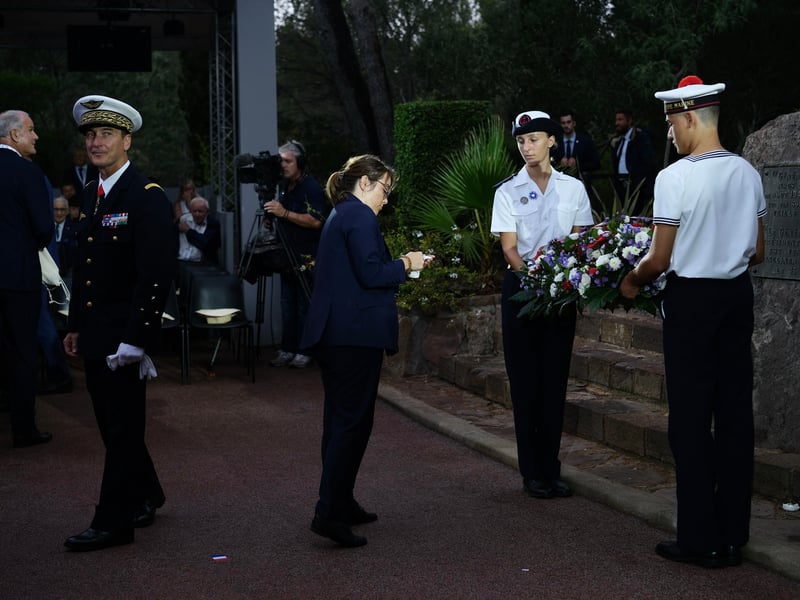
SAINT-RAPHAËL, France (CN) — Under light rainfall and gray skies, French President Emmanuel Macron on Thursday praised the critical role soldiers from Africa, the Antilles and Oceania played in the Provence invasion 80 years ago that helped lead to France’s liberation from Germany.
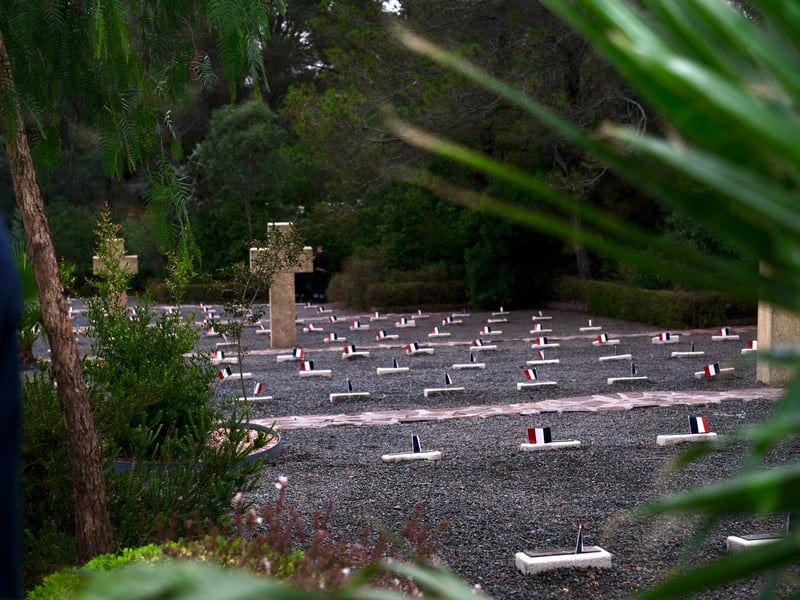
Against the backdrop of 464 graves of World War II soldiers at the National Necropolis of Boulouris, Macron shifted away from the more traditionally nationalistic version of the story of Operation Dragoon.
The operation has held a symbolic place in France’s collective imagination for decades, since 230,000 “Army B” troops liberated their own territory. But a critical piece was long brushed over: Most of these soldiers were recruited from French colonies and then left out of the popular narrative in the aftermath of the war.
Three veterans — one from France, one from Tunisia and one from Morocco — received the Legion of Honor, France’s highest military decoration.
Pierre Salsedo, who was born in Tunis, looked teary eyed as Macron pinned the medal onto his suit jacket. He volunteered for the war effort in 1943.
Macron spoke alongside African heads of state from Africa, including Cameroonian President Paul Biya, Togolese President Faure Gnassingbé and Moroccan Prime Minister Aziz Akhannouch.
“These men of the French army were called François, Boudjema, Harry, Pierre, Niacara — they came from Corsica and Poitou, from the Pacific and Algeria, from Senegal, Morocco and the Ardennes,” Macron said.
“Officers of the empire or children of the Sahara, natives of Casamance or Madagascar, former soldiers of Verdun or young men thrown into the strange defeat. They were not of the same generation, they were not of the same religion, they were not of the same condition, yet they were the army of the most armed nation,” he said.
World War II veterans came from France, Senegal and Morocco to participate.
Experts argue Operation Dragoon was one of the most successful amphibious landings in the course of the war. Over 100,000 Allies invaded France’s Mediterranean shores on Aug. 15, 1944, and suffered roughly 400 casualties — a fraction of those incurred on D-Day. The French army of roughly 230,000 immediately backed up the effort and drove the mission home within weeks. The country had been under German occupation for more than four years.
Macron said, “This breath is that of sacrifice, of will, of unity — and still makes us an irreducibly free people, the ones who, that day, were also liberated by this army of Africa. And we will not forget.”
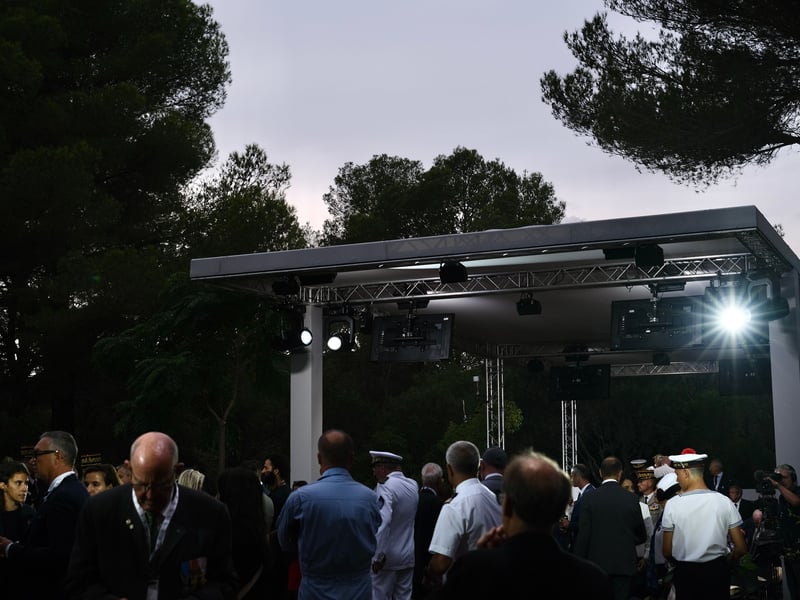
The ceremony opened with a procession of government officials walking down a leafy pathway lined with flags and army personnel. The French army’s choir sang “The Commandos of Africa" before Cameroonian President Biya took the stand.
“The thousands of men … came from all over the French colonial empire,” Biya said. “The contribution of Africa was significant in the fight to free France of the chains of German occupation.”
Over half of the soldiers in France’s “Army B” were recruited, sometimes coercively, into joining the war effort. Most came from colonies under the French empire. They were not treated equally to French soldiers and were largely repatriated after the war. Much of this, from the perspectives of the soldiers themselves, remains undocumented.
“In terms of what the operation means to French colonial soldiers, it’s actually pretty difficult to get their thoughts, because many of them didn’t leave behind recorded remembrances,” military historian Cameron Zinsou, told Courthouse News. “Most of the information we have comes from the French officers, the white French officers who are leading these units.”
Though officially the French empire sought to instill its three-pillared value system — liberty, equality and fraternity — throughout the colonies, this didn’t play out on the ground or in the war effort, Zinsou said.
Colonial soldiers were not allowed to rise up in the ranks of the French army. There were instances of families who refused to join the war effort being relocated into “holding camps,” according to Zinsou. On the ground, these troops weren’t paid the same wages as French soldiers.
In Dakar, Senegal, just months after the invasion of Provence, dozens of repatriated African soldiers who had fought alongside French soldiers were shot after demanding equal pay and treatment. Some were posthumously honored by France in July.
But in the decades following the war, the popular narrative centered on France’s self-liberation. According to Zinsou, Charles de Gaulle propagated this version of events.
“Part of that is done to portray the unity of France as this kind of fighting resistance through the entirety of the German occupation,” Zinsou said.
He said at the time of Operation Dragoon, 1.8 million French soldiers were prisoners of war in Germany, and France simply didn’t have the manpower or resources to carry out an independent operation of this scale alone.
Cameroon’s Biya said that the diverse French forces were “artisans of victory.”
He said that the lessons learned during World War II should be used to foster worldwide solidarity.
“It’s our collective responsibility to preserve peace and justice in this world,” he said.
 Follow @lilyradz
Subscribe to our free newsletters
Our weekly newsletter Closing Arguments offers the latest about ongoing trials, major litigation and rulings in courthouses around the U.S. and the world, while the monthly Under the Lights dishes the legal dirt from Hollywood, sports, Big Tech and the arts.