
 Search Articles


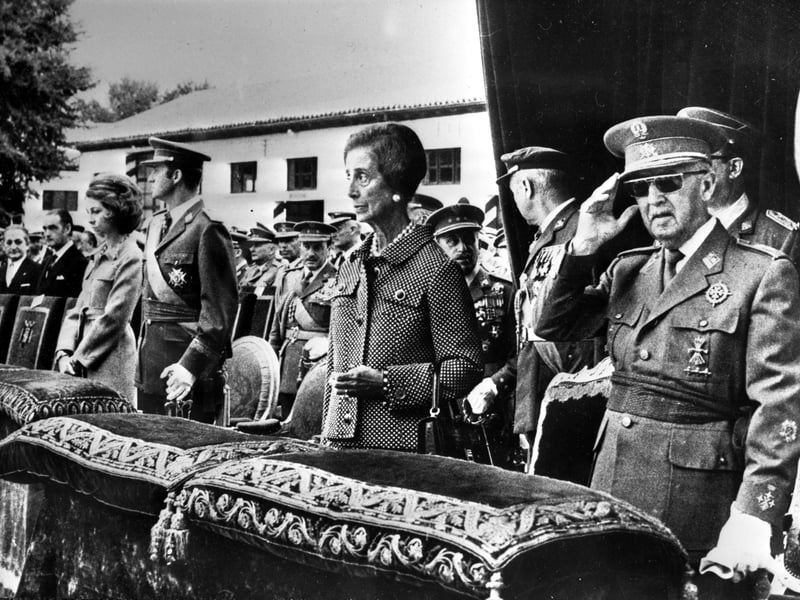
(CN) — Spain marked a dark day in its history Thursday: 50 years ago, the body of Western Europe’s last dictator, General Francisco Franco, finally ceased to breathe. A day later, his death was officially announced to the world, drawing a muted response as the era of fascist European regimes finally ended 30 years after World War II.
Fast forward to the present and Spain remains deeply divided over the legacy of Franco and the arch-conservative state apparatus constructed under his watch that violently stamped out the nation’s left-wing and liberalizing forces.
Franco died a few minutes after midnight on Nov. 20, 1975, at 82. His death was caused by heart failure, following complications related to acute peritonitis and multiple organ failure. Doctors, led by his surgeon son-in-law, had kept the “Generalissimo” alive through life support devices since he fell into a coma on Nov. 3 due to gastrointestinal bleeding.
Historians don’t know the reason for unplugging him at that moment but — either by design or by coincidence — he died on the anniversary of the 1936 death of José Antonio Primo de Rivera, the founder of the Falange fascist movement that had carried him to power during the Spanish Civil War and underpinned his 36-year authoritarian anti-communist regime.
Political divisions were starkly on display Thursday.
For those on the left, led by Socialist Prime Minister Pedro Sánchez, Franco’s demise should be hailed as the dawn of democracy on the Iberian Peninsula. For those on the right, respecting Franco’s legacy and defending his regime is central to a vision of Spain as a conservative nation grounded in church, family and tradition.
On social media, Sánchez remarked that for him Nov. 20, 1975, was the “the beginning of the transformation that turned us into the full and prosperous democracy we are today.”
“We celebrate being able to express opinions, think, vote and be what one wants to be,” the prime minister said. “Democracy is our power. Let us defend it.”
During his premiership, Sánchez has sought to dismantle Franco’s heroic image, most symbolically by removing his remains from a massive mausoleum Franco had built in the hills outside of Madrid to commemorate the victors of the Civil War. The remains of Rivera, interred next to Franco’s at the center of the basilica at the Valley of the Fallen, were removed in 2023.
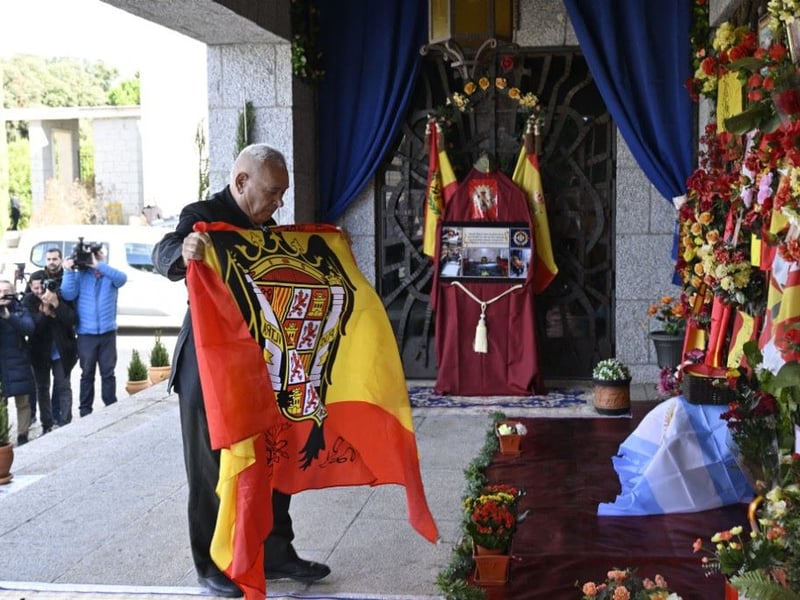
Thursday’s anniversary kicked into high-gear a series of government-sponsored cultural events called “Spain in Freedom” related to the Franco dictatorship, from theatrical productions to a project asking the public to submit stories about what they were doing on the night Franco died.
In Granada, one of the events — a play entitled “The Death of the Big Bastard” — summed up the animosity still felt by many Spaniards. In a blurb, organizers said performers would “spit their words upon his grave” in remembrance of the regime’s victims.
Spain remains haunted by Franco’s dictatorship, which carried out mass executions during and after the Civil War in the 1930s, forced communists and state enemies into exile and squashed dissent with its state police.
Among many Spaniards, resentment toward Franco runs deep. Those feelings extend toward the royal family, which was restored following his death, and the United States for its backing of Franco during the Cold War, effectively turning Spain into a puppet regime. Upon his death, Richard Nixon called him a “loyal friend and ally of the United States.”
When Franco finally expired, the reins of power passed not through an eruption of public will but through a carefully staged transfer to Prince Juan Carlos, the heir Franco had handpicked years earlier to perpetuate the regime.
He was named King Juan Carlos I on Nov. 22, 1975, but abdicated the throne in June 2014 following a series of scandals, to his son, King Philip VI.
Juan Carlos has been living in unofficial exile in Abu Dhabi in the United Arab Emirates since 2020, but he was expected to return to Spain Friday to celebrate the restoration of the monarchy. In a new memoir, Juan Carlos said he “respected [Franco] enormously, appreciated his intelligence and political sense.”
The restoration of the Bourbon monarchy led to a fragile and uncertain journey toward democracy. Under pressure to dismantle the dictatorship, Juan Carlos worked with reformist allies to roll back press censorship, political repression and the rigid authoritarian structures that had defined Spanish life since the Civil War.
What followed was a three-year process — tense, contested, and often on the brink of collapse — that culminated in 1978 with a new constitution approved overwhelmingly by Spanish voters. However, the constitution also acknowledged Juan Carlos as the rightful heir of the Spanish dynasty and king, thereby turning Spain into a constitutional monarchy with the king as chief of state.
The new**** democratically elected government also passed an amnesty law that meant atrocities committed during the Civil War and under Franco’s regime would not be prosecuted.
That constitution marked the rebirth of Spain as a modern, pluralistic, parliamentary democracy. In spirit, it completed an arc interrupted violently in the 1930s when the Second Republic had attempted to build precisely such a state: secular, egalitarian, liberal and aligned with the progressive ambitions of the era.
Those aspirations were shattered by Franco’s rebellion and the devastating civil war that followed. The fascist powers of Benito Mussolini’s Italy and Nazi Germany tipped the balance, using Spain as a proving ground for their own methods of annihilation.
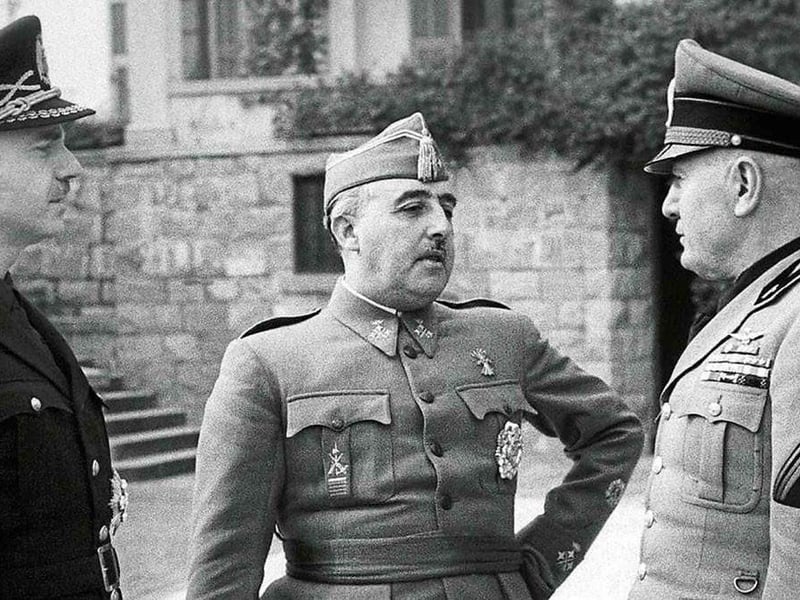
The bombing of Guernica — immortalized by Pablo Picasso’s monumental canvas — endured as the defining symbol of the brutality that crushed the Republican dream and installed an authoritarian regime that would survive long after its European counterparts had vanished.
While the dictatorships of Mussolini and Adolf Hitler fell in the ashes of World War II, Franco’s Spain remained a holdout.
Its survival was secured not only by domestic repression but by geopolitics. In the emerging Cold War, the United States saw Franco as a strategic asset — a rigidly anticommunist strongman who could anchor American influence on Europe’s southwestern flank.
Military bases, economic aid and diplomatic rehabilitation followed, transforming Spain into a quasi-protectorate within Washington’s expanding sphere.
The 1953 military agreement with Washington marked a significant step in Spain’s international rehabilitation from a bankrupt pariah state following World War II. As a fascist-aligned dictatorship sympathetic to the Axis powers, Spain was excluded from the United Nations and the Marshall Plan.
Franco’s regime leveraged this American patronage to secure its longevity, even as the rest of Western Europe embraced democracy, social welfare and integration into a common European superstate.
By the 1960s and early 1970s, Spain appeared increasingly anomalous: A nation with booming tourism, rising prosperity and a modernizing economy, still under the rule of an aging autocrat. Even though liberalizing forces— students, workers, intellectuals, parts of the Church— were gaining momentum, the dictatorship maintained its grip through censorship, secret police and show trials.
Franco’s death pried the regime open and when that moment finally came, it arrived with a mixture of dread and hope.
When Franco died, “there was a huge fear that Spain was going to get plunged into another civil war,” said Duncan Wheeler, a professor of Spanish studies at the University of Leeds, in a telephone interview.
“One of the ways in which that’s avoided is to have this agreement that the sins of the past on both sides in what happened during the Civil War and during the dictatorship afterwards are put to one side,” Wheeler said.
“In the one sense, that’s a success story because Spain doesn’t become in the late ’70s what happened in Yugoslavia in the ’90s,” he said. “But it did come at a cost because it meant a lot of crimes went unpunished. A lot of people didn’t get to grieve for their dead.”
Efforts to exhume and identify victims of the regime are ongoing as forensic scientists sift through mass graves and scholars dissect the secretive workings of the Franco state.
Wheeler pointed to the recent move to turn La Model prison in Barcelona — used by the Franco regime — into a memorial space as an example of initiatives to better understand the fascist government.
While a majority in Spain are eager to condemn Franco, many others view the dictatorship as a beneficial force in Spanish history. A recent poll found one out of every four Spanish youths view the Franco years favorably, a reflection of the growing popularity of far-right politics, most notably the anti-immigrant and nationalist rhetoric of the political party Vox.
Countering the criticism of Franco, several groups planned commemorations to honor the dictator, including the Spanish Catholic Movement, which laid flowers at Franco’s grave in Madrid.
Meanwhile, a Franco nostalgia group known as Platform 2025 called on Spaniards to “remember and vindicate the legacy of Francisco Franco on the 50th anniversary of his death.” The group planned to hold events, including scholarly conferences and the release of a book and documentary, to celebrate him.
Wheeler noted that official commemorations themselves have stirred controversy.
“One is the way it’s been labeled because it is celebrating 50 years of somebody’s death,” he said. “Is it right to celebrate it even if it’s the death of the dictator?”
He said the government’s decision to name the events as “50 years of democracy” is also problematic because Spain cannot truly be viewed as having become “straight away a democracy after Franco died.”
Also, the Sánchez government has come under fire by those who accuse it of seeking to use the anniversary to distract from current political problems, he added. The administration is in the midst of corruption scandals involving high-ranking officials close to the prime minister.
In the final analysis, many Spaniards see all the fuss over Franco’s death and legacy as overwrought and annoying.
Wheeler said that while the anniversary has received some coverage locally, “a lot of Spaniards just want to carry on with their everyday lives,” and many feel frustrated that Franco “is still such a big story internationally about the country."
Abroad, the anniversary is generating at least as much attention as it is inside Spain, he said.
After all, Spain has evolved from being the last dictatorship in Western Europe to become one of the most progressive countries in the European Union. That shift, he says, is partly explained by the brutality of the Civil War and dictatorship.
“Spaniards, since the transition, because they had such bloody divisions, have actually favored moderation,” he said.
He saw Spain as “a very healthy country in comparison with many others in Europe” with an economy performing better than much of the continent and a society that feels notably optimistic.
Social cohesion, he argued, remained one of Spain’s strengths because “the family and social structure haven’t broken down in the way they have in a lot of societies,” making the country “a pretty good model for living.”
Courthouse News reporter Cain Burdeau is based in the European Union.
 Follow @cainburdeau
Subscribe to our free newsletters
Our weekly newsletter Closing Arguments offers the latest about ongoing trials, major litigation and rulings in courthouses around the U.S. and the world, while the monthly Under the Lights dishes the legal dirt from Hollywood, sports, Big Tech and the arts.