
 Search Articles


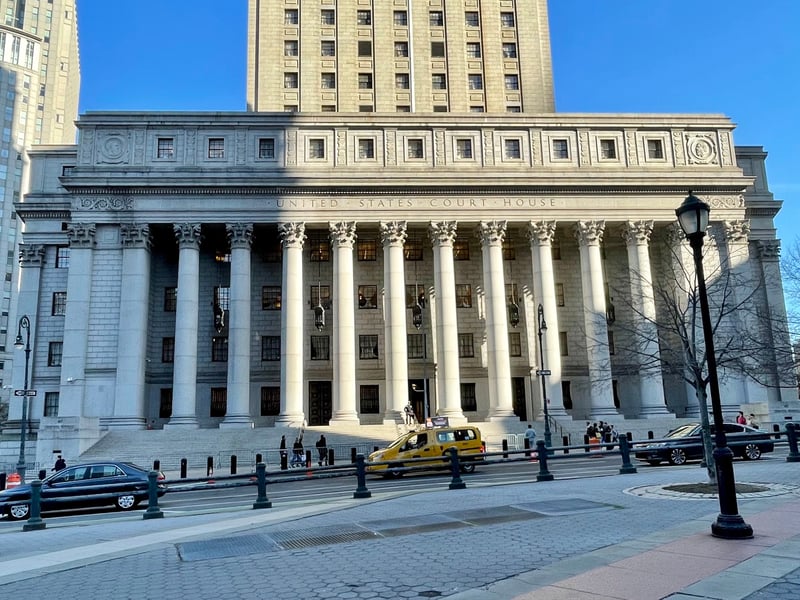
MANHATTAN (CN) — A Second Circuit panel seemed unpersuaded on Wednesday that an advocacy group should be able to continue giving advice to people facing debt-collection lawsuits.
In 2022, the nonprofit Upsolve Inc. and the Reverend John Udo-Okon sued New York State, claiming a state law wrongly prohibited their non-lawyer volunteers from providing free legal advice to low-income New Yorkers facing debt-collection lawsuits, violating their First Amendment rights.
The group and Udo-Okon claim that many people in the Bronx, where he is a pastor, are in desperate need of legal aid for debt-collection litigation. They say that allowing non-lawyers to offer advice would “close this gap in the access to justice.”
Many New Yorkers complain that the legal forms are available only in English or are too complex for a lay person to understand, the plaintiffs say in the complaint.
In response, New York argues the group is trying to practice law without a proper license, noting there is no proof “anyone would avail themselves of unlicensed legal services, even if the challenged statutes did not stand in the way.”
While New York regulators have not said they would prosecute Udo-Okon or Upsolve, they haven’t ruled out enforcement.
A federal judge ruled in 2022 that the nonprofit had standing to sue and allowed the group to open its legal advice program, but the state quickly appealed. The attorney general argued that since the nonprofit cannot legally practice law it cannot have clients, noting the attorney-licensing requirement is not a content-based regulation of speech and thus not unconstitutional.
During oral arguments on Wednesday, all three judges on the 2nd Circuit panel seemed inclined to reverse the lower court’s decision, noting Upsolve had clearly intended to provide legal advice.
Plaintiffs’ attorney Robert McNamara of the Institute for Justice in Arlington, Virginia, argued that the state’s regulations curtail speech and not conduct, saying several times that advocacy groups could talk about baseball during meetings and that unsolicited advice was “rampant” in society, both on legal matters and medical ones.
“This kind of advice is given every day,” McNamara argued. “The problem here is we propose to do it in a more formal way.”
He added that the purpose of one-on-one meetings with advocacy groups did not matter, but rather what is discussed.
“I don’t think you can give legal advice by talking about the Mets,” he said.
But U.S. Circuit Judge Richard Sullivan disagreed that only the content and not the reason for a meeting matter.
“That’s not true,” the Trump appointee said.
He also took issue with the repeated analogy to discussing baseball. “That just seems so frivolous to me,” Sullivan said.
McNamara noted Upsolve could merely tell consumers to go see a lawyer and pointed to Utah and other states that have allowed community groups to give general advice to those facing debt-collection lawsuits.
“I freely concede that people who are savvy and pretty good at the internet can probably find substantially similar information to what our volunteers give,” McNamara said. “We’re trying to talk to a community that is not necessarily incredibly savvy.”
U.S. Circuit Judge Pierre Leval countered that Upsolve and similar organizations could have avoided a legal challenge by working with state regulators and through pamphlets that offer practical rather than legal advice.
“It just seems to me that your interest might be much better served by a more cooperative and less confrontational approach,” the Clinton appointee said.
U.S. Circuit Judge Sarah Merriam, a Biden appointee, agreed that the case revolves around one-on-one meetings and legal expertise instead of generic advice.
Arguing that Upsolve should be prohibited from offering services, state attorney Cleland Welton II said “this is not a case about conversations between friends or family” but about the practice of law.
Leval asked whether practical suggestions, such as telling people to show up at hearings if they received a notice, would violate the law.
“Do you need to be a lawyer to do that kind of advice?” Leval asked.
Welton agreed that organizations could publish training guides or pamphlets, but he said Upsolve had advertised individualized legal advice.
“That’s what makes this the practice of law instead of something else,” he said.
More than a dozen advocacy groups have spoken in support of Upsolve. In its amicus brief, the Center for Access to Justice wrote that many debt-collection lawsuits are confusing and that Udo-Okon has the “trust and confidence” of his community to help in such cases.
“Many who find the forms dauting can complete them successfully with a modicum of informed advice,” the group wrote. “But without access to advice from the reverend and those like him, many low-income debt-defendants inevitably will be left confused and potentially stymied upon being served with a debt-collection complaint.”
 Follow @NickRummell
Subscribe to our free newsletters
Our weekly newsletter Closing Arguments offers the latest about ongoing trials, major litigation and rulings in courthouses around the U.S. and the world, while the monthly Under the Lights dishes the legal dirt from Hollywood, sports, Big Tech and the arts.