
 Search Articles


(CN) — A coalition of four states urged a Ninth Circuit Court of Appeals panel on Wednesday to find President Donald Trump’s controversial Day 1 executive order that took aim at birthright citizenship unconstitutional, even as the federal government fiercely defended it.
Trump’s “Protecting the Meaning and Value of American Citizenship” order — narrowing birthright citizenship to children with at least one U.S. citizen parent — has spawned multiple lawsuits and nationwide preliminary injunctions, and is currently under consideration in the U.S. Supreme Court.
To the federal government, the order is consistent with the original meaning of the citizenship clause of the 14th Amendment.
“The framers of the 14th Amendment expressly rejected a proposal to make birth in the United States the sole criterion of birthright citizenship,” argued Eric McArthur, Justice Department attorney. ”Instead, they adopted the jurisdictional clause to limit birthright citizenship to those owing primary allegiance to the United States.”
“Where did it come from?” U.S. Circuit Judge Michael Hawkins, a Bill Clinton appointee, interjected. “You said they adopted it, where did it come from?”
McArthur pointed to the language Congress proposed to replace that of the Civil Rights Act of 1866, which stated that “all persons born in the United States and not subject to any foreign power, excluding Indians not taxed, are hereby declared to be citizens of the United States.”
The citizenship clause of the 14th Amendment, ratified in 1868, altered the language to say “all persons born or naturalized in the United States, and subject to the jurisdiction thereof, are citizens of the United States and of the state wherein they reside.”
McArthur said that the simplification of the phrasing was intended to reduce ambiguity about whether they were extending birthright citizenship to Native Americans, which he said they all agreed they did not intend to do.
Hawkins asked why, if it was agreed also that children of foreign ambassadors were excluded from birthright citizenship, wasn’t it specifically included in the text?
“Because the same language, ‘subject to the jurisdiction thereof,’ already excluded them in the same way they excluded Native Americans, because they owed allegiance to a separate sovereign,” McArthur responded.
“Our fundamental submission is that for their children to be birthright citizens under the 14th Amendment, to come within that subject to the jurisdiction clause, their parents had to be domiciled in the United States,” McArthur argued.
U.S. Circuit Judge Ronald Gould, a Bill Clinton appointee, asked where the government had gotten the term “domiciled,” since it doesn’t appear in the text of the citizenship clause.
The answer, in the government’s view, is twofold: First is that “subject to the jurisdiction thereof” means subject to the complete political jurisdiction of the United States rather than simply the regulatory jurisdiction. The second is that foreigners need to be domiciled in order to become subject to the complete political jurisdiction of the United States.
Political jurisdiction is a “mutual relationship of allegiance on the part of the individual and protection on the part of the government,” McArthur explained.
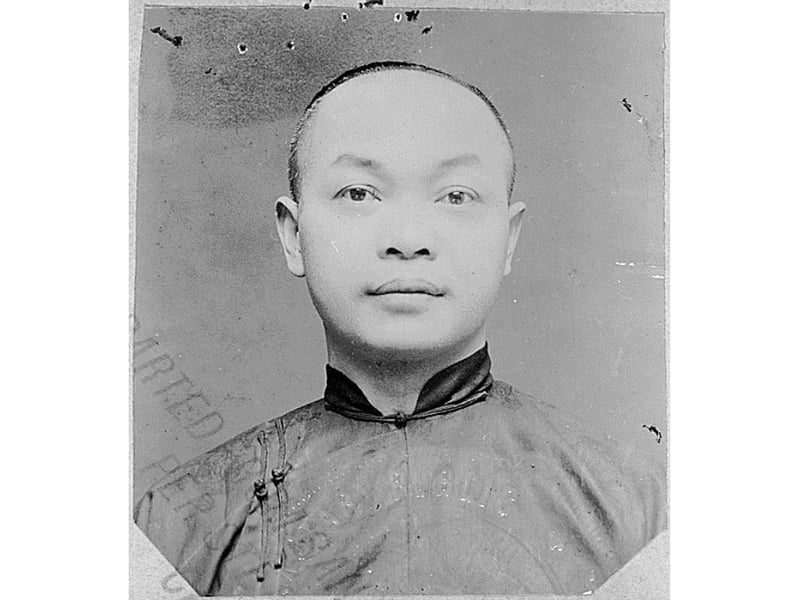
United States v. Wong Kim Ark
Both the federal government and the states relied heavily on the Supreme Court’s 1898 ruling in United States v. Wong Kim Ark, which granted citizenship to a child born in the United States to Chinese immigrant parents, but diverged on its interpretation, especially surrounding how the word “domiciled” was used in it.
McArthur argued that in deciding that case, the court rejected English common law, which granted broader citizenship and lifelong allegiance to the crown to all who were born in England.
“It’s very clear, for example, that American law has repudiated the inalienable allegiance part of that,” McArthur said.
Noah Purcell, Washington solicitor general representing Washington, Arizona, Illinois and Oregon, also pointed to Wong Kim Ark , noting that it set the expectation between the branches of government that citizenship is granted to everyone born in the United States, regardless of their parents’ immigration status.
“The Trump administration’s position is that for that entire time, everyone was wrong,” Purcell said. “If you accept that view, it would also mean that millions of babies born during that time who got the benefit of birthright citizenship never actually should have been treated as citizens.”
Hawkins asked whether the parents in Wong Kim Ark owed allegiance to their home country of China, which Purcell confirmed and used to undermine the government’s argument. Bumatay needled the states on their position as to whether the holding is limited to children of aliens who are permanently domiciled in the country.
“That is not how the court reached its conclusion, and that is not how the Supreme Court has understood it,” Purcell said. “Ever since then. In many, many cases, the court has cited Wong Kim Ark for the principle that any child born in this country, except for those very limited categories, becomes a citizen.”
“If you accept the interpretation in the executive order, it would mean that that’s what the Constitution always meant. So it would also have retroactive consequences,” Purcell added.
Bumatay challenged that argument, noting that it could prove the preliminary injunction is premature because the government never had the chance to explain how the order would be implemented.
“They’re not enjoined from thinking internally and discussing internally how they would implement this — they’re enjoined from external steps to implement the order,” Purcell said.
As to why the word domiciled appears so frequently in the Wong Kim Ark opinion, Matt Adams, representing the individual plaintiffs — two non-U.S. citizen Seattle-area women who were pregnant at the time of filing the lawsuits — argued that it is used in conjunction with the word temporary at times.
“The text of the statute, the subsequent case law, as well as the history of the 14th Amendment, make abundantly clear there is no room for the president now to attempt to redefine citizenship,” Adams, an attorney with the Northwest Immigrant Rights Project, said.
The government countered that the 14th Amendment “sets a floor for birthright citizenship and not a ceiling,” and that Congress is free to grant citizenship to foreigners as it sees fit, but adopting the plaintiffs’ position undermines constitutional ideals.
“It forces our immigration law to be at war with itself, prohibiting illegal immigration with one hand while inducing and rewarding it with the other,” McArthur said.
The Ninth Circuit panel did not indicate when it would rule, but U.S. Circuit Judge Patrick Bumatay, a Donald Trump appointee, asked how the court should proceed given the Supreme Court’s consideration of the nationwide injunction in the case.
McArthur encouraged the panel to consider the merits of the case, which aren’t before the high court, but hold off on turning to the injunction before additional guidance is released.
“I suppose if I were in your shoes, I probably wouldn’t put pen to paper on that part of the analysis for a few weeks,” McArthur said, eliciting wry smiles from the panel.
Subscribe to our free newsletters
Our weekly newsletter Closing Arguments offers the latest about ongoing trials, major litigation and rulings in courthouses around the U.S. and the world, while the monthly Under the Lights dishes the legal dirt from Hollywood, sports, Big Tech and the arts.