
 Search Articles


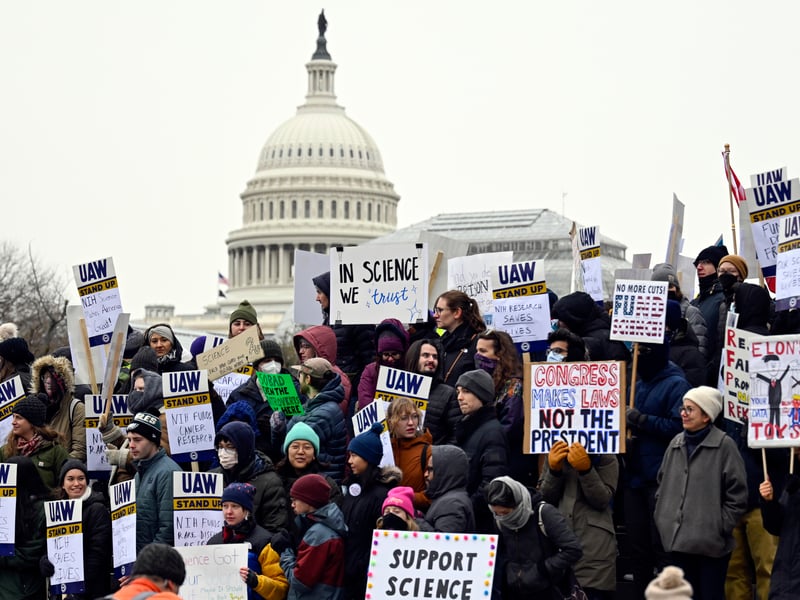
(CN) — A coalition of 16 attorneys general filed a lawsuit on Wednesday against the National Science Foundation to stop the agency from slashing programs aimed at promoting diversity, equity and inclusion in STEM.
The states say in the suit filed in the Southern District of New York that investment in promoting the participation of women, minorities and people with disabilities in science, technology, engineering and math fields has been directed by Congress numerous times with unwavering support from the legislative body.
In April, the agency announced on its website that it was adopting “new priorities” for its funding programs.
Co-leading the suit, New York Attorney General Letitia James said in a statement that dozens of projects have already been cancelled since then. In New York alone, she said, 18 programs funded with $11 million in National Science Foundation funds that specifically seek to promote diversity in STEM have had funding revoked.
The coalition argues in the complaint that this priority directive violates the Administrative Procedure Act, fails to offer any legal basis for the change in priorities andby defying Congress’s directive to “promote the full human resources of the nation” by uplifting underrepresented groups in STEM.
It adds that the National Science Foundation violates the separation of powers by defying Congress’s directive to support women and minorities in STEM by refusing to dole out appropriated funds or strive to meet the expressed goals.
“Congress has been consistent in its observations about the ‘untapped STEM talent pools’ where broader participation must be ’encourage[d],’ and has never suggested that all such efforts must be diluted to also encourage STEM participation amongst populations that are already participating in STEM fields at higher rates,” the states say.
If allowed to stand, the states say, the agency’s new priorities would devastate scientific research at universities throughout the country and unseat the United States as a global leader in STEM.
“Every time we go online, scan a barcode at checkout or get an MRI, we use technology made possible by the National Science Foundation,” James said. “This administration’s attacks on basic science and essential efforts to ensure diversity in STEM will weaken our economy and our national security.”
Congress has repeatedly observed that the STEM workforce is woefully unprepared to to meet the nation’s demand, according to the plaintiffs. The coalition says the congressional directive didn’t stop at hiring more women, people of color and disabled people — it directed the foundation to broaden its criteria for selecting projects, as well.
Despite the policy successes, the foundation’s National Science Board estimated in 2020 that full participation by underrepresented groups will not be reached until 2030: “the number of women must nearly double, Black or African Americans must more than double, and Hispanic or Latinos must triple the number that are in the 2020 workforce.”
The National Science Foundation is an independent federal agency established by Congress in 1950 with a mission to provide federal support for scientific and engineering research and contribute to math and science education at academic institutions across the country.
It accomplishes that goal through grants and loans aimed at important projects like developing artificial intelligence technology, solving environmental and economic challenges and strengthening the power grid through research at countless universities.
In May, one month after the priority directive was announced, the agency also said it would cap reimbursement of indirect costs at 15% for grants awarded to higher education institutions.
Indirect funds are often administrative of facility costs like specialized equipment, advanced computer systems and utilities that cannot be easily attributed to singular projects. The federal government reimburses researchers for these costs at a fixed rate that is dependent on the kind of research being conducted.
The arbitrary 15% cap on indirect cost reimbursement also violates the Administrative Procedure Act, according to the states.
“Plaintiff states’ institutions will not be able to maintain essential research infrastructure and will be forced to significantly scale back or halt research, abandon numerous projects, and lay off staff,” the coalition writes.
James co-leads the suit with Hawaii Attorney General Anne Lopez and is joined by the attorneys general of California, Colorado, Connecticut, Delaware, Illinois, Maryland, Massachusetts, Nevada, New Jersey, New Mexico, Oregon, Rhode Island, Wisconsin, and Washington.
By throwing out the negotiation process for indirect cost rates in favor of a static percentage across the board, the states claim the foundation will divest millions of dollars from university-driven research that Congress has directed the agency to support.
The plaintiffs say the law does not allow the foundation to undercut previously negotiated rates with a lowball percentage that wouldn’t begin to cover the costs of complex scientific research, nor does it allow any agency to terminate grants to universities without just cause.
Former National Science Foundation Director Sethuraman Panchanathan said in the April announcement that its goals of investing in the most promising ideas and people across all fields of science and engineering should not “preference some groups at the expense of others,” and that “research projects with more narrow impact limited to subgroups of people based on protected class or characteristics do not effectuate NSF priorities.”
Panchanathan did not clarify which projects were so narrow as to only impact people of protected classes. Panchanathan stepped down as NSF director one week after the announcement.
A coalition of universities sued the U.S. Department of Energy in April for a similar reimbursement cap. In that case, the government said it wanted to halt “inefficient spending by colleges and universities,” though the agency’s regular audits of the projects affected did not seem to raise any red flags.
Similar caps were also placed on National Institutes of Health grants for biomedical research into treatments for AIDS, HIV, Covid-19, Zika, Alzheimer’s and Shingles due to a change in agency priorities.
In March, a federal judge blocked those cuts after 16 states sued Trump and Secretary of Health and Human Services Robert F. Kennedy Jr. for violations to the Administrative Procedure Act.
 Follow @desdev5
Subscribe to our free newsletters
Our weekly newsletter Closing Arguments offers the latest about ongoing trials, major litigation and rulings in courthouses around the U.S. and the world, while the monthly Under the Lights dishes the legal dirt from Hollywood, sports, Big Tech and the arts.