
 Search Articles


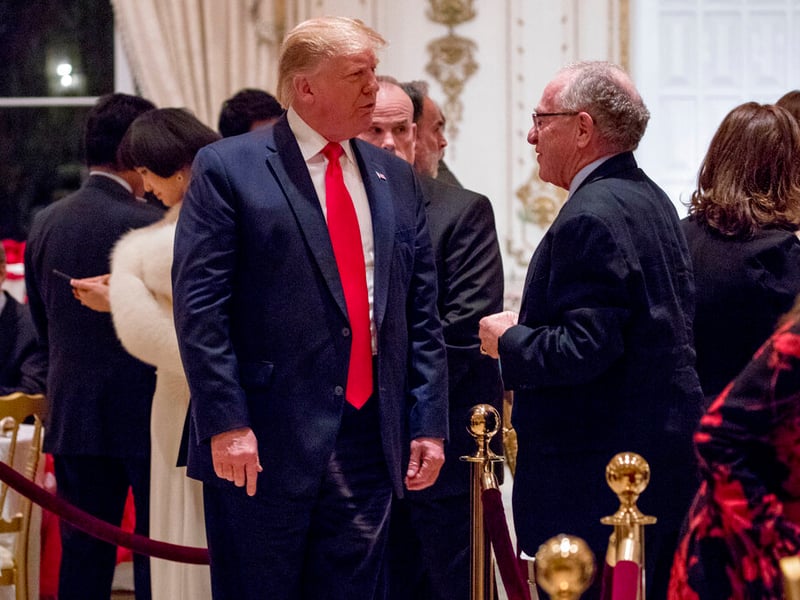
(CN) — An 11th Circuit panel shot down a $300 million defamation suit against CNN on Friday brought by a prominent lawyer who represented President Donald Trump in impeachment proceedings.
Alan Dershowitz, a retired Harvard University law professor and practicing criminal defense lawyer, asked the federal appeals court to revive his claims that the cable news network defamed him. A federal judge in Florida dismissed Dershowitz’s lawsuit in 2023.
In Friday’s opinion, the panel concluded Dershowitz failed to prove that any untrue statements were knowingly made by the network’s commentors or producers to destroy his reputation, as required for liability under the 1964 U.S. Supreme Court decision’s in New York Times Co. v. Sullivan.
“For a public figure like Dershowitz to prevail, defamation law has long required proof of a speaker’s actual malice: knowledge of or reckless disregard for the falsity of a statement,” U.S. Circuit Judge Britt Grant wrote for the unanimous opinion.
“But here, the available evidence points to the reporters’ sincere — if mistaken or even overwrought — belief in the truth of their accusations. Dershowitz has presented no evidence that shows otherwise,” the Donald Trump appointee added.
Dershowitz has made a name for himself representing prominent figures in some of the most infamous criminal trials in recent memory, including O.J. Simpson. He also represented Jeffrey Epstein against accusations by women and girls that Epstein had sexually assaulted them when they were underage.
U.S. Circuit Judge Barbara Lagoa, a fellow Trump appointee, agreed with the panel’s finding but wrote separately to express her concerns with harm caused by the New York Times Co. v. Sullivan case on the court’s First Amendment jurisprudence.
Lagoa wrote that she believes Dershowitz was defamed by CNN, “under any common understanding of the term,” through its writers and anchors who misrepresented his statements made on the Senate floor in 2020.
“In some instances, they blurred the line between fact and commentary, and in others, they simply lied about what Dershowitz had said,” Lagoa wrote. “And — though damages were not ultimately tested at trial — Dershowitz offered evidence at the summary judgment stage to show that he was harmed as a result because news outlets he finds more desirable stopped inviting him to speak after the CNN coverage, and he was left with access only to platforms he found less desirable.”
Lagoa criticized the Supreme Court’s precedent for federalizing major aspects of libel law and causing harm to public figures by leaving them with little opportunity for recourse. She quoted D.C. Circuit Judge Laurence Silberman, who called for the “actual malice” standard to be overruled before his death in 2022, for allowing media organizations to “cast false aspersions on public figures with near impunity.”
Lagoa added the First Amendment was intended to protect the free dissemination of ideas, but not the dissemination of lies in order to support an informed public, who are entitled to adequate information about their government.
However, U.S. Circuit Judge Charles Wilson also wrote separately to warn of the “real world” consequences of stripping away Sullivan ’s protections for the press in the current media climate.
Sullivan ’s longstanding protections are critical for the country’s press to function and allow the public to criticize public officials and contribute to vital national dialogue without fear of unwarranted retaliation, added the Bill Clinton appointee.
At the center of Dershowitz’s complaint was a series of remarks he made before Congress about the scope of impeachable offenses during his highly scrutinized representation of Trump in the president’s first impeachment trial in January 2020.
When Senator Ted Cruz asked, “As a matter of law, does it matter if there was a quid pro quo? Is it true that quid pro quos are often used in foreign policy?” Dershowitz’s response sparked a dispute, with swift reaction following in the news and social media. That night and through the next morning, several of CNN’s broadcasts and publications criticized Dershowitz and hisstatement.
More than a few observers of the trial including CNN immediately thought that Dershowitz was arguing that a president could get away with any impeachable offense if he claimed that it was in the public interest. While Dershowitz had prefaced his remarks by stating that a quid pro quo would only be unlawful if the quo itself was illegal, that context was left out of clips that CNN aired.
Dershowitz argued that the network collaborated to deceive their viewers, pointing to a series of internal emails in which a correspondent said he had “gone crazy,” and phone calls with producers discussing arguments made by Trump’s legal team.
But “these communications suggest not conspiracy but sincerity, however misplaced,” Grant wrote for the panel.
Grant added that CNN offered unrefuted evidence that its commentators believed in the truth of their statements about Dershowitz and reached their interpretations independently. She noted that at least two commentators — Joe Lockhart and Paul Begala — tweeted critically about Dershowitz’s statement while he was still speaking or shortly after he concluded, refuting any contention that their opinions were formed a few hours later at the direction of CNN leaders.
The network also allowed Dershowitz to go on air twice to explain his position after he complained it had mischaracterized his statements.
 Follow @Megwiththenews
Subscribe to our free newsletters
Our weekly newsletter Closing Arguments offers the latest about ongoing trials, major litigation and rulings in courthouses around the U.S. and the world, while the monthly Under the Lights dishes the legal dirt from Hollywood, sports, Big Tech and the arts.