
 Search Articles


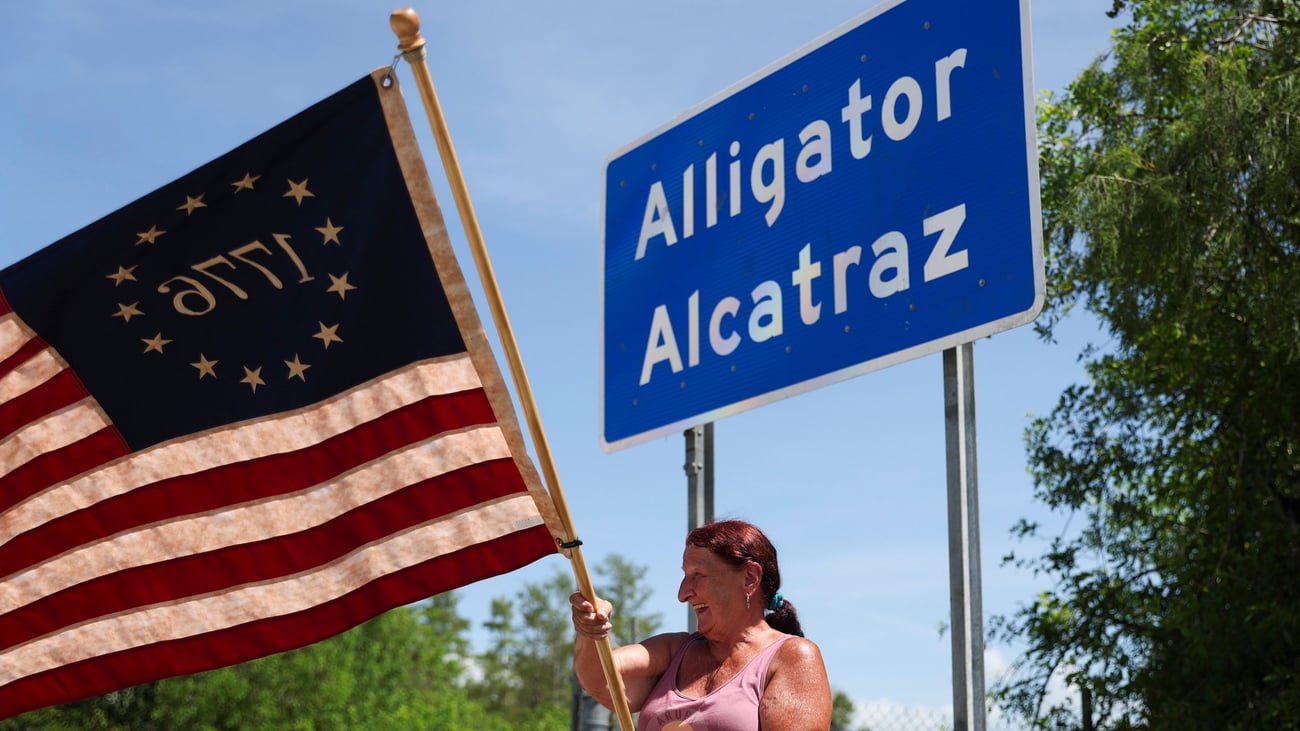
(CN) — A divided 11th Circuit panel refused to shut down the South Florida migrant detention center known as “Alligator Alcatraz" on Tuesday.
The 2-1 decision tosses out a lower court’s injunction directing the transfer of inmates and dismantling of the facility, with the majority ruling the order went too far.
“Florida, not federal, officials constructed the facility,” wrote Chief U.S. Circuit Judge William Pryor. “They control the land and entirely built the facility at state expense. The only federal action the environmentalists can identify is the decision not to conduct an environmental review.”
Pryor, a George W. Bush appointee, said if there were any federal authority, it would only be indirectly involved and emphasized it is Florida officials who dedicated the land for immigration use, and it is Florida officials that have the final say.
In their June 2026 lawsuit, Friends of the Everglades, the Center for Biological Diversity and the Miccosukee Tribe of Florida claimed the state and federal officials built of the detention center without first going through any environmental review as required under federal law.
In August 2025, U.S. District Judge Kathleen Williams sided with the environmental groups, telling state and federal officials to transfer inmates and remove generators, gas, lighting and sewage fixtures from the hastily built site in the middle of the Everglades within 60 days.
Florida Attorney General James Uthmeier immediately appealed to the 11th Circuit, contending the detention center is operated by the Florida Division of Emergency Management and has yet to receive any federal funding.
A month later, in a divided 2-1 decision, a different 11th Circuit panel ruled state officials “unilaterally” controlled the detention center, therefore barring the environmental groups’ claims the site violates federal environmental laws. The reversal allowed the facility to continue operating while the lawsuit continued.
Tuesday’s ruling by the 11th Circuit panel reiterates the appellate court’s previous decision and allows the detention center to remain open pending further proceedings in federal court.
The panel noted the authorization of $608 million by the Department of Homeland Security in October for reimbursement of the costs to run the facility is irrelevant, because those funds have yet to be released.
“State officials constructed the facility using state funds,” Pryor wrote. “Florida officials planned to seek reimbursement of its expenses from the federal government but when the District Court entered its injunction, Florida had received no federal funding. The agency has taken no action to fund the project.”
The majority — consisting of Pryor and U.S. Circuit Judge Andrew Brasher, a Donald Trump appointee — also pushed back against the environmental groups’ claims that Florida’s 287(g) agreement with U.S. Immigration and Customs Enforcement allowing local law enforcement to implement some immigration enforcement proves federal control.
“The need for federal approval to use a project for a purpose does not establish federal control; the non-federal actor still chooses the purpose of its project,” the judge added. “A property owner who builds an office building must comply with the Americans with Disabilities Act, but his compliance with federal law does not make it a federal building.”
U.S. Circuit Judge Nancy Abudu dissented, calling the majority’s decision “just plain wrong.”
“The agreement between Florida, DHS and ICE is not an exercise in cooperative federalism; it is a clear and classic delegation of federal authority,” Abudu, a Joe Biden appointee, wrote.
The judge said that the federal government enlisted the state as a deputy in its immigration enforcement practices, operating under it, not alongside it.
“The facility would not, and could not, have been built and used as an immigration detention center without the federal defendants’ request," Abudu wrote. “State officials exercise federal power, under a federal statute, at the behest of federal officials, to perform a uniquely federal function, the state/federal project easily involves substantial federal control.”
Abudu also lamented the impact of the decision on migrants detained at other facilities.
“More terrifying, especially given the documented instances of abuse in immigration facilities, is the majority’s open-door invitation to eliminate the federal government’s duty to immigrants in its care wherever they are housed,” the judge wrote. “That cannot stand.”
In a statement, Eve Samples, executive director of Friends of the Everglades, said the fight wasn’t over.
“Alligator Alcatraz was hastily erected in one of the most fragile ecosystems in the country without the most basic environmental review, at immense human and ecological cost,” Samples said. “We are pursuing every legal avenue available to right this wrong. Alligator Alcatraz will go down in history as a boondoggle to taxpayers and a flagrant assault on the Everglades, and we look forward to returning to the District Court to advance our case to shut it down.”
The Florida Attorney General’s Office did not immediately respond to a request for comment.
Last summer, in response to Trump’s immigration crackdown, Republican Governor Ron DeSantis and Florida’s attorney general proposed the idea of a detention center in the Everglades and used emergency powers to acquire the Dade-Collier Training and Transition Airport, a small runway surrounded by the Big Cypress National Preserve and Everglades National Park.
Within days, trucks carrying prefabricated housing, generators, security lighting and fill dirt entered the area and workers hastily set up tents and trailers to house those arrested by immigration authorities and state law enforcement.
Trump visited the facility on July 1, 2025 — the day before the first detainees arrived — and told reporters, “We’re going to teach them how to run away from an alligator if they escape prison.”
Since then, environmental activists, indigenous tribes, Democratic state lawmakers and members of Congress have decried the detention center as inhumane and detrimental to the ecosystem, pointing to reports of flooding, pest infestations, sewage backups and light pollution.
 Follow @alexbpickett
Subscribe to our free newsletters
Our weekly newsletter Closing Arguments offers the latest about ongoing trials, major litigation and rulings in courthouses around the U.S. and the world, while the monthly Under the Lights dishes the legal dirt from Hollywood, sports, Big Tech and the arts.
Additional Reads
 11th Circuit shoots down challenge to machine gun ban April 21, 2026