
 Search Articles


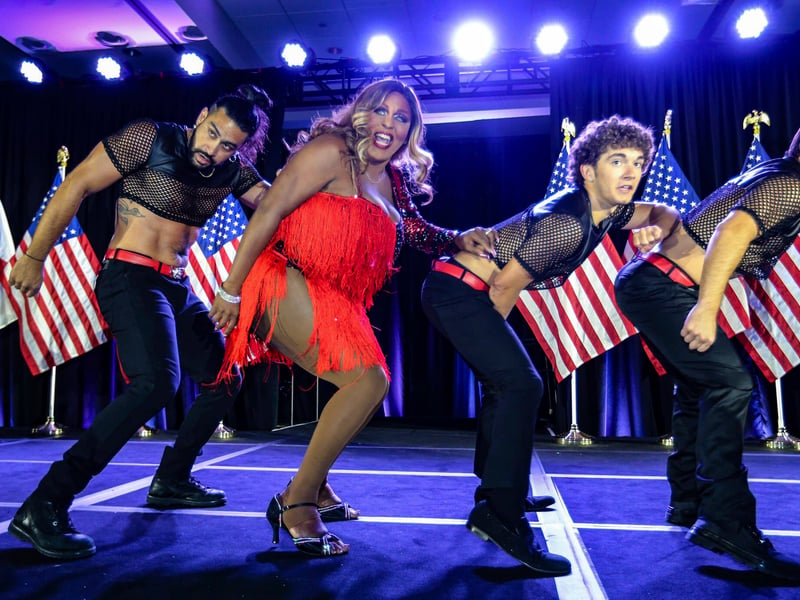
ATLANTA (CN) — A Florida law that would have banned minors from attending “adult live performances” such as drag shows is “substantially overbroad” and likely unconstitutional, a divided panel of the 11th Circuit ruled on Tuesday.
A 2-1 majority of the Atlanta-based appeals court panel upheld a Florida federal judge’s 2023 injunction barring enforcement of the Protection of Children Act.
“The act prohibits children’s admission to ‘live performances’ that Florida considers obscene for minors. But by providing only vague guidance as to which performances it prohibits, the act wields a shotgun when the First Amendment allows a scalpel at most,” U.S. Circuit Judge Robin Rosenbaum wrote on behalf of the majority. “And Florida’s history of arbitrarily enforcing other, similar laws against performances that are far from obscene only deepens our concerns.”
The decision by U.S. District Judge Gregory Presnell to block the law came after Hamburger Mary’s Restaurant and Bar, an Orlando business known for hosting family-friendly drag shows, sued Florida Department of Business and Professional Regulation (FDBPR) secretary Melanie Griffin.
The restaurant has argued that the law — which authorizes the Florida Department of Business and Professional Regulation to impose fines and suspend or revoke operating and liquor licenses of businesses that knowingly admit children to impermissible performances — violates the free speech clause of the First Amendment. The law also allows for misdemeanor prosecutions.
The U.S. Supreme Court refused to grant the state emergency relief to limit Presnell’s ruling and enforce the law on establishments not involved in the lawsuit.
Tuesday’s decision is yet another blow to Florida officials’ attempts to implement the statute. A spokesperson for Griffin did not immediately respond to a request for comment.
Florida’s Protection of Children Act “takes an ‘I know it when I see it’ approach to regulating expression,” Rosenbaum wrote, referencing U.S. Supreme Court Justice Potter Stewart’s famous “non-definition” of obscenity: “I know it when I see it.”
The panel sided with Hamburger Mary’s in finding that the statute deployed undefined terms like “lewd conduct” and “lewd exposure” too broadly.
The law’s definition of an “adult live performance” includes shows in front of a live audience depicting or simulating “nudity, sexual conduct, sexual excitement or specific sexual activities” and “lewd conduct or the lewd exposure of prosthetic or imitation genitals or breasts,” which would be considered obscene “for the age of the child present.”
The provision against “lewd conduct” could lead venues to “restrict minors from consuming speech that they are within their constitutional rights to access,” Rosenbaum wrote in the 81-page opinion.
The Barack Obama appointee added that “lewd conduct” is a “catchall phrase” that “’catches’ much non-obscene speech” and that the law’s “age-variable standard” is “impossibly vague.”
The vagueness of the law caused Hamburger Mary’s to “self-censor,” a move Rosenbaum characterized as “reasonable” since the ambiguities in the law could be read to include even the restaurant’s “family-friendly” drag performances.
“The possibility that FDBPR might view a gender-bending but chaste drag performance as ‘lewd’ and lacking ‘value’ is far from an unreasonable conclusion,” the majority found.
Hamburger Mary’s canceled its family drag shows and barred children from attending its other shows in response to the law, resulting in the cancellation of 20% of its bookings. The restaurant announced the closure of its Orlando location last year but, according to the ruling, plans to open a new Florida location.
“The act does little to teach speakers, performance venues, parents, or anyone else who might ‘admit’ a child to a performance what is acceptable for children of any given age,” Rosenbaum wrote.
Rosenbaum pointed out that Griffin’s own attorney was unable to explain during oral arguments the difference between performances that would be acceptable for an eight-year-old to attend versus a twelve-year-old.
“If the secretary’s attorney can’t articulate the difference, it’s hard to imagine how we could expect performance proprietors to know what the act means,” the judge wrote.
The ruling also notes that Florida already has laws on the books barring minors from viewing sexually explicit materials and prohibiting them from being admitted to shows depicting nudity and sexual conduct.
Rosenbaum was joined in the majority by U.S. Circuit Judge Nancy Abudu, a Joe Biden appointee.
U.S. Circuit Judge Gerald Tjoflat dissented from the majority’s ruling, writing that the appeals court should have sent the case to the Florida Supreme Court to answer a question about the law’s interpretation of “lewd conduct.”
Tjoflat, an appointee of Gerald Ford, wrote that Florida courts were not afforded a chance to interpret the law — a “run-of-the-mill obscenity statute” — before Presnell handed down his injunction.
The majority, according to Tjoflat, “passes over the tools meant to harmonize state and federal law, overlooks the state courts’ interpretive role, and leaps to constitutional invalidation prematurely.”
But Rosenbaum suggested that certifying a question to the Florida Supreme Court would just “postpone a constitutional collision that, as we show, is unavoidable.”
Attorney Melissa Stewart of Donati Law, who represents Hamburger Mary’s, celebrated the decision in a statement Tuesday.
“The court’s opinion recognizes this law for what it is — an egregiously unconstitutional attempt to censor the speech and expression of citizens,” said Stewart. “We are thrilled that the First Amendment rights of all Floridians will remain protected as we continue to litigate this case.”
 Follow @KaylaGoggin_CNS
Subscribe to our free newsletters
Our weekly newsletter Closing Arguments offers the latest about ongoing trials, major litigation and rulings in courthouses around the U.S. and the world, while the monthly Under the Lights dishes the legal dirt from Hollywood, sports, Big Tech and the arts.