
 Search Articles


ATLANTA (CN) — A federal appeals court rejected attempts Thursday from multiple co-defendants of former President Donald Trump to have their election interference cases moved from state to federal court.
The 11th Circuit ruled that Jeffrey Clark, David Shafer, Shawn Still, and Cathleen Latham are not entitled to remove their state criminal prosecutions to federal court under the federal-officer removal statute, because it doesn’t apply to former officers.
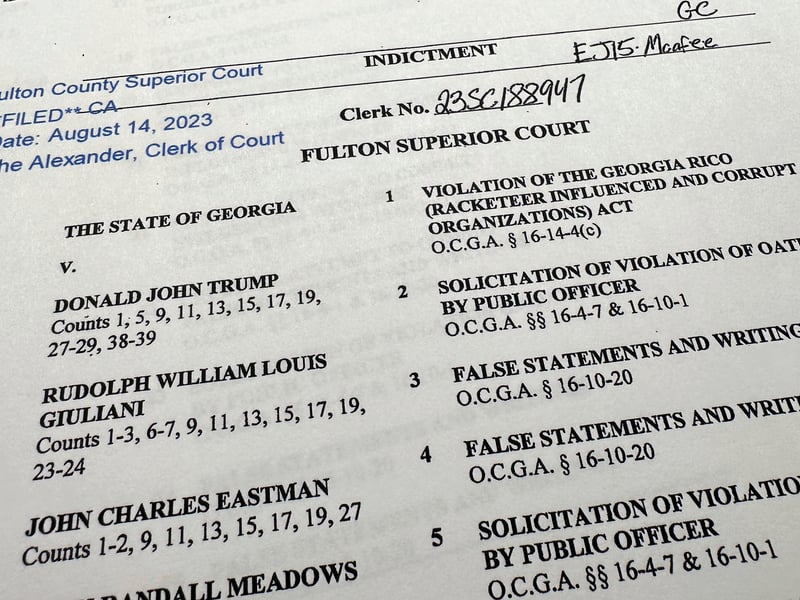
Under the indictment, Shafer, Still and Latham face charges for “knowingly and willfully” conspiring to unlawfully change the outcome of the 2020 presidential election in Trump’s favor. It claims they did so by purporting to give Georgia’s 16 electoral votes to Trump and issuing fraudulent elector certificates to state and federal officials during a sham elector meeting held after Georgia’s governor certified that President Joe Biden had prevailed.
In their consolidated appeal, they argued that they were charged with conduct stemming directly from their service as “contingent Republican Presidential Electors,” acting as federal officers at the direction of Trump and counsel for his campaign.
“We need not decide whether nominated presidential electors are federal officers. Even if Shafer, Still, and Latham were federal officers in 2020 when they were nominated to the Republican slate of electors, they would not be current federal officers,” the 11th Circuit panel wrote in the unanimous opinion.
The panel was compromised of U.S. Circuit Judges Robin Rosenbaum, a Barack Obama appointee, Britt Grant, an appointee of Donald Trump and Chief Judge William Pryor, who was appointed by George W. Bush.
However, in a concurring opinion, Rosenbaum wrote that even actual presidential electors don’t qualify as federal officers because they are appointed by the state and never assume functions on behalf of the whole United States.
She detailed the process of how electors are chosen and noted that every state appoints a slate of electors selected by the political party whose candidate has won the state’s popular vote. She added that states are allowed to “penalize an elector for breaking his pledge and voting for someone other than the presidential candidate who won his state’s popular vote.”
Under the U.S. Constitution, federal and state law, defendants were not 2020 presidential electors, Rosenbaum wrote.
“The people of Georgia did not vote for them to be electors. Nor does the purported position of ‘contingently elected presidential elector’ exist in the Constitution or federal or state law,” the judge wrote.
“And defendants were no more presidential electors simply because they give themselves the title than Martin Sheen was ever the President because he went by President Bartlet,” she added.
Shafer, Still, and Latham are charged with violating the Georgia Racketeer Influenced and Corrupt Organizations Act, and other state law crimes including impersonating a public officer, forgery in the first degree, criminal attempt to commit filing false documents, and false statements and writings.
Shafer was chairman of the Republican Party of Georgia in 2020, Still was the former finance chairman of the state GOP, but is now a state senator, and Latham is the former chairwoman of the Coffee County Republican Party in rural Georgia.
Latham faces additional charges of conspiring to defraud the state and to commit election fraud, computer theft, computer trespass, and computer invasion of privacy, due to her unauthorized copying of confidential election data in January 2021at the county’s election office.
In a separate opinion, the circuit judges wrote that Clark, a former senior Justice Department official, also cannot have his case moved to federal court because his criminal accusations bear no connection to the roles of his position and he is no longer a federal official.
Clark is charged with violating Georgia’s RICO act and criminal attempt to commit false statements and writings.
According to the indictment, Clark committed these crimes by knowingly and willfully making a false writing stating that the Justice Department had identified “significant concerns that may have impacted the outcome of the election in multiple states, including the state of Georgia” and by asking two department officials to join him in signing and issuing the false writing to Georgia officials.
The circuit judges also denied Clark’s request to remove the special purpose grand jury proceedings that preceded the sprawling criminal indictment brought in August 2023.
“Regardless of whether the proceeding could have been removed during the investigation, the removability of the proceeding is moot because it no longer presents a ’live controversy,’” the panel wrote.
“Clark identifies no concrete interest in having the ‘case’ heard now by a federal court, nor could he. The special purpose grand jury issued its final report and was dissolved over seven months before another grand jury indicted Clark and before he sought removal. And the special grand jury was not responsible for indicting Clark in the first place,” the circuit judges added.
In May 2022, a special purpose grand jury was impaneled in Fulton County to conduct a criminal investigation into possible attempts to disrupt the lawful administration of the 2020 elections in Georgia and to prepare a report and recommendation “concerning criminal prosecution as it shall see fit.” Its final report was issued in January 2023.
The 11th Circuit’s decision comes after it previously turned downanother request for removal from Trump’s co-defendant, Mark Meadows. Pryor and Rosenbaum contributed to that opinion as well.
Meadows, a former White House chief of staff, was on Trump’s infamous phone call on Jan. 2, 2021, in which the former president pressed Georgia Secretary of State Brad Raffensperger to “find” enough votes to overturn Biden’s victory in that state.
Much of the state election interference case remains on hold until the Georgia Court of Appeals determines whether Fulton County District Attorney Fani Willis should be disqualified as lead prosecutor. The court is set to hear oral arguments on the appeal on Dec. 5.
Four defendants have pleaded guilty after reaching deals with prosecutors, but Trump and his 14 remaining co-defendants have pleaded not guilty.
 Follow @Megwiththenews
Subscribe to our free newsletters
Our weekly newsletter Closing Arguments offers the latest about ongoing trials, major litigation and rulings in courthouses around the U.S. and the world, while the monthly Under the Lights dishes the legal dirt from Hollywood, sports, Big Tech and the arts.