
 Search Articles


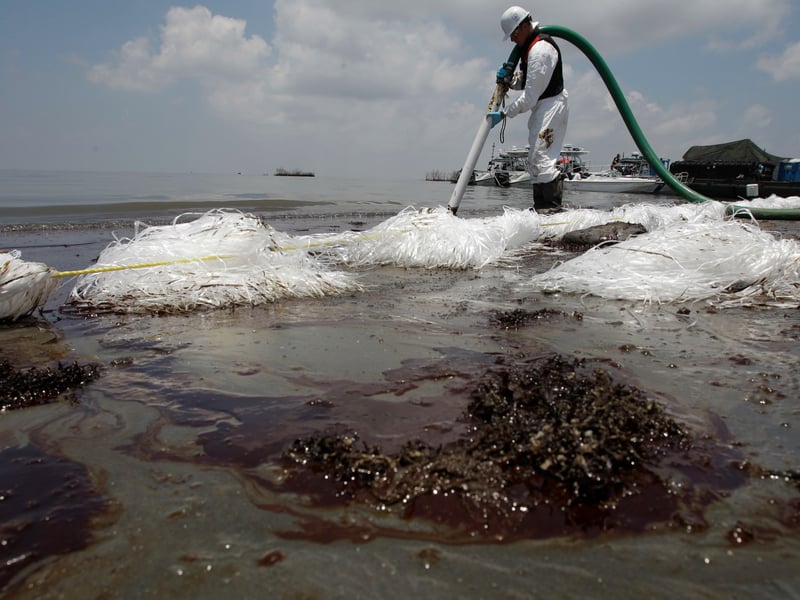
(CN) — Workers who responded to BP’s 2010 Deepwater Horizon oil spill brought their injury claims to the 11th Circuit Court of Appeals on Thursday. The court’s ruling could have immediate bearing on at least 18 similar cases that were stayed pending its resolution, but according to the plaintiffs, it could also affect “every toxic tort case in which general causation is disputed.”
On appeal, the court is considering whether certain expert testimony about the general cause of related illnesses is admissible.
The plaintiffs, Lester Jenkins and Dwight Siples, were Florida residents who helped to clean up the oil spill and who later developed chronic sinusitis, a respiratory ailment that causes the sinuses to swell and prevents mucus from draining.
In June 2024, U.S. District Court Judge M. Casey Rodgers adopted a magistrate’s report and recommendations to exclude expert testimony by two epidemiologists, both of whom offered evidence that exposure to oil or dispersants was associated with increased respiratory symptoms among workers who responded to the spill.
The magistrate determined the experts failed to identify a “threshold harmful dose” or which specific chemicals contained in crude oil or dispersants could cause the plaintiffs’ health conditions. Further, the magistrate reported the experts did not reliably analyze the studies they had relied upon or reliably apply the Bradford Hill nine principles of causation.
The plaintiffs argue those factors can be weighed when determining specific causation of illnesses, but not the general causation necessary for the case to proceed.
On Thursday, attorney Shea T. Moxon said the lower court abused its discretion by “imposing a legally and scientifically unfounded requirement to identify a minimum harmful dose at the general causation stage of a bifurcated proceeding.”
“Nothing requires an expert to identify a threshold dose to give a reliable opinion on general causation,” he argued.
Chief U.S. Circuit Judge William Pryor, an appointee of George W. Bush, interjected to mention there has to be a benchmark regarding the likelihood of a person developing a disease without exposure to exacerbating circumstances, and for general causation, “you have to be able to establish at what level that exposure will make a difference.”
U.S. Circuit Judge Robert Luck, an appointee of Donald Trump, said the standard for general causation was set in McClain v. Metabolife . There, the court determined it required “a scientific knowledge of the harmful level of exposure to a chemical, plus knowledge that the plaintiff was exposed to such quantity … as well as the plaintiff’s actual level of exposure.”
“The first question has to be, is it a toxic amount of an otherwise nontoxic substance?” Luck noted. “And second, was the plaintiff in his or her daily life exposed to that level?”
Luck said that standard was reaffirmed in the case Chapman v. Proctor & Gamble Distribution LLC.
Moxon disagreed, arguing he hadn’t seen any definition in case law or in any scientific text “that includes threshold in the definition of general causation.”
Luck said that’s because toxic tort cases are widely variable, providing an example of tobacco manufacturers who know smoking is inherently toxic, versus exposure to oil byproducts such as plastics, which most people are exposed to daily.
“How much [oil] do I ingest that is going to cause me harm?” he asked.
“Our point is that it is not required for a general causation analysis, at least not when the experts’ methodology is epidemiological,” Moxon replied.
U.S. Circuit Judge Ed Carnes, an appointee of George H.W. Bush and the final member of the panel, chimed in to question what difference it made.
“If you can’t show and didn’t present to the district court evidence showing what dose produces the disorder," Carnes said, “then you can’t prove anything to them. So you lose either way.”
Moxon reiterated his argument that the time to introduce such evidence is during the specific causation stage, not the general causation stage.
Representing BP, attorney George W. Hicks said the trial court provided more than a dozen reasons the expert testimony should be excluded.
“None is erroneous, much less an abuse of discretion,” he argued. “At the outset, this court has repeatedly made clear that a toxic tort plaintiff must demonstrate through expert testimony to the level an allegedly harmful chemical is hazardous to a human.”
As a matter of logic, Luck questioned how the toxic dose level may vary based on the individual. For example, a child may have a more profound reaction to a certain dose than an adult.
“In other words, there is an overlap between what the toxic dose level is generally and what it would be for the plaintiff to have chronic sinusitis, right?” he asked.
Hicks agreed, but added, “you don’t even get there until you’ve established a minimum level of exposure.”
Luck said the Chapman case “seems to indicate there are three methodologies for establishing general causation:” dose/response relationship, toxicity and epidemiology. He asked for Hicks to explain why the plaintiffs may claim they can proceed on the third.
Hicks said the case law is clear and there is no “carve out” for epidemiology or other methodologies. Rather, the panel’s review should narrowly focus on whether the district court abused its discretion.
“In a toxic tort case, whatever the case, you have to know what the benchmark is,” Hicks argued, returning to Luck’s point about the toxicity of everyday exposure to petroleum byproducts. “Oil can be potentially toxic in some sense, though low dosages, for many years, will have no consequences at all. So I think you do have to establish that as a matter of law.”
At the end of the day, Hicks said the case boils down to a question of whether the plaintiffs had met the Daubert standard, and he argued they had not. Hicks also briefly argued the plaintiffs’ epidemiology reports were unreliable.
The case is one of hundreds of Back End Litigation Options cases advanced as part of a class settlement agreement following multi-district litigation against BP for the Deepwater Horizon oil spill. Such cases were available to class members who were diagnosed with a qualifying health condition after April 15, 2021. In order to succeed, the plaintiff must provide that his or her health condition was caused by exposure to substances released in the spill, or decontaminants and dispersants used to clean it up.
 Follow @gabetynes
Subscribe to our free newsletters
Our weekly newsletter Closing Arguments offers the latest about ongoing trials, major litigation and rulings in courthouses around the U.S. and the world, while the monthly Under the Lights dishes the legal dirt from Hollywood, sports, Big Tech and the arts.