
 Search Articles


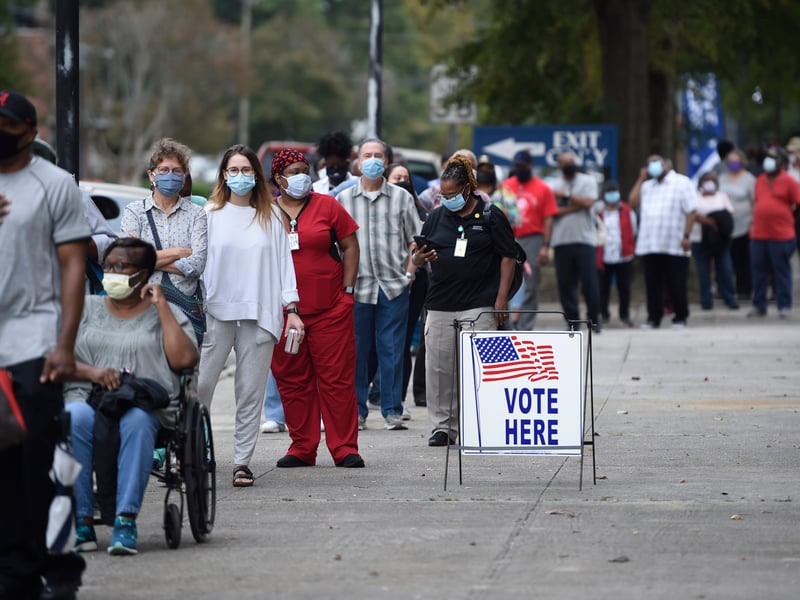
ATLANTA (CN) — National voting rights group Fair Fight and Georgia voters urged a federal appeals court Tuesday to overturn a ruling finding a conservative vote-monitoring group did not unlawfully intimidate voters.
The 11th Circuit expressed concern that the lower court may not have fully analyzed whether Texas-based True The Vote and its president Catherine Engelbrecht violated the Voting Rights Act by “attempting” to intimidate voters.
“This is an open-and-shut appeal,” True the Vote’s attorney, Jake Evans, told the court.
“No, it’s not,” U.S. Circuit Court Judge Adalberto Jordan replied.
“I think the district court committed legal error, not factual error, with regards to the attempt claim,” the Barack Obama appointee added.
Jordan explained that attempt is generally defined as the attempt to carry out an objective and taking a substantial means toward doing that, such as a bank robbery attempt that is thwarted by a security guard.
Evans asserted that True the Vote only sought to clean Georgia’s voter rolls and that the group never attempted to contact individual voters.
Fair Fight asked the judges to reimagine the nation’s atmosphere in the aftermath of the 2020 presidential election. Now-President Donald Trump and his allies spewed claims that the election was rigged in the Democrats’ favor as Joe Biden won Georgia by just 11,779 votes.
This led to True the Vote launching a massive campaign in December 2020 to challenge the voting rights of over 360,000 Georgia voters in the weeks before the state’s Senate runoff election.
The contentious runoff, in a Southern state notorious for its Republican dominance, would determine whether Democrats or Republicans controlled the upper chamber.
While Georgia law permits an unlimited amount of individual voter challenges, Fair Fight attorney Uzoma Nkwonta noted that True the Vote relied merely on voters who had submitted change-of-address forms with the U.S. Postal Service and were ultimately rejected by county election boards.
“I don’t believe any of them were successful,” Evans admitted when questioned by the judges.
“Isn’t that a pretty telling statistic? You submit 360,000 challenges and none of them were successful. Doesn’t that tell you a little about the motivation behind the challenges?” Jordan said.
“Attempt doesn’t require success,” the judge added.
In its complaint brought four years ago, Fair Fight argued True the Vote’s actions violated the Voting Rights Act, which prohibits anyone from intimidating, threatening or coercing voters.
After hearing testimony and evidence over a seven-day bench trial last year, a federal judge ultimately decided the plaintiffs “provided no compelling evidence that True the Vote’s election-related activities in the period preceding the Senate runoff election had any effect or reached any Georgian voter.”
But Nkwonta argued their efforts should still be deemed unlawful because the act separately proscribes any “attempt” to commit those acts, imposing liability even if defendants’ scheme ultimately fails.
“What about the evidence that True the Vote said, ‘We’re gonna root out election fraud?’ Why isn’t that evidence of attempt to intimidate?” asked U.S. Circuit Judge Jill Pryor, a fellow Obama appointee.
Evans argued True the Vote is entitled to freedom of speech. Pryor said the “statements themselves are not illegal, but part of the totality of the circumstances” when determining whether intent was involved.
To aid its efforts, True the Vote recruited volunteers to serve as “citizen watchdogs” and monitor voters as they returned their ballots and offered a $1 million reward fund to “incentivize” individuals to report instances of “election malfeasance.”
The consequences of that effort were predictably devastating, argued Fair Fight. Because it is common for voters to temporarily forward their mail for school, work, military service, or any number of reasons unrelated to voting eligibility, it claims True the Vote’s gargantuan challenge net ensnared qualified voters across Georgia.
Longtime Georgia Democrat and former gubernatorial candidate Stacey Abrams founded Fair Fight in 2018 to address voter suppression in the state and across the country.
“This case represents one of the strongest opportunities to have a federal court uphold and enforce the Voting Rights Act,” lawyer and founder of Democracy Docket, Marc Elias, said ahead of Tuesday’s arguments.
The three-judge circuit panel was rounded out by U.S. District Judge Federico Moreno, a George H. W. Bush appointee.
 Follow @Megwiththenews
Subscribe to our free newsletters
Our weekly newsletter Closing Arguments offers the latest about ongoing trials, major litigation and rulings in courthouses around the U.S. and the world, while the monthly Under the Lights dishes the legal dirt from Hollywood, sports, Big Tech and the arts.