
 Search Articles


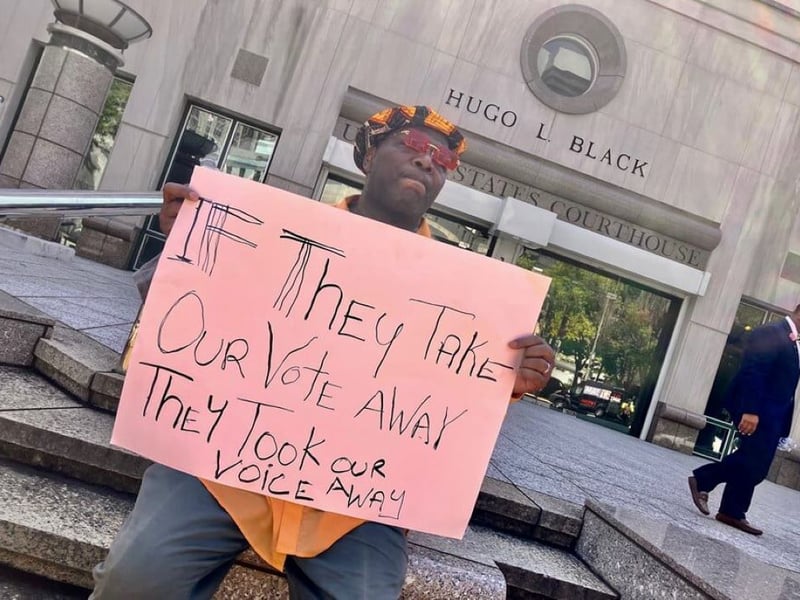
(CN) — The 11th Circuit Court of Appeals declared a stalemate Monday in a case against a 2024 Alabama election law that criminalized paid election assistance in a Republican-led effort to discourage ballot harvesting.
A three-judge panel determined Alabama’s Senate Bill 1 was far too vague and opted instead to ask the Alabama Supreme Court to resolve four primary questions before the case could continue: how SB1’s provisions interact, what specific conduct is criminalized, whether paid workers and volunteers are exposed to criminal liability, and whether everyday voter-assistance activities fall within the law’s reach.
In the meantime, the panel maintained a lower court’s injunction against the law.
During oral arguments in September, an attorney representing the plaintiffs emphasized their concerns that the law could severely criminalize common assistance provided to handicapped, deaf, blind or speech-impaired voters. The state argued the law protected against election fraud and was intended to be enforced in cases of third-party election manipulation.
In its per curiam order Monday, the panel explained that SB1 is riddled with undefined terms, conflicting language and unanswered questions.
“After listening to the parties’ positions at oral argument, we’re unclear about whether SB1 precludes plaintiffs from engaging in any of their desired activities. If it doesn’t, we lack jurisdiction because plaintiffs lack standing to bring suit in its current form,” the order read.
They noted no Alabama state court has yet interpreted the statute and depending on how the law is read — it may either severely restrict voter assistance or barely restrict it at all.
“We have substantial doubt as to what counts as ‘knowingly receiv[ing] a payment or gift for’ engaging in this prohibited conduct,” the panel wrote, addressing a central concern about whether paid caregivers or volunteers could be prosecuted for offering assistance. “Such an aide generally receives a wage or salary for assisting his charge in many ways. One way might include assisting the voter with an absentee ballot application.”
The panel certified a series of questions to the Alabama Supreme Court: whether a subsection of SB1 creates an exception to the prohibitions for certain paid caregivers and volunteers; whether the scope of prohibited conduct includes “distributing, ordering, requesting, collecting, completing, prefilling, obtaining, or delivering” an absentee ballot application; and finally clarifying the legal definitions of “payment,” “third party" and “gift.”
The plaintiffs are a group of nonprofit organizations including the Alabama NAACP, the League of Women Voters, disability rights advocates, and faith-based groups that claim SB1 scared them into stopping ordinary voter-assistance work like helping voters fill out applications, providing stamps or envelopes, and mailing applications for people who physically can’t do it themselves. They argued that SB1 conflicts with, and is therefore preempted by, federal law that protects voting rights.
If Alabama state courts answer the 11th Circuit’s questions, the panel can determine if SB1 actually prohibits what these organizations want to do and whether they face a real threat of prosecution. Absent those answers, the federal court cannot even assume its jurisdiction, the panel wrote.
Even so, the court cannot decide whether SB1 conflicts with federal law unless it first knows what SB1 truly forbids under Alabama law. Because SB1 carries penalties up to 20 years in prison and $30,000 in fines, the panel was unwilling to guess at the law’s meaning.
“Rather than stumble around in the dark, we humbly ask the Alabama Supreme Court to turn on the lights,” the panel concluded. “As a matter of federalism and comity, dispositive issues of Alabama law should be first presented to the Alabama Supreme Court to decide.”
The appellate panel included U.S. Circuit Judges Britt Cagle Grant and Andrew Lynn Brasher — both appointees of Donald Trump — along with U.S. Circuit Judge Robin Rosenbaum, a Barack Obama appointee. The nine justices on the Alabama Supreme Court are all Republicans.
In an emailed statement Monday, the Alabama Attorney General’s Office said it appreciates the 11th Circuit’s decision to consult the state’s high court and looks forward to defending the law there.
“Alabama’s law prohibits paid ballot harvesters from preying on vulnerable voters with disabilities, while ensuring that voters who need help with their ballot applications can seek assistance at no cost and without the mixed incentives that come from a ‘helper’ being paid by a political campaign or organization."
Anuja Thatte, senior counsel for the NAACP Legal Defense Fund, said the plaintiffs welcome the court’s questions.
“We look forward to vindicating our clients’ rights and ensuring that blind, disabled, and low literacy voters across Alabama are able to continue receiving the assistance with the absentee application process that they request, as guaranteed under longstanding federal law,” Thatte offered Monday in a statement.
 Follow @gabetynes
Subscribe to our free newsletters
Our weekly newsletter Closing Arguments offers the latest about ongoing trials, major litigation and rulings in courthouses around the U.S. and the world, while the monthly Under the Lights dishes the legal dirt from Hollywood, sports, Big Tech and the arts.